
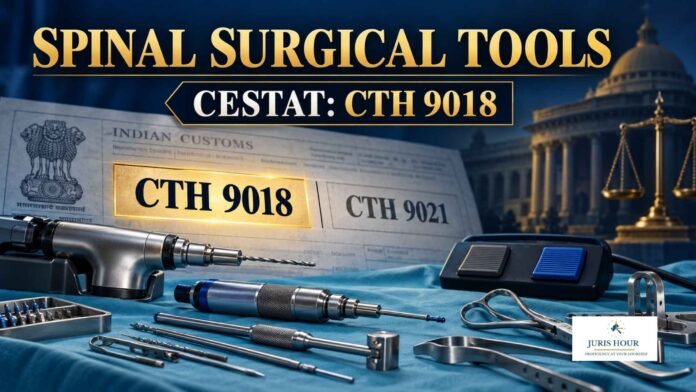
The Chennai Bench upheld the reclassification of imported surgical instruments and rejected the importer’s claim to the customs treatment available to orthopaedic appliances. It also dismissed the Customs Department’s appeal seeking to overturn relief granted for earlier imports.
The bench of P. Dinesha (Judicial Member) and M. Ajit Kumar (Technical Member) observed that instruments used by surgeons during spinal operations cannot be classified as orthopaedic appliances merely because they serve an orthopaedic purpose. Such surgical tools fall under Customs Tariff Heading (CTH) 9018, while Heading 9021 covers appliances used to correct deformities or support parts of a patient’s body.
BUY NOW: 100+ Judgements On Customs Classification
The appellant/assessee challenged the reclassification of its imports and the resulting differential duty demand. The department challenged the relief granted to the company for certain earlier imports, including the application of customs and IGST notification benefits.
The appellant/assessee imported goods including a “Power Drive Art1”, a “Power Stick M5/0 Handpiece” and an “Art1 Footswitch”. In a bill of entry dated December 7, 2021, it declared the goods as orthopaedic appliances under CTH 90211000 and claimed nil basic customs duty and a benefit under Notification No. 50/2017-Customs.
Customs officers questioned that classification after examining the goods, the supplier’s website and Avana Surgical’s earlier imports. The company had previously declared similar goods as orthopaedic instruments under tariff items within Heading 9018. A show cause notice issued on July 7, 2023 proposed reclassification under Heading 9018, differential duty, interest and penalty.
The appellant argued that its earlier declarations did not determine the correct classification of later imports. It maintained that Heading 9021 was the more specific entry for the goods and questioned the department’s failure to obtain an expert opinion.
The Bench examined the tariff headings and Chapter Note 6 to Chapter 90. The note describes orthopaedic appliances, for the purpose of Heading 9021, as appliances that prevent or correct bodily deformities or support or hold parts of the body following illness, an operation or injury.
The Tribunal drew a distinction based on how the goods are used. Orthopaedic instruments are used by surgeons during an operation; orthopaedic appliances are used by patients to perform the functions described in Heading 9021. The disputed surgical tools were neither implanted in nor strapped to a patient’s body as orthopaedic appliances, it found.
The Bench also noted that the Principal Commissioner had checked the supplier’s website and examined the use of the imported items. Avana Surgical had not adequately answered that analysis or explained its change from the earlier Heading 9018 classification. The Tribunal therefore upheld the classification under Heading 9018 and dismissed the company’s appeal.
The department separately disputed the notification benefits allowed for imports made between July 16, 2018 and December 12, 2019. The relevant version of List 30 under Notification No. 50/2017-Customs expressly referred to spinal instruments and implants. The department argued that surgical instruments should nevertheless be excluded from a concession framed around assistive devices and rehabilitation aids.
The Tribunal rejected that argument. Having found that the goods were spinal instruments designed for use in spinal surgery, it held that the adjudicating authority had correctly extended the customs notification benefit for the earlier period.
It also upheld the corresponding IGST benefit. The Bench observed that the relevant entry in the IGST rate notification used wording identical to the customs notification entry applicable to those earlier imports.
Membership Required to Access Case Details & Order Copy
To view the complete Case Details and Download Order Copy, you must have an active membership. Please subscribe to continue.

