
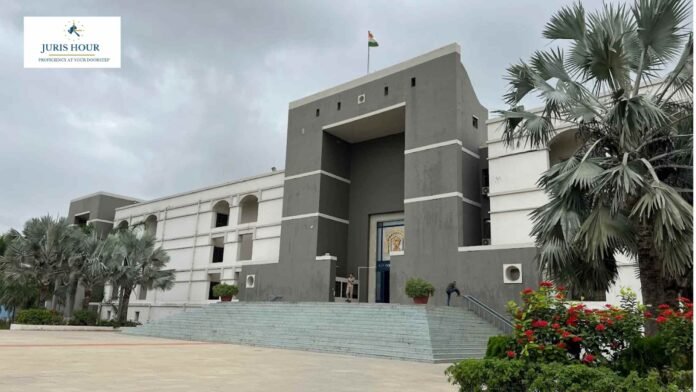
The Gujarat High Court has dismissed the Income Tax Department’s appeal against an Income Tax Appellate Tribunal (ITAT) order quashing reassessment proceedings, holding that where the Assessing Officer makes no addition on the grounds recorded for reopening an assessment, the reassessment cannot be sustained merely by making additions on unrelated issues.
The Bench of Justice Bhargav D. Karia and Justice Pranav Trivedi has observed that the Section 148 notice had been issued beyond four years from the end of the relevant assessment year, though within the then applicable six-year period. The two reasons recorded by the Assessing Officer concerned the Section 14A computation and the alleged NSEL income of Rs. 244.98 crore.
The case arose from the assessment of a company engaged in the manufacture of edible and non-edible oil products and their by-products. For Assessment Year 2009-10, the assessee’s original assessment under Section 143(3) was completed on December 29, 2011, determining its total income at approximately Rs. 22.55 crore.
Buy Now: 80+ Income Tax Judgments | E-Magazine July 2026
Subsequently, the Assessing Officer issued a notice under Section 148 on March 9, 2015, proposing to reopen the assessment on two grounds.
The first related to an alleged short computation of disallowance under Section 14A read with Rule 8D, where the Assessing Officer believed that the disallowance should have been Rs. 2,18,174 instead of Rs. 1,13,521.
The second and more significant ground concerned an alleged amount of Rs. 244.98 crore received from the National Spot Exchange Limited (NSEL). According to the reasons recorded for reopening, the amount represented income allegedly introduced into the assessee’s debtors’ accounts through purported paper transactions and was liable to taxation.
However, while completing the reassessment, the Assessing Officer did not make an addition on either of those two recorded reasons. Instead, he made a substantial disallowance of Rs. 13,89,08,810 under Section 43(5), read with Sections 73 and 40A(2)(b), besides making an additional disallowance of Rs. 1,04,652 under Section 14A.
The assessee challenged the validity of the reopening before the Commissioner of Income Tax (Appeals), contending that the Assessing Officer had failed to make any addition on the grounds for which the assessment had originally been reopened.
The CIT(A) accepted the contention and held that the reassessment proceedings were bad in law. With respect to the NSEL issue, the appellate authority noted that the assessee had not undertaken any NSEL transaction during the relevant assessment year. The Special Auditor had also accepted this position. Further, the Rs. 244.98 crore figure relied upon by the Assessing Officer actually related to an addition made in the assessee’s case for Assessment Year 2011-12, rather than Assessment Year 2009-10.
The Section 14A ground also failed. The original assessment had already considered a Section 14A disallowance, and the ITAT had subsequently deleted that disallowance on the ground that the assessee had not earned any exempt income during the relevant year.
The CIT(A) consequently concluded that the effective addition made during reassessment was under Sections 43(5), 73 and 40A(2)(b), an issue which did not form part of the reasons recorded for reopening. It held that once the grounds forming the foundation of the reopening did not result in an addition, the Assessing Officer could not proceed to make additions on entirely different grounds.
The CIT(A) also found that the Section 14A reopening, having been initiated beyond four years from the end of the relevant assessment year, was unsustainable in the absence of any allegation that the assessee had failed to disclose fully and truly all material facts. The appellate authority further observed that no new tangible material had been brought on record and that the attempted recomputation amounted to a change of opinion.
The department challenged the CIT(A)’s decision before the ITAT. The assessee, meanwhile, filed cross-objections concerning the special audit under Section 142(2A) and the merits of the additions.
The Tribunal dismissed the Revenue’s appeal and upheld the CIT(A)’s decision that the reassessment itself was without jurisdiction. Consequently, the addition of Rs. 13,89,08,810 made under Section 43(5) read with Sections 73 and 40A(2)(b) was also quashed.
The Tribunal specifically noted that the Section 14A addition made in the original assessment had already been deleted because there was no exempt income. It also accepted that the Rs. 244.98 crore NSEL figure related to another assessment year and that the assessee had no NSEL transaction during the year under consideration.
Before the Gujarat High Court, the Revenue argued that once an assessment was validly reopened, the Assessing Officer was entitled to examine other issues that came to his notice during the reassessment proceedings.
The Department also defended the additions made under Section 43(5) read with Section 73 and contended that the NSEL receipts represented taxable income introduced into the assessee’s books through paper transactions.
The assessee, on the other hand, argued that the reasons recorded for reopening did not pertain to the relevant assessment year and that no addition had ultimately been made on either of the grounds stated in the Section 148 notice. Reliance was placed, among other decisions, on the Gujarat High Court’s ruling in CIT v. Mohmed Juned Dadani, as well as the Bombay High Court’s decision in CIT v. Jet Airways (I) Ltd.
The High Court focused on the statutory framework governing reassessment under Sections 147 and 148.
The Court found it significant that the Assessing Officer did not make any addition in respect of either of these reasons. Therefore, according to the Court, there was no failure by the assessee to disclose truly and fully the material facts relating to the income allegedly escaping assessment so as to confer jurisdiction for reopening beyond four years.
The Bench relied upon the principle laid down by the Gujarat High Court in Mohmed Juned Dadani. That decision recognizes that although an Assessing Officer may, in a valid reassessment, assess other escaped income that comes to his notice during the proceedings, the foundational requirement is that the reopening itself must be valid.
The Court highlighted the problem that would arise if the Assessing Officer could abandon the very ground on which the assessment was reopened and proceed solely against unrelated issues. Such an approach, the earlier judgment had observed, would effectively circumvent the statutory requirement applicable to reassessment notices issued beyond four years.
A key legal issue before the High Court was the effect of Explanation 3 to Section 147, inserted by the Finance (No. 2) Act, 2009 with retrospective effect from April 1, 1989.
Explanation 3 permits the Assessing Officer, during reassessment proceedings, to assess or reassess income relating to an issue which comes to his notice subsequently, even though the reasons for that issue were not included in the recorded reasons for reopening.
The Revenue had questioned whether the ITAT was correct in holding that this Explanation could not expand the scope of the substantive provisions of Section 147.
The High Court answered the issue against the Revenue. Referring to the reasoning in Mohmed Juned Dadani, the Court held that Explanation 3 does not override the basic conditions governing the assumption of jurisdiction under Section 147.
The Court emphasized that an Explanation is intended to explain or clarify the statutory provision and cannot enlarge the substantive scope of the provision itself. The judgment specifically referred to the Supreme Court’s observations in S. Sundaram Pillai v. V.R. Pattabiraman regarding the limited function of an Explanation to a statutory provision.
The High Court ultimately held that Explanation 3 to Section 147 does not dispense with the requirement that the conditions contained in the substantive provision must first be satisfied.
In particular, the Court observed that the amendment permitting assessment of other issues during reassessment does not override the requirement of establishing failure by the assessee to make a true and full disclosure of material facts in cases where reassessment is initiated beyond four years. This requirement assumes particular significance where the income allegedly escaping assessment on the recorded reasons does not result in any addition.
The Court also noted that the legal position had been reiterated by other High Courts and that the Supreme Court had dismissed the Special Leave Petition arising from the Delhi High Court decision in Jakhotia Plastics Private Limited.
Concluding the matter, the Gujarat High Court held that the ITAT had correctly followed the jurisdictional High Court’s settled position. The Bench found no legal infirmity in the Tribunal’s order and held that no question of law, much less a substantial question of law, arose from the impugned decision.
Membership Required to Access Case Details & Order Copy
To view the complete Case Details and Download Order Copy, you must have an active membership. Please subscribe to continue.

