
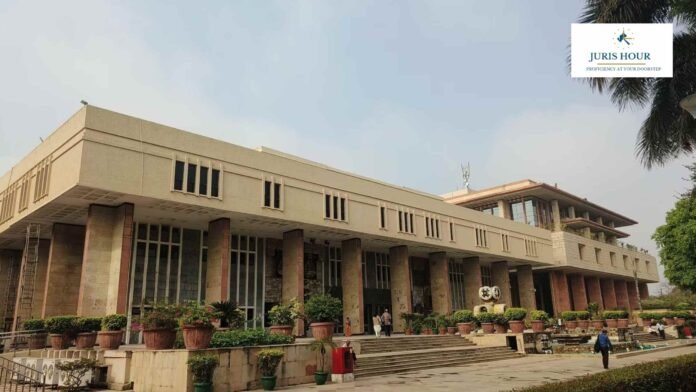
The Delhi High Court has held that the National Faceless Appeal Centre (NFAC) cannot dispose of an income tax appeal without granting the assessee an opportunity for a personal or virtual hearing where such a request has been made.
The bench of Justice Dinesh Mehta and Justice Rajneesh Kumar Gupta observed that written submissions alone cannot substitute an oral hearing and directed the Central Board of Direct Taxes (CBDT) to ensure that a video conferencing facility is made available for appellate proceedings under Section 250 of the Income Tax Act within three months.
The petitioner/assessee had challenged an order passed by the Commissioner of Income Tax (Appeals), National Faceless Appeal Centre (NFAC), under Section 250 of the Income Tax Act.
Buy Now: INCOME TAX E-COMPILATION – JUNE 2026
The company had filed an appeal in January 2020 against an assessment order passed under Section 143(3). However, during subsequent penalty proceedings initiated by the Assessing Officer (AO), the petitioner discovered that its appeal had already been dismissed. The assessee contended that although it had participated in the appellate proceedings through written submissions and adjournment requests, its repeated request for a virtual hearing was never considered and no video conferencing link was provided before the appeal was decided.
The petitioner argued that the denial of a personal or virtual hearing amounted to a violation of the principles of natural justice.
It was submitted that under the faceless appeal mechanism, assessees have no physical interaction with appellate authorities. Therefore, where a taxpayer specifically seeks an opportunity to explain the facts through virtual mode, such a request cannot be ignored. The petitioner maintained that several complex issues concerning the nature of transactions required oral explanation, which could not effectively be conveyed through written submissions alone.
During the hearing, the Revenue, upon instructions, accepted before the Court that although the assessee had sought a personal hearing, no video conferencing link had been communicated.
The Department pointed out that several hearing notices had been issued over the course of the appellate proceedings and that the assessee had participated by filing written submissions. Nevertheless, it could not dispute that the requested virtual hearing was never arranged.
The Division Bench observed that appellate proceedings necessarily contemplate an opportunity of hearing, whether physically or through virtual means.
The Court held that the consideration of written submissions or the memorandum of appeal cannot replace an oral hearing. Even though notices had been issued and written replies were received, once the assessee specifically requested a virtual hearing, the appellate authority was obligated to provide one before deciding the appeal.
According to the Court, the failure to provide a video conferencing facility resulted in a miscarriage of justice because several issues could have been explained more effectively during an interactive hearing.
The Court noted that the appeal involved substantial additions, including disallowance of advances written off amounting to ₹1.27 crore, and addition of advances under Section 68 of the Income Tax Act amounting to ₹20.70 crore.
The Bench observed that such issues are often better explained through personal interaction between the assessee and the appellate authority, making oral or virtual hearings an important component of fair adjudication.
Holding that the appellate proceedings suffered from a breach of natural justice, the High Court set aside the NFAC’s appellate order and restored the appeal for fresh adjudication.
The Court directed the NFAC to issue a fresh hearing notice and provide the petitioner with a video conferencing facility. It further clarified that if the existing system does not support video conferencing, the appellate authority may use alternative virtual platforms such as Zoom, Cisco Webex, Google Meet, WhatsApp, or any other suitable video communication mode.
Since the appellate order itself was quashed, the Court also set aside the consequential penalty orders passed under Sections 271AAC(1) and 270A of the Income Tax Act, while granting liberty to the Assessing Officer to pass fresh orders after the appeal is decided afresh.
In a broader systemic direction, the High Court instructed the Chairman of the CBDT and the Principal Chief Commissioner of Income Tax (NFAC) to coordinate and ensure that a functional video conferencing facility is made available for appellate proceedings under Section 250 within three months, if such a facility is not already operational.
The Court emphasized that whenever an assessee or an authorised representative requests a virtual hearing, it should be provided as a matter of right, thereby strengthening procedural fairness under the faceless appellate system. A copy of the judgment was also directed to be forwarded to the CBDT Chairman and the Principal Chief Commissioner of Income Tax (NFAC) for compliance.
Membership Required to Access Case Details & Order Copy
To view the complete Case Details and Download Order Copy, you must have an active membership. Please subscribe to continue.

