
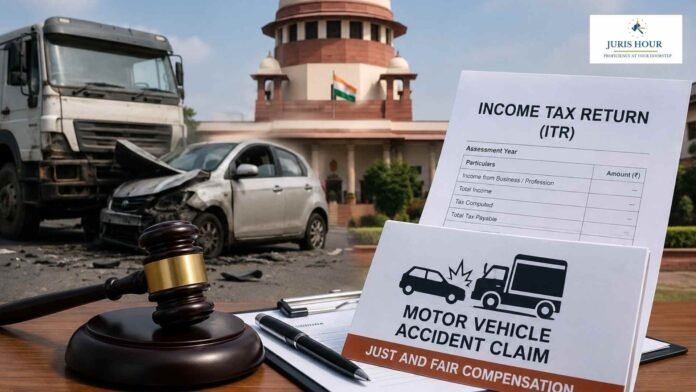
The Supreme Court has laid down comprehensive guidelines for determining the annual income of deceased victims and claimants based on Income Tax Returns (ITRs) and held that use last Income Tax Return (ITR) for salaried employees, three-year average itr for self-employed in motor accident compensation.
A Bench comprising Justice Sanjay Karol and Justice Nongmeikapam Kotiswar Singh has observed that for self-employed individuals or business owners, the Court held that the average income reflected in the previous three years’ ITRs should ordinarily serve as the reference point. Where only one or two returns are available, courts must examine surrounding circumstances instead of mechanically applying averages.
For salaried persons, the Court ruled that ordinarily only the ITR of the immediately preceding year should be relied upon because promotions, increments and salary revisions are generally reflected in the latest return. Where a promotion has occurred but the corresponding ITR has not yet been filed, courts may consider promotion letters and supporting financial records.
Buy Now: INCOME TAX E-COMPILATION – JUNE 2026
The case arose out of a fatal road accident that occurred on 29 May 2018, in which Manoranjan Pandey, a 39-year-old construction businessman, lost his life after a truck allegedly driven rashly collided with his vehicle near Kaliabali Chakka on the National Highway in Odisha. His legal heirs sought compensation of ₹2.25 crore before the Motor Accident Claims Tribunal (MACT), contending that he earned around ₹15 lakh annually from his construction business.
The MACT accepted the latest ITR (Assessment Year 2018-19), assessed the annual income at approximately ₹15 lakh and awarded compensation of ₹2.27 crore with interest at 6% per annum.
The insurance company challenged the award before the Orissa High Court, arguing that the Tribunal had incorrectly assessed the deceased’s income and applied the wrong multiplier. The High Court reduced the compensation to ₹1.87 crore by averaging the income reflected in the previous two ITRs and applying a lower multiplier.
The claimants thereafter approached the Supreme Court.
The principal issue before the Court was whether, while determining compensation under the Motor Vehicles Act, courts should rely solely upon the latest Income Tax Return or calculate the average income reflected in previous years’ returns.
Recognising that High Courts across the country had adopted differing approaches, the Supreme Court appointed Senior Advocate J.R. Midha and Advocate Salil Paul as amici curiae to assist in framing uniform principles.
The Court held that no rigid formula can be prescribed for determining annual income, as the ultimate objective under the Motor Vehicles Act is to award “just and fair compensation.” However, it laid down broad principles to ensure uniformity.
The Court distinguished between salaried employees and self-employed individuals.
The Supreme Court further held that ITRs alone may not always reflect the true earning capacity of a self-employed individual.
Accordingly, courts should evaluate several additional factors, including: Nature and category of the business; Geographical location of operations; Growth trajectory of the business; Impact of the deceased’s death on business operations; Future earning potential; Initial business losses in capital-intensive ventures; and Any other relevant commercial circumstances.
The Bench observed that such considerations are essential because income in business activities often fluctuates and may not accurately reflect future earning capacity.
Another important clarification concerns ITRs filed after the death of the victim.
The Court observed that such returns require greater scrutiny because there may be situations where income is artificially inflated after death. Nevertheless, such returns cannot be rejected outright and may be considered if adequately supported by financial statements and other corroborative evidence.
Applying these principles to the present case, the Court noted that the deceased had filed two ITRs showing annual incomes of approximately ₹11.60 lakh and ₹15.06 lakh.
Instead of mechanically averaging the figures adopted by the High Court, the Supreme Court considered the nature of the deceased’s construction business and fixed his annual income at ₹14 lakh, holding that such assessment would better serve the objective of awarding just compensation.
Based on the revised computation, the Court enhanced the compensation payable to the claimants from ₹1,87,75,150 to ₹1,97,81,505, while maintaining the Tribunal’s direction regarding payment of 6% annual interest on the enhanced amount. The insurer was directed to deposit the amount directly into the claimants’ bank accounts within four weeks after receiving their banking particulars.
Membership Required to Access Case Details & Order Copy
To view the complete Case Details and Download Order Copy, you must have an active membership. Please subscribe to continue.

