
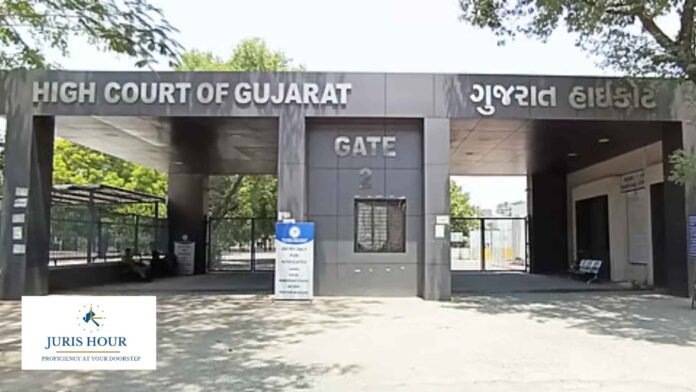
The Gujarat High Court has directed the Commissioner of Income Tax (Appeals) to decide an assessee’s appeal pending since January 2019 within three months, holding that the appellate authority cannot rely on the expression “where it is possible” in Section 250(6A) of the Income Tax Act, 1961, to justify years of delay.
A Division Bench of Justice A.S. Supehia and Justice Vaibhavi D. Nanavati observed that prolonged pendency frustrates the legislative intention of time-bound disposal of income tax appeals.
Buy Now: Direct tax (Income Tax) E-Magazine September 2026
The bench has observed that the petitioner, and similarly situated appellants whose appeals remain pending beyond one year, would fall within the “any other case of genuine hardship” category under the Central Board of Direct Taxes’ guidelines for priority disposal.
The petitioner/assessee has challenged the Income Tax Officer, Ward 2(1)(1), Ahmedabad, and other authorities.
The company had filed its appeal before the Commissioner of Income Tax (Appeals) on January 19, 2019. Before the High Court, it submitted that the appeal had remained undecided despite approximately seven years having passed.
Advocate B.S. Soparkar, appearing for the company, confined the relief sought in the petition to a direction requiring the appellate authority to decide the pending appeal within four weeks.
In support, the petitioner relied on the Punjab and Haryana High Court’s decision in Kulwinder Paul Singh v. Central Board of Direct Taxes, reported in (2025) 173 taxmann.com 358. In that case, the appellate authority had been directed to decide an appeal within three months after it had remained pending for almost five years.
Senior Standing Counsel Dev D. Patel, appearing for the Revenue, referred to the CBDT guidelines providing for priority and out-of-turn disposal of appeals falling within five specified categories.
The central issue before the Court was whether the qualified language of Section 250(6A) permits the appellate authority to leave an appeal undecided for several years.
The provision contemplates that, where possible, the Joint Commissioner (Appeals) or Commissioner (Appeals), as applicable, may hear and decide an appeal within one year from the end of the financial year in which it is filed or transferred under the relevant statutory provisions.
The Gujarat High Court agreed with the Punjab and Haryana High Court’s interpretation that, although the provision uses the expression “where it is possible”, the legislative intention remains unequivocally in favour of time-bound disposal.
The Bench held that this intention cannot be frustrated by allowing appeals to remain pending for more than six years. It emphasised that the qualification in the provision cannot become a justification for indefinite postponement of appellate decisions.
The Court also examined the CBDT guidelines issued through Letter F. No. 279/MISC./M-102/2021-ITJ dated March 7, 2024, which identify five categories for taking up appeals on priority.
It found that the petitioner’s case, as well as cases of similarly situated appellants whose appeals have remained pending beyond one year, would fall within the fifth category: “any other case of genuine hardship.”
The finding recognises prolonged appellate delay as a basis for priority consideration under the guidelines. In the present case, the Court considered the extended wait for an appellate decision sufficient to bring the assessee within that category.
The Bench held that the Commissioner (Appeals) must decide appeals expeditiously after the expiry of the one-year period contemplated by Section 250.
It expressly rejected the use of the words “where it is possible” as shelter for postponing appeals for years, observing that such an approach would defeat the intention of the legislature.
The ruling does not treat the one-year period as an absolute deadline whose expiry automatically determines the appeal. Instead, it makes clear that the statutory qualification does not authorise prolonged inaction and that delayed appeals require expeditious attention.
Although the company sought disposal within four weeks, the High Court directed the appellate authority to decide the appeal within three months from the date of receipt of a copy of the order.
The writ petition was allowed to that extent, and the rule was made absolute.
The Court’s decision concerns the delay in deciding the statutory appeal. It does not adjudicate the merits of the underlying tax dispute, which remain for the appellate authority to determine.
Membership Required to Access Case Details & Order Copy
To view the complete Case Details and Download Order Copy, you must have an active membership. Please subscribe to continue.

