
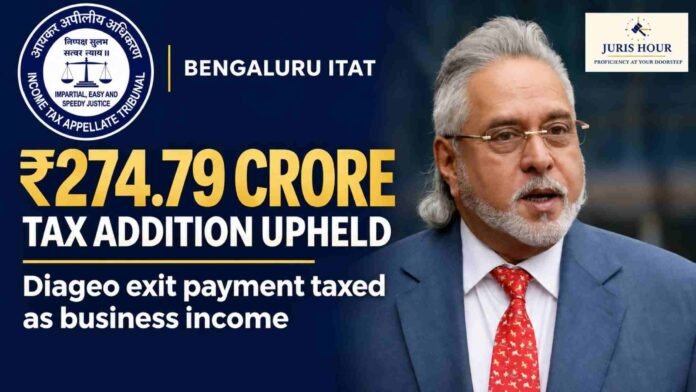
The Bengaluru Bench of the Income Tax Appellate Tribunal (ITAT) has held that the $40 million Vijay Mallya received from Diageo when he stepped down as chairman and non-executive director of United Spirits Ltd. (USL) was taxable in India as business income under Section 28(ii)(a) of the Income-tax Act, 1961.
The bench of Keshav Dubey (Judicial Member) and Balakrishnan S (Accountant Member) found that the payment was made for relinquishing rights and benefits attached to Mallya’s position in an Indian company, including appointment and governance rights. That link to USL was central to the finding that the income accrued in India, despite the involvement of foreign companies and payment overseas.
Buy Now: Direct tax (Income Tax) Judgments E-Magazine October 2026
The bench upheld the ₹274.79 crore addition for assessment year 2016–17 and rejected the Revenue’s bid to include a further $35 million in deferred installments in the same year.
On 25 February 2016, Mallya signed a Deed of Disengagement with Diageo Plc, Relay BV and Diageo Holdings Netherlands BV. Under the agreement, Diageo agreed to pay $75 million. Mallya received $40 million on signing, and the remaining $35 million was scheduled for payment in five annual installments of $7 million each. He resigned from the USL board following execution of the deed.
The payment was omitted from Mallya’s return for AY 2016–17, which declared income of about ₹3.99 crore. The Assessing Officer issued a notice under Section 148 on 19 March 2020 and, in the reassessment order of 30 September 2021, added the entire $75 million, equivalent to ₹515.24 crore, as business income. The Commissioner of Income Tax (Appeals) [CIT(A)] restricted the addition to the $40 million paid on signing, equivalent to ₹274.79 crore. Mallya challenged the surviving addition, while the Revenue sought restoration of the full amount.
Mallya argued that the payment was consideration for a five-year global non-compete restriction, excluding the United Kingdom. His representative argued that Section 28(va), as it stood for AY 2016–17, covered non-compete payments relating to business and did not extend to the professional or personal restrictions he said were at issue. He also argued that a non-executive chairmanship and directorship did not give him control over the whole or substantially the whole of USL’s affairs.
Section 28(ii)(a) brings within business income compensation or other payments connected with the termination of management, or changes to its terms, where the recipient manages the whole or substantially the whole of an Indian company’s affairs. The tribunal examined the terms of the deed and found that Mallya’s resignation involved giving up appointment and governance rights as well as the benefits attached to his position at USL. On those facts, it held that Section 28(ii)(a) applied.
The tribunal examined the scope of a non-resident’s taxable income under Section 5(2) and the rules on income deemed to accrue or arise in India under Section 9(1)(i). It concluded that the consideration actually accrued in India because it flowed from the relinquishment of rights and benefits tied to Mallya’s position at USL. The bench therefore found an Indian source for the income even though the payment was made abroad.
Mallya also claimed protection under the India–UAE Double Taxation Avoidance Agreement. He relied on nine UAE tax residency certificates that his representative said covered the date of the deed. The bench found that the certificates had been issued for the UAE–France treaty and that the evidence did not establish his residence for purposes of the India–UAE treaty. It agreed with the CIT(A)’s treaty analysis, which concluded that India could tax the payment under the relevant provisions even if residence were established in the UAE or the UK.
The Revenue argued that the entire $75 million accrued once Mallya signed the deed and stepped down, even though the balance was payable over five years. Mallya maintained that his right to the installments depended on continued compliance with the deed. His representative also told the tribunal that Diageo had cancelled the agreement, withheld the balance and brought proceedings in the UK seeking repayment.
The CIT(A) recorded that Diageo withheld the $35 million over an alleged breach of contractual obligations. The CIT(A) held that the balance could be brought to tax in the respective years if received under the instalment arrangement. By dismissing the Revenue’s appeal, the tribunal left the addition confined to the $40 million received in the year relevant to AY 2016–17.
The tribunal held that the omission of a reference to Section 143 in the reassessment order was a procedural defect curable under Section 292B. It also rejected the argument that the reassessment framework introduced by the Finance Act, 2021 should have been applied to proceedings initiated by the March 2020 notice, holding that the substituted provisions applied prospectively.
Membership Required to Access Case Details & Order Copy
To view the complete Case Details and Download Order Copy, you must have an active membership. Please subscribe to continue.
Read More: ITAT Quashes S. 153C Assessments Based on Seized WhatsApp Chats Over Late, Single Satisfaction Note

