
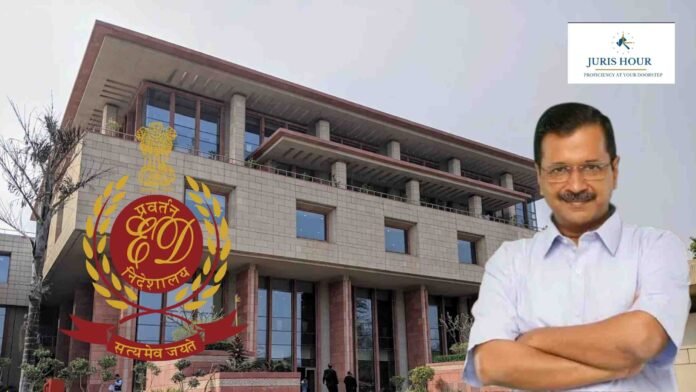
The Delhi High Court on Wednesday issued notice on a plea filed by the Enforcement Directorate (ED) challenging the acquittal of former Delhi Chief Minister Arvind Kejriwal in cases relating to alleged non-compliance with summons issued in connection with the liquor policy investigation.
The bench of Justice Swarana Kanta Sharma sought a response from Kejriwal and listed the matter for further hearing on April 29. The Court also noted the absence of the respondent despite advance notice and directed that fresh notice be issued. Additionally, it ordered that the Trial Court Record (TCR) be requisitioned for examination.
Appearing for the ED, Special Counsel Zoheb Hossain argued that the trial court had committed a “grave error” in acquitting Kejriwal. He contended that there was no dispute regarding the receipt of summons by the respondent and his failure to comply with them. Emphasizing settled legal principles, counsel submitted that when the authenticity of documents is not contested, there is no requirement for further proof. Advocate Vivek Gurnani also appeared in support of the ED’s case.
The proceedings arise from an order dated January 22, wherein the trial court acquitted Kejriwal in criminal complaints filed by the ED alleging wilful non-compliance with summons issued under the money laundering framework. The ED had maintained that Kejriwal deliberately failed to join the investigation despite repeated notices.
According to the agency, Kejriwal did not appear in response to summons issued on November 2 and December 21, 2023, as well as January 3 and January 18, 2024. The Aam Aadmi Party leader had publicly termed these summons as “illegal” and declined to comply.
Subsequently, Kejriwal was arrested by the ED on March 21, 2024, in connection with the broader investigation into the alleged liquor policy scam. He was granted bail on June 20, 2024, by a vacation judge of the Rouse Avenue Courts. However, this relief was later stayed by the Delhi High Court upon challenge by the ED.
In July 2024, the Supreme Court of India granted interim bail to Kejriwal while referring his challenge to the ED’s arrest to a larger bench, thereby adding another layer of judicial scrutiny to the matter.
The ED’s case stems from allegations surrounding the now-scrapped excise policy of the Delhi government. The agency has claimed that the policy was implemented as part of a conspiracy to extend undue benefits to select private entities. Specifically, it alleged that a profit margin of 12 percent was extended to certain wholesalers, despite such provisions not being formally recorded in the decisions of the Group of Ministers (GoM).
The agency has further alleged that the conspiracy involved coordination between multiple individuals, including Vijay Nair, and entities described as the “South Group,” to facilitate extraordinary gains for liquor wholesalers. According to the ED, Nair was acting on behalf of Kejriwal and former Deputy Chief Minister Manish Sisodia in executing the alleged scheme.
With the High Court now set to examine the ED’s challenge to the acquittal, the case is poised to revisit critical questions surrounding compliance with investigative summons and the evidentiary standards applicable in such prosecutions. The outcome of the proceedings could have significant implications for ongoing and future cases involving alleged non-cooperation in financial investigations.

