
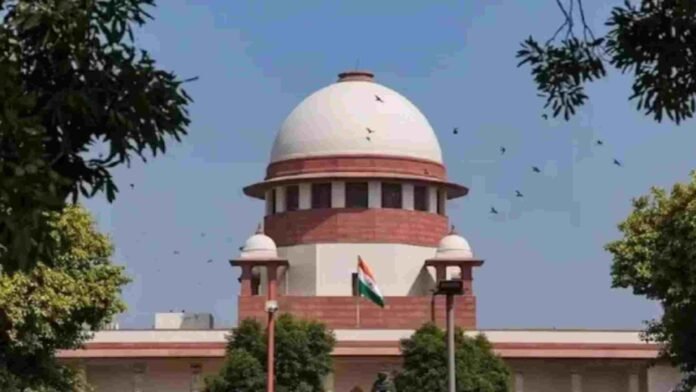
The Supreme Court has held that a long-pending and procedurally non-compliant Scheme of Arrangement (SOA) under the Companies Act, 1956 cannot stall Corporate Insolvency Resolution Proceedings (CIRP) initiated under Section 7 of the IBC.
The Bench of Justice K. Vinod Chandran and Justice Sanjay Kumar, allowed the appeal filed by Omkara Assets Reconstruction Private Limited and restored the order of the National Company Law Tribunal (NCLT) initiating CIRP against the corporate debtor.
The proceedings stemmed from a default in repayment of loans originally disbursed in 1999 and 2000. The principal amount of ₹10.60 crore had ballooned to over ₹154.33 crore with accumulated interest. The Stressed Assets Stabilisation Fund (SASF) of IDBI Bank, predecessor-in-interest to the appellant, approached the NCLT under Section 7 of the IBC seeking initiation of CIRP.
The corporate debtor resisted the application, citing a pending Scheme of Arrangement under Sections 391–394 of the Companies Act, 1956 before the Punjab and Haryana High Court. It was argued that the approval of the scheme precluded insolvency proceedings and that material facts regarding the scheme had been suppressed before the Adjudicating Authority.
While the NCLT admitted the Section 7 application and declared moratorium under Section 14 of the IBC, the National Company Law Appellate Tribunal (NCLAT) stayed the CIRP proceedings, keeping them in abeyance pending disposal of the High Court proceedings. The Supreme Court had earlier revived the moratorium through an interim order.
The Supreme Court undertook a detailed examination of the statutory framework governing schemes of arrangement under the Companies Act and the Companies (Court) Rules, 1959.
The Court noted that after approval by creditors in 2008, the second motion seeking sanction of the scheme was not filed within the prescribed time. Even when filed belatedly in 2009, no effective steps were taken for nearly a decade. The High Court sanctioned the scheme only in July 2019—almost 11 years after creditor approval. The sanction order was not filed before the Registrar of Companies within the mandatory 30-day period. The sanction was later recalled in 2022, and although the recall was stayed, statutory timelines remained uncomplied. Filing of Form INC-28 in 2023 was far beyond the prescribed period.
The Court held that the SOA, based on dues as of 2008, had become “redundant and inoperative” due to sheer passage of time and persistent non-compliance with statutory requirements.
It further observed that creditors had independently pursued remedies under the SARFAESI Act and the Recovery of Debts and Bankruptcy Act, obtaining recovery certificates and enforcing security interests.
Emphasizing Section 238 of the IBC, which grants the Code overriding effect over inconsistent laws, the Court reiterated that the IBC is a special statute focused on revival and resolution of stressed companies.
The Bench relied on precedents including A. Navinchandra Steels (P) Ltd. v. Srei Equipment Finance Ltd. and Sunil Kumar Sharma v. ICICI Bank Ltd., reiterating that insolvency proceedings under the IBC are independent and cannot be thwarted merely due to parallel or pending proceedings under the Companies Act.
The Court observed, “Judicial discipline, though a cornerstone of justice, cannot be urged by tardy litigators engaged in fractious and opulent litigations aimed at jeopardizing public funds and putting the economy in a hostage situation.”
It held that allowing a stale and non-operational scheme to derail insolvency proceedings would undermine financial probity and the larger national interest.
The Court also prima facie observed that after the Companies (Transfer of Pending Proceedings) Rules, 2016 came into force, the pending second motion ought to have been transferred to the NCLT, as it had neither been reserved for orders nor finally adjudicated by the High Court.
Thus, the High Court’s later sanction of the scheme was found to be jurisdictionally questionable.
Importantly, the Court clarified that compromise or arrangement is not alien to IBC proceedings. Referring to Section 230 of the Companies Act, 2013, it noted that such schemes may be considered even during liquidation under the IBC framework, but only in accordance with the Code.
The emphasis under the IBC, the Court reiterated, is revival through new management rather than protection of a defaulting management.
Setting aside the NCLAT’s order, the Supreme Court restored the NCLT’s admission order and permitted the Interim Resolution Professional (IRP) to resume charge. The interim direction keeping the management involved in day-to-day affairs was vacated.
The appeal was allowed, and all pending applications were disposed of.
Case Details
Case Title: Omkara Assets Reconstruction Private Limited Versus Amit Chaturvedi and Ors.
Citation: JURISHOUR-86-SC-2026
Case No.: Civil Appeal No.11417 of 2025
Date: 24/02/2026
Read More: DGFT Exempts ITC HS Chapters 01–24 from Reduced RoDTEP Rates Notified on February 23

