
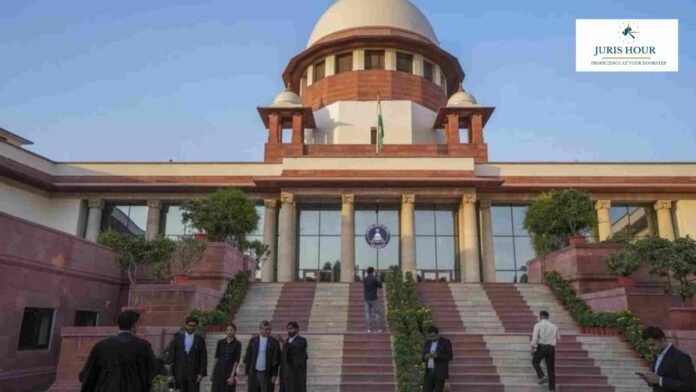
The Supreme Court has held that liabilities arising from corporate guarantees squarely fall within the ambit of “financial debt.”
The bench of Justice Pamidighantam Sri Narasimha and Justice Alok Aradhe has observed that rejection of claims by tribunals on technical grounds such as non-disclosure, improper verification, or alleged stamping defects is legally unsustainable.
The dispute arose from a complex lending structure involving a consortium of banks led by State Bank of India, which had extended substantial financial assistance to group entities of Reliance Communications. Separately, Doha Bank had extended a foreign currency loan to Reliance Infratel Limited (RITL), the corporate debtor.
To secure loans extended to group companies, RITL executed corporate guarantees in favour of the consortium lenders in March 2017. Subsequently, insolvency proceedings were initiated against the corporate debtor before the National Company Law Tribunal (NCLT), Mumbai.
However, Doha Bank challenged the validity of these guarantees on multiple grounds, including lack of disclosure in financial statements, questionable timing (post-default), and insufficient stamping. These objections were accepted by both the NCLT and later the National Company Law Appellate Tribunal (NCLAT), which denied the consortium lenders the status of “financial creditors.”
Buy Now: 500+ CGST Notifications (2017–2025) | Clickable Index E-Magazine | Hyperlinked Original PDFs
The principal question before the Court was whether corporate guarantees executed by a corporate debtor can be treated as “financial debt” under Section 5(8) of the IBC, thereby entitling lenders to recognition as financial creditors.
Additionally, the Court examined whether procedural objections—such as alleged non-submission of documents, improper verification by the Resolution Professional, or deficiencies in stamping—could defeat otherwise valid financial claims.
The Court emphatically held that a liability arising from a corporate guarantee is a “financial debt” under Section 5(8) of the IBC. It reiterated that such guarantees involve consideration for time value of money and create coextensive liability with the principal borrower, thereby satisfying the statutory definition.
Rejecting the findings of the tribunals, the Court observed that execution of the corporate guarantees was clearly established and even acknowledged by the corporate debtor in communications. Mere non-disclosure of guarantees in financial statements does not invalidate the underlying liability; at best, it may amount to a compliance lapse by the corporate debtor. The timing of execution of guarantees cannot be questioned solely because the borrower was under financial stress, particularly when restructuring efforts were ongoing. Claims cannot be rejected merely because supporting documents were not initially filed before the NCLT, especially when they were later produced before the appellate forum.
Addressing the issue of insufficient stamping, the Court clarified that such defects are curable and do not render the instrument void or unenforceable. It emphasized that stamp laws are fiscal in nature and cannot be used as a tool to defeat substantive rights.
The Court also held that since the guarantees were executed and produced in New Delhi, the applicability of the Maharashtra Stamp Act was misplaced.
The Supreme Court found the conclusions of both NCLT and NCLAT to be “perverse” and contrary to settled legal principles. It held that the tribunals erred in rejecting the claims of consortium lenders despite clear evidence of guarantee execution and verification.
Accordingly, the Court exercised its appellate jurisdiction under Section 62 of the IBC to interfere with concurrent findings of fact, noting that such interference is warranted where findings are manifestly erroneous.
Setting aside the orders of the NCLT and NCLAT, the Supreme Court recognized the consortium lenders as “financial creditors” of the corporate debtor; directed reconstitution of the Committee of Creditors (CoC) to include them; and ordered continuation of the Corporate Insolvency Resolution Process in accordance with law.
Case Details
Case Title: State Bank Of India & Ors. Versus Doha Bank Q.P.S.C. & Anr.
Citation: JURISHOUR-981-SC-2026
Case No.: Civil Appeal No. 8527 Of 2022
Date: 28/04/2026

