
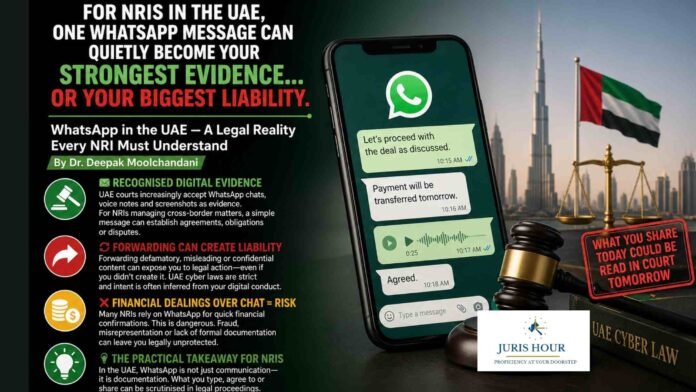
For Non-Resident Indians (NRIs) residing in the United Arab Emirates, everyday communication through messaging platforms such as WhatsApp is no longer just a matter of convenience—it is increasingly acquiring legal significance. Legal experts are cautioning that what may appear to be casual, informal communication can carry serious consequences under UAE law, particularly in disputes involving financial transactions, defamation, or contractual obligations.
BUY NOW : Litigation Guide on Evidentiary Value of Electronic Evidence Including WhatsApp Chats
WhatsApp Chats Gaining Recognition as Legal Evidence
Courts in the UAE have progressively acknowledged digital communication, including WhatsApp chats, voice notes, and screenshots, as admissible evidence in legal proceedings. This shift reflects the growing reliance on digital platforms for both personal and professional interactions. For NRIs managing cross-border dealings—whether related to business, property, or financial arrangements—a simple message exchange can be used to establish the existence of agreements, commitments, or disputes.
Legal practitioners note that even in the absence of formally executed contracts, a sequence of messages indicating consent, negotiation, or acknowledgment may be relied upon by courts to determine liability or enforce obligations.
Forwarding Messages May Attract Legal Consequences
One of the lesser-understood risks relates to forwarding messages. Under the UAE’s stringent cyber laws, individuals may be held accountable not only for content they create but also for content they share. Forwarding defamatory, misleading, or confidential material—even without malicious intent—can expose NRIs to legal action.
Authorities in the UAE often assess digital conduct holistically, and intent may be inferred from the nature and context of communication. As a result, users are being advised to exercise caution before sharing unverified or sensitive information.
Financial Transactions Over Chat Pose Risks
A growing concern is the reliance on WhatsApp for financial confirmations and business dealings. Many NRIs use the platform for quick agreements, payment assurances, or transactional discussions. However, legal experts warn that such practices can be risky.
In the absence of formal documentation, disputes arising from fraud, misrepresentation, or non-performance may become difficult to resolve. While WhatsApp chats may serve as evidence, they may not always provide the clarity or enforceability of properly drafted legal agreements.
“WhatsApp is Documentation, Not Just Communication”
Summarising the evolving legal position, experts emphasise that in the UAE, WhatsApp communication is effectively treated as documentation. Messages, voice notes, and shared content can all be scrutinised in legal proceedings, often carrying significant evidentiary weight.
For NRIs, the practical takeaway is clear: every message should be drafted with caution and precision. What is written, agreed upon, or forwarded today may later be examined in a courtroom setting.
Need for Increased Awareness Among NRIs
Given the increasing digitisation of communication and the strict regulatory framework in the UAE, there is a growing need for awareness among NRIs about the legal implications of their digital behaviour. Legal advisors recommend avoiding informal agreements for significant transactions, refraining from forwarding sensitive or unverified content, and maintaining proper documentation for all financial and business dealings.
As digital communication continues to blur the line between informal and formal exchanges, the message for NRIs in the UAE is unequivocal—treat every WhatsApp interaction as a potential legal record.
Read More: GST Demand of Rs. 363 Crore Against Vodafone Idea Quashed: Bombay High Court

