
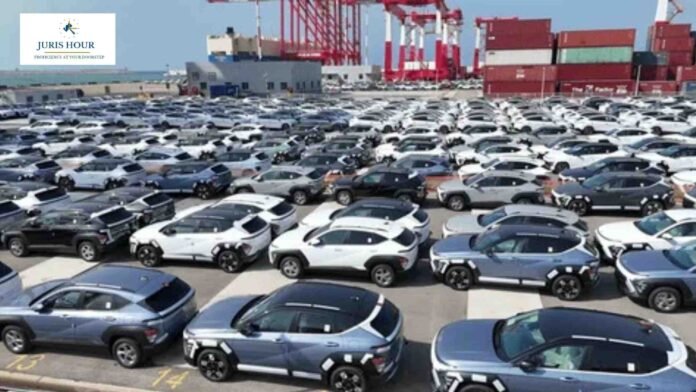
The escalating conflict in West Asia is beginning to significantly disrupt maritime trade routes, with Indian exporters already facing shipment delays, rerouting of cargo, and mounting financial losses. In one of the most prominent disruptions so far, a consignment of nearly 2,000 Hyundai cars exported from India to Gulf countries may be diverted back to Chennai Port due to growing uncertainty in key shipping corridors.
According to officials at the Chennai Port Authority, the vehicles were originally shipped from India and routed through Sri Lanka’s Hambantota Port for onward transportation to markets in West Asia. However, shipping lines are now reconsidering their routes amid concerns over safe navigation through the Strait of Hormuz and Red Sea corridors, both of which have been affected by the ongoing regional conflict.
A senior port official stated that the volatile security situation has forced several carriers to suspend or rethink sailings to Gulf destinations, resulting in cargo already at sea being rerouted or returned to Indian ports.
Table of Contents
Thousands of Containers Affected
The disruption is not limited to automobile shipments. Port sources revealed that nearly 4,000 export containers linked to Gulf-bound trade have been rerouted, with around 1,800 containers originating from Chennai alone. These containers include a wide variety of export goods destined for West Asian markets.
Indian exporters have expressed serious concern over the situation, warning that the continued disruption could lead to major financial losses, delayed deliveries, and cancelled orders.
Tamil Nadu Ports Facing Major Impact
Since the conflict intensified on February 28, maritime operations from ports in Tamil Nadu have slowed considerably. The impact has been particularly severe at the VO Chidambaranar Port (VOC Port) in Thoothukudi, which handles significant containerised cargo shipments to Gulf countries.
Key export commodities shipped through this port include:
- Garments
- Home textiles
- Food products
- Eggs
- Industrial castings
A vessel named Zhong Gu Tai Yuan, which loaded approximately 250 containers from VOC Port on February 28, was reportedly stranded mid-sea due to the uncertainty surrounding regional maritime routes. According to sources, the vessel was ultimately forced to divert and offload the containers at Nhava Sheva Port in Mumbai.
Export Cargo Piling Up in Warehouses
The shipping disruption has also resulted in large volumes of export cargo getting stuck at logistics facilities across Tamil Nadu. Containers filled with textile and garment products are currently stranded at:
- Container Freight Stations (CFSs)
- Warehouses in and around Thoothukudi
- Manufacturing hubs including Tiruppur, Karur, Namakkal, and Coimbatore
Exporters noted that many of these consignments were intended to reach Gulf markets before the Ramzan festival, which traditionally sees a surge in demand for garments and textiles. The delays now threaten to derail these seasonal export opportunities.
Ports Prepare for Temporary Cargo Storage
In anticipation of more diverted shipments, port authorities in Tamil Nadu are preparing additional storage infrastructure.
At VOC Port, authorities have identified 19,000 square metres of land outside the terminal area that can be used to temporarily store cargo if ships decide to discharge shipments there.
Similarly, Chennai Port has earmarked 20,000 square metres of yard space to handle any incoming diverted cargo.
S. Viswanathan, Chairman of the Chennai Port Authority, said that a high-level consultative meeting with exporters was held to assess the evolving situation and explore possible solutions.
Possibility of Diverting Perishable Goods to Domestic Markets
Port officials also indicated that if perishable commodities are affected by prolonged delays, authorities may consider diverting those goods for domestic consumption to prevent wastage.
Viswanathan clarified that such a scenario has not yet arisen at Chennai Port but noted that similar measures have previously been implemented at western Indian ports when international shipping routes were disrupted.
Shipping Lines Reassessing Gulf Routes
Shipping companies are also taking precautionary steps. Global logistics major Maersk has temporarily suspended acceptance of cargo bookings for several Gulf destinations, citing security concerns and route uncertainties.
The company is reportedly prioritising essential shipments such as food supplies and medicines, while postponing or cancelling non-essential cargo movements until the situation stabilises.
Export Sector on Edge
With the conflict showing no signs of easing, exporters fear that prolonged disruptions could severely impact India’s trade with West Asia and Europe, regions that rely heavily on maritime routes passing through the Strait of Hormuz and the Red Sea.
Industry stakeholders are now urging the government and shipping companies to identify alternative maritime routes and logistics solutions to ensure that export consignments reach international markets without further delay.
For now, however, uncertainty continues to loom over cargo movements from southern Indian ports, leaving exporters and shipping operators bracing for further disruptions.
Read More: Supreme Court Upholds Bharti Telecom’s Minority Share Buyout

