
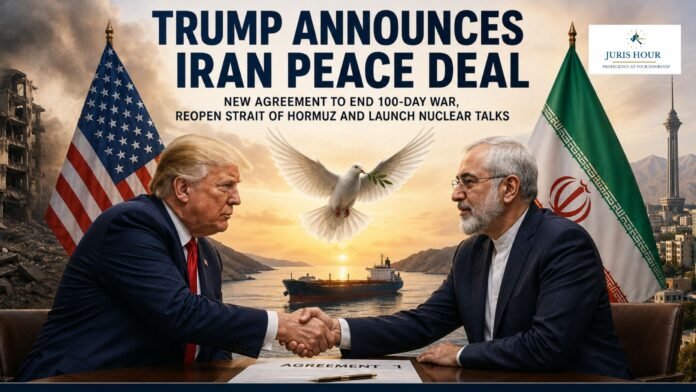
A major diplomatic breakthrough may be on the horizon as U.S. President Donald Trump announced US-Iran war end and what he called a “historic agreement” aimed at ending more than 100 days of military conflict involving Iran. Officials from both Washington and Tehran have outlined a framework that could immediately halt hostilities and pave the way for broader negotiations on regional security, nuclear issues, sanctions relief and maritime trade.
According to statements released by Iranian authorities, the proposed arrangement includes an immediate cessation of military operations across all fronts, including Lebanon. Iran’s Supreme National Security Council stated that military action would cease permanently and that restrictions affecting Iranian maritime access would be lifted. A formal signing ceremony is reportedly expected to take place in Switzerland later this week.
Lebanon Remains a Major Flashpoint
One of the most sensitive aspects of the proposed agreement concerns Lebanon. Iranian officials have indicated that the understanding includes a ceasefire involving Israeli military operations in Lebanon. However, uncertainty remains over whether Israel will withdraw from territories it currently controls in southern Lebanon.
The issue has become particularly contentious following recent Israeli strikes near Beirut, which reportedly caused friction during the final stages of negotiations. President Trump publicly criticized the attacks, suggesting they nearly jeopardized the agreement. Analysts have warned that the Lebanon question could become the biggest challenge to the long-term success of the peace framework.
Questions Over Israel’s Position
The agreement has generated intense debate within Israel. Critics from across the political spectrum argue that several of Israel’s strategic objectives have not been achieved, including efforts to weaken Iran’s regional influence and secure broader concessions concerning groups such as Hezbollah.
Some Israeli leaders have expressed concern that the arrangement does not adequately address long-term security concerns. Others argue that the negotiations were largely conducted between Washington and Tehran, leaving Israel with limited influence over the final outcome.
Nuclear Programme Negotiations to Continue
A crucial element of the agreement is a proposed 60-day negotiation period focused on Iran’s nuclear programme. Reports indicate that the final settlement may permit Iran to continue uranium enrichment for civilian purposes while imposing restrictions designed to prevent military use.
The future of Iran’s stockpile of highly enriched uranium remains one of the most difficult issues facing negotiators. President Trump has warned that military options could return to the table if discussions on a final nuclear settlement fail.
Missile Programme and Regional Allies
Another unresolved issue concerns Iran’s ballistic missile programme and its relationships with regional groups, including Hezbollah, Hamas, the Houthis and allied organizations operating in Iraq and Syria.
While earlier U.S. demands reportedly included restrictions on these activities, reports suggest that discussions concerning missiles and regional alliances may have been removed from the current negotiation agenda. If confirmed, this would represent a significant shift in the American negotiating position.
Strait of Hormuz Set to Reopen
The reopening of the strategically vital Strait of Hormuz is among the most significant economic aspects of the agreement.
The waterway handles approximately one-fifth of global oil and liquefied natural gas shipments. President Trump announced that navigation through the strait would resume, initially for mine-clearing operations before broader commercial traffic returns.
Experts believe the restoration of normal shipping activity may take several months, even if the agreement is fully implemented. Questions also remain about potential maritime service charges that Iran may seek to impose on vessels using the route.
Sanctions Relief and Frozen Assets
The proposed framework does not immediately remove sanctions imposed on Iran. However, reports indicate that future negotiations could address restrictions affecting Iranian oil exports and financial transactions.
Another key component involves the possible release of approximately $24 billion in frozen Iranian assets. Iranian officials reportedly view access to these funds as essential for post-war reconstruction efforts. U.S. officials, however, have suggested that any economic relief would be tied to Iran’s compliance with future commitments.
Markets Respond Positively
Global financial markets reacted favorably to reports of the agreement. Oil prices declined sharply as investors anticipated the restoration of energy supplies through the Strait of Hormuz. Stock futures in the United States also recorded gains, reflecting optimism that reduced tensions could ease inflationary pressures and improve global economic stability.
Nevertheless, economists caution that damage to energy infrastructure, shipping disruptions and supply-chain challenges caused by the conflict could continue affecting international markets for months.

