
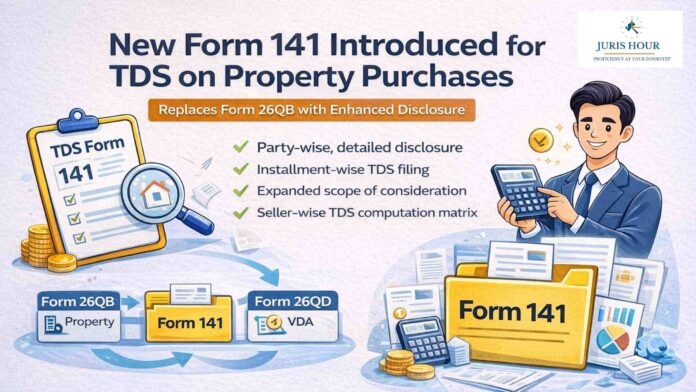
The taxation framework governing Tax Deducted at Source (TDS) on property transactions has undergone a significant overhaul with the introduction of Form 141, replacing the existing Form 26QB. The new form brings a more structured, transparent, and comprehensive reporting mechanism, especially aimed at addressing complexities arising in multi-party transactions and staged payments.
Table of Contents
Applicability and Key Thresholds
Form 141 continues to operate within the existing framework of Section 194-IA of the Income-tax Act, wherein TDS is required to be deducted at the rate of 1% on property transactions where the consideration value is ₹50 lakh or more.
The compliance timeline has also been streamlined. Unlike the earlier system where TDS was deposited within 30 days from the end of the month, the new structure mandates filing within 30 days from the end of the quarter, thereby aligning it with broader TDS compliance cycles.
Importantly, the provisions remain inapplicable to rural agricultural land, maintaining continuity with prior exclusions.
Replacement of Form 26QB and Structural Evolution
Form 141 replaces not only Form 26QB (used for property transactions) but also integrates elements that were previously handled separately, including certain disclosures akin to those in Form 26QD (for virtual digital assets). This consolidation reflects a shift towards a unified reporting system.
One of the most notable changes is that Form 132 will now replace Form 16B, which was earlier issued as the TDS certificate to the seller. This signals a broader reconfiguration of compliance documentation.
Major Structural Changes in Form 141
The new form introduces several structural enhancements aimed at improving traceability and accuracy:
- A separate field for Stamp Duty Value has been introduced, ensuring that both actual consideration and deemed valuation are captured distinctly.
- Buyer and seller details must now be disclosed party-wise, rather than in aggregate form.
- A new feature enables lifecycle tracking of instalments, capturing each stage of payment rather than treating the transaction as a lump sum.
- A seller-wise TDS computation matrix has been incorporated, particularly useful in transactions involving multiple sellers.
- Integration with lower or nil TDS certificate mechanisms ensures better compliance where exemptions or reduced rates apply.
Expanded Scope of Property Consideration
Under Form 141, the definition of “consideration” has been widened to include several ancillary charges that were often overlooked or ambiguously treated under the earlier regime. These include:
- Club membership fees
- Parking charges
- Electricity and water connection fees
- Maintenance charges and advance payments
- Incidental transfer charges
This expanded scope ensures that the entire financial outflow related to property acquisition is brought within the TDS net, reducing scope for underreporting.
Shift from Limited to Comprehensive Disclosure
Under the earlier Form 26QB system, disclosures were relatively limited. Only basic details such as PAN, name, and date of agreement were required, and transactions were often reported as lump-sum amounts without granular breakdown.
Form 141 fundamentally alters this approach by introducing complete party-wise disclosure requirements:
- For buyers: PAN, name, and share in consideration must be specified.
- For sellers: PAN, name, contact details, and percentage of sale consideration received must be disclosed.
Additionally, the number of forms to be filed is now directly linked to the number of buyers. This means each buyer must file a separate Form 141, significantly increasing compliance granularity.
Instalment-Based Reporting Mechanism
A major shift lies in the treatment of staged payments. Earlier, only broad stages such as first instalment, subsequent instalments, and final instalment were referenced without strict reporting requirements.
Form 141 now mandates precise reporting of each payment stage, including:
- First instalment
- Subsequent instalments
- Final instalment
This ensures real-time tracking of tax deductions across the lifecycle of the transaction, making it easier for authorities to reconcile payments with actual financial flows.
Conclusion
The introduction of Form 141 marks a decisive move towards greater transparency, accountability, and digitised compliance in property transactions. By mandating detailed disclosures, expanding the scope of consideration, and introducing instalment-based tracking, the new system seeks to plug loopholes that previously enabled tax leakage or reporting inconsistencies.
While the enhanced requirements may initially increase the compliance burden for taxpayers, they ultimately contribute to a more robust and reliable TDS ecosystem, particularly in complex real estate transactions involving multiple stakeholders.
Read More: GST Dept. Can’t Insist on Personal Appearance or Delay Seizure Proceedings: Calcutta High Court

