
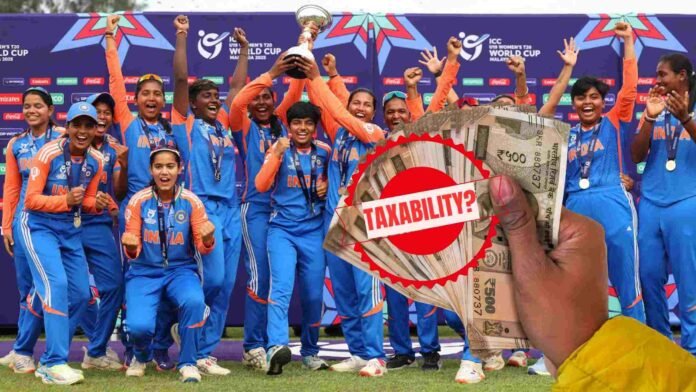
Amounts that the Indian women’s cricket team (and its individual players) receive — prize money, match and central-contract fees, government rewards, sponsorships and endorsements — are generally taxable in India, but the tax treatment depends on (a) the nature of the receipt, and (b) the recipient’s status (professional sportsperson vs. amateur, resident vs. non-resident).
Government-awarded honours approved under section 10(17A) are exempt; most commercial receipts (prize money paid by tournament organisers, match fees, endorsements, sponsorships) are taxed as income(normally as business/profession or salary depending on contract), and withholding (TDS) obligations exist under different provisions depending on payer/recipient.
Legal framework — the headline provisions you must watch
- Income heads — Taxable receipts are normally assessed under:
- Profits and gains of business or profession (if the sport is the player’s profession or they operate through a business/firm), or
- Income from salaries (where a clear employer–employee relationship exists), or
- Income from other sources (residual head for receipts not falling in the other heads).
The classification is fact-specific (nature of contract, regularity, intent).
- Exemption for government awards — Section 10(17A).
Awards instituted by the Central/State Government (or approved by Central Government) for proficiency in sports are exempt under section 10(17A). CBDT circulars clarify the scope and interactions with other provisions. If the award/ reward is from a government scheme and covered by 10(17A), it is tax-exempt. - CBDT guidance on awards to non-professional sportsmen.
Historically, CBDT Circulars (e.g., Circular No.447 and Circular No.2/2014) distinguish professional and non-professional sportsmen: awards to non-professional sportsmen were earlier treated as non-taxable gifts/testimonials; for professionals, awards are generally taxable as income from their profession. Whether a player is a “professional” is a facts-and-circumstances question. - Special provisions for non-resident sportsmen/sports associations.
Income of non-resident sportsmen for performances in India is governed by special provisions (e.g., Section 115BBA / related provisions) and withholding at specified rates. These provisions impose a flat rate and usually disallow deductions for the non-resident in computing taxable income. - TDS provisions (withholding) — practical consequences.
Different TDS sections may apply to different receipts:- Section 194B — TDS on winnings from lotteries, games, etc. (30%). The Government TDS chart lists Section 194B for “winnings from lotteries, crossword puzzles, card games and other games of any sort.” In practice, tournament organisers sometimes apply Section 194B to prize payouts where they consider the amount akin to “winnings.”
- Section 194E — TDS (20%) on payment to non-resident sportsmen/sports associations.
- Section 194J (professional fees), Section 192 (salary), or other sections may be used depending on the payer’s view of the nature of payment (endorsement fees, professional fees) — with corresponding rates and withholding practice.
Common receipt types for the Indian women’s team — tax treatment, issues and practice
A. Tournament / prize money (e.g., ICC World Cup prize, bilateral-series prize)
- Nature: Usually paid by the tournament organiser or board (e.g., ICC/BCCI) and distributed among players, support staff and/or the Board.
- Tax treatment: For professional players, prize money is usually treated as income from profession/business or fees for services — taxable under normal heads at the player’s marginal rate. It does not normally fall within the flat-rate special provisions for lotteries etc. unless the organiser characterises it as a “game” falling under those provisions (which is rare for mainstream sports tournaments).
- TDS: Organisers often deduct TDS — practices vary: some deduct under Section 194B (30% + cess) if they view it as “winnings” from a game; some deduct under 194J (professional fees) or under 192 if the player is technically an employee. Careful drafting in tournament agreements and payout letters (who pays, to whom, gross vs. net distribution) matters. The tax withheld may be a credit when players file returns.
B. Match fees / central contract retainer (e.g., BCCI contracts)
- Nature: Regular payments under central contracts or match-by-match fees.
- Tax treatment: If the contract is employment-like, receipts may be taxed as salary; if they are payments to independent contractors/players, they are professional/ business income. Players can claim business expenses (training, travel, kit, physiotherapy) if assessed as business/profession.
- TDS: Employers/contracting body should deduct under Section 192 (salary) or apply the relevant professional fees TDS (e.g., 194J) if the payer treats them as independent contractors.
C. Government rewards / cash prizes from State or Central government
- Nature: e.g., cash awards for medals, civilian honours, state award schemes.
- Tax treatment: Exempt under section 10(17A) if the award is instituted/approved by Central/State Government as per that section (e.g., many government sports rewards, some Olympic/Asian/Commonwealth rewards). Confirm whether specific state reward notifications are covered. If the award is from a private sponsor (company/NGO), it is not covered by 10(17A) and is taxable.
D. Endorsement & sponsorship income
- Nature: Brand endorsements, sponsored appearances, kit deals, advertising.
- Tax treatment: Commercial income — normally business/professional income for the player or the entity (if the player uses an LLP/company). All ordinary business deductions allowed (subject to substantiation). For endorsement contracts, GST may also apply if the player is registered for GST and supplies services as per GST law.
- TDS: Payers typically withhold under Section 194J (fees for professional services) at 10% (subject to thresholds), or under other applicable sections depending on the contract.
E. Prize/Grant from NGOs, corporate or private sponsors
- Nature: Cash rewards not issued by the government (e.g., corporate awards, private foundations).
- Tax treatment: Taxable in the hands of the player — either under business/profession or income from other sources depending on facts. The CBDT distinction between professional vs. non-professional can be relevant if the recipient is an amateur.
F. Insurance payouts, match insurance, prize in kind (cars, jewellery)
- Nature: Non-cash prizes are taxable at market value. If insured/compensated, relevant heads apply. Tax authorities compute tax on fair market value of non-cash awards.
3. Practical withholding (TDS) traps — what organisers & teams commonly get wrong
- Mismatch between tax treatment and TDS section: Payers sometimes mechanically apply Section 194B (lottery/gaming) at 30% to tournament prize payouts. If the payout is better characterized as professional fees/salary, a lower withholding (and allowance of deductions in the player’s return) may be appropriate — but the payer’s risk is in choosing the wrong section. Organisers should get tax advice and state the basis for withholding in contracts.
- Non-resident players / foreign tournaments: Payments to foreign players or for matches played abroad may attract Section 194E or be taxed under DTAA rules; the payer must verify residency and apply the correct withholding.
- Government awards vs. private rewards confusion: Players may assume all sports awards are tax-free; only government-instituted/approved awards under 10(17A) are exempt — private rewards are taxable. Verify the award’s legal basis and approvals.
Example (illustrative arithmetic — how prize money might flow and be taxed)
Suppose a tournament awards ₹5 crore to the winning team and that amount is distributed equally among 15 players.
- Per player share = ₹5,00,00,000 ÷ 15 = ₹33,33,333.33 (approx).
(Illustration only — actual splits may differ due to team management/board share.)
Tax effect (illustrative, not advice):
- If treated as professional income, the player includes ₹33,33,333 in their total taxable income for the year, and pays tax at slab rates after claiming allowed business expenses and exemptions. If the payer has deducted TDS (say 30% under a mechanical application of Section 194B), the player will get credit for TDS and can claim refund if actual tax per return is lower. Always model with the player’s other income/components for precise liability.
GST considerations
Endorsement & appearance fees: May attract GST if the player’s aggregate turnover crosses the threshold (and the supply is taxable as “services”); invoices should be GST-compliant where required. Players operating through a business entity must consider GST registration, invoicing and input tax credit rules.
Compliance checklist — for team accountants and players
For each receipt, document:
- Source and payor (ICC/BCCI/private sponsor/government).
- Nature of receipt (prize, salary, endorsement, grant, gift).
- Agreement terms (gross vs net, who bears taxes, whether Board retains portion).
- Whether the award is government-instituted/approved (for 10(17A)). Keep notification/approval copies.
- TDS certificates (Form 16A / Form 16) — collect immediately and reconcile with Form 26AS.
- Expenses substantiation — training, physiotherapy, travel, kit, coaching staff invoices to support business/profession claims.
- Residency — confirm whether the recipient is resident or non-resident for correct withholding (Section 194E / DTAA).
Practical drafting points for tournament organisers / boards
- Contract clarity: Specify whether payouts are gross or net of taxes; specify the basis for withholding; obtain PAN/Aadhaar of beneficiaries to avoid higher TDS.
- Payment routing: If prize funds flow to the Board and the Board pays players, allocate formal written minutes/advice about distribution to avoid disputes and to show proper accounting.
- Advance opinion: For large tournaments, obtain a tax opinion on withholding to avoid exposure from wrong section application.
Recent developments & authorities to consult
- CBDT circulars & Income-tax Act (sections and TDS charts) are primary. See CBDT Circular No.2/2014 and Income-tax department tables for current TDS sections and rates.
- Specialist commentary (Taxmann, TaxGuru, Tax2Win, academic articles) provide practical illustrations and recent practice notes — use them for compliance examples.
Conclusion
The taxability of money received by the Indian women’s cricket team is mostly fact-driven: government-approved awards can be exempt under section 10(17A), but most commercial receipts (prize money, match fees, endorsements) are taxable as income, with specific withholding obligations. The practical issues that cause litigation or friction are incorrect TDS application, failure to obtain the right documentation for exemptions, and poor contract drafting about who will bear tax. For any large payout or novel arrangement, obtain a written tax opinion and document approvals.

