
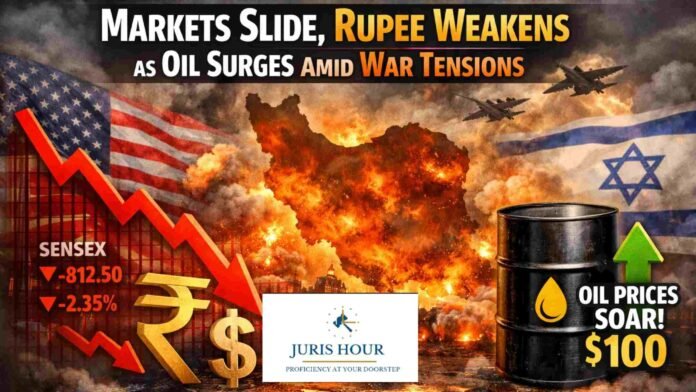
Indian equity benchmarks opened sharply lower on Monday, while the rupee weakened to a one-month low, as investors reacted to a dramatic escalation in West Asia. The United States and Israel reportedly carried out coordinated strikes on Iran, triggering retaliatory actions across multiple countries and injecting fresh uncertainty into global markets. With tensions rising around the Strait of Hormuz — a vital artery for global oil shipments — crude prices have emerged as the central risk factor for India’s macroeconomic stability and near-term market direction.
Table of Contents
Oil Shock Takes Centre Stage
Brent crude futures climbed nearly 6% in the first trading session following the strikes, touching $77 per barrel. Investment banks swiftly recalibrated their projections. Goldman Sachs indicated that oil prices already incorporate a substantial geopolitical risk premium, estimating roughly $18 per barrel embedded in current levels. The firm cautioned that if half of the oil flows through the Strait of Hormuz were disrupted for a month, the risk premium could moderate to around $4 per barrel over time, depending on supply adjustments.
Citi analysts projected that Brent could trade in the $80–$90 range in the immediate term, though they also noted that prices might retreat toward $70 if tensions de-escalate. The trajectory of crude prices is now widely seen as the decisive variable for emerging markets such as India, which relies heavily on imported energy.
Markets React: Sensex, Nifty and Rupee Under Pressure
Domestic equities reflected the heightened anxiety. The Sensex dropped about 900 points in early trade, while the Nifty slipped 1% to hover around the 24,900 mark. Banking stocks, automobile manufacturers and oil marketing companies (OMCs) led the declines.
The rupee weakened by 0.3% to 91.2350 against the US dollar, its lowest level since early February, as investors factored in higher oil import bills and potential pressure on India’s current account.
Dr. V.K. Vijayakumar, Chief Investment Strategist at Geojit Investments, noted that the energy risk stemming from rising crude prices represents the most immediate concern for markets. According to him, a sharp surge of 20% or more in crude is likely only if the Strait of Hormuz is formally closed, which has not yet been confirmed. If Brent stabilises around the mid-$70s, equity markets may remain subdued but are unlikely to experience a severe collapse.
He advised investors against panic selling, pointing to historical precedents such as the Covid-19 crisis, the Russia-Ukraine conflict and the Gaza hostilities, where markets eventually recovered within months. Periods of weakness, he suggested, could provide opportunities to gradually accumulate quality stocks in domestic consumption themes including banking, automobiles, capital goods and defence.
How Long Will the Conflict Last?
Market consensus appears to lean toward a relatively brief episode of hostilities. Seshadri Sen of Emkay Global expects tensions to ease within one to two weeks, potentially paving the way for a sharp rebound similar to recoveries seen in previous geopolitical shocks.
However, he warned that a prolonged conflict would materially alter the macro outlook. His base case anticipates the Nifty testing the 24,500–25,000 range, with downside risks if hostilities extend beyond a fortnight.
The economic arithmetic is stark. Analysts estimate that every $10 increase in crude oil prices could widen India’s current account deficit by approximately 0.5% of GDP. Higher oil prices also tend to weaken the rupee and feed into domestic inflation, complicating monetary policy.
Sectoral Impact: Clear Winners and Losers
The geopolitical flare-up has created a sharply divided market landscape.
Beneficiaries
Upstream oil producers such as ONGC and Oil India stand to benefit directly from elevated crude prices. According to JM Financial, every $1 increase in Brent can lift their earnings per share by 1.5% to 2%. Moreover, earlier pricing caps on realisations at $75 per barrel are no longer viewed as binding constraints.
Defence companies including Bharat Electronics (BEL), Hindustan Aeronautics (HAL) and Data Patterns are also seen as potential gainers amid expectations of sustained or higher defence spending. Brokerage assessments highlight that India’s defence expenditure has already recorded robust growth and may continue to expand in response to regional security risks.
Sectors Under Strain
Oil marketing companies face immediate margin compression. JM Financial estimates that each $1 rise in Brent reduces auto-fuel marketing margins by roughly Rs 0.55 per litre and cuts consolidated EBITDA by 7% to 9%.
Airlines, particularly IndiGo, are exposed to the dual impact of rising aviation turbine fuel costs and possible route disruptions or cancellations. Engineering and infrastructure firms with significant Middle East exposure — including Larsen & Toubro (L&T), KEC International and Kalpataru Projects — may face risks if the conflict persists. The Middle East accounts for a substantial portion of their order books.
Export-oriented companies such as Cummins India, Thermax and AIA Engineering could also encounter headwinds if regional trade flows are affected.
Broader Economic Stakes
India’s economic ties with the Middle East heighten its vulnerability to sustained unrest. The region absorbs roughly 17% of India’s exports, supplies more than half of its crude oil imports, and accounts for nearly 38% of worker remittances. Any extended disruption could therefore impact trade balances, currency stability and household income flows.
Jefferies cautioned that a prolonged conflict coupled with persistently high oil prices would pose a significant macroeconomic challenge. Nevertheless, the brokerage noted that previous regional flare-ups have tended to be temporary, and sharp corrections have often created selective buying opportunities.
Investment Strategy: Where to Seek Shelter?
In the current environment, market participants are reassessing allocations. Emkay Global’s preferred defensive positioning includes upstream energy names such as ONGC and Oil India, metal producers like Hindalco, information technology companies such as Infosys and HCL Tech — which may benefit from rupee depreciation — and pharmaceutical firms traditionally viewed as defensive plays.
Private sector banks with attractive valuations are also being considered as relatively resilient options in a volatile market.
The Road Ahead
The immediate direction of Indian markets hinges on how the situation evolves over the next 48 hours. If retaliatory actions escalate further or if oil flows through the Strait of Hormuz are materially disrupted, markets may face deeper corrections. Conversely, signs of de-escalation could quickly restore risk appetite.
For now, crude oil remains the pivot around which India’s macro outlook and stock market trajectory will revolve.
Read More: What Is The Best Way To Buy Silver As An Investment? Know Comparision

