
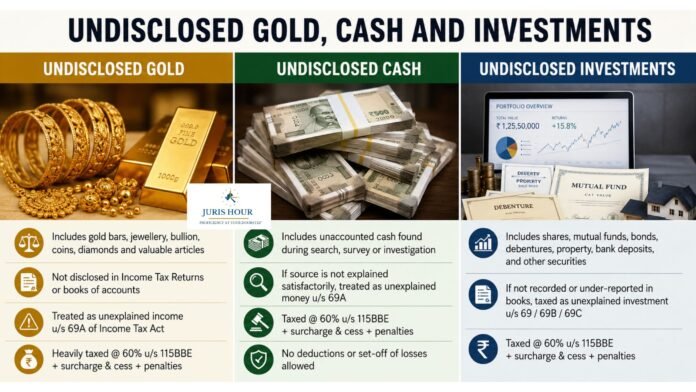
The discovery of undisclosed cash, gold, jewellery, bullion, property, or investments during an Income Tax investigation can trigger some of the harshest tax and penalty provisions under Indian law. The Income Tax Department treats unexplained assets as “deemed income” and taxes them at punitive rates under the Income-tax Act, 1961.
In recent years, the government has significantly tightened the framework dealing with black money, benami holdings, unaccounted wealth, and unexplained investments. Search and seizure operations, data analytics, digital surveillance, bank reporting systems, and cross-verification of financial transactions have increased scrutiny on high-value assets.
The law today not only imposes heavy taxes on undisclosed assets but also penalties, interest, prosecution risks, and confiscation exposure in certain situations.
What Counts as Undisclosed Gold, Cash or Investments?
Undisclosed assets generally refer to money or valuables for which a taxpayer cannot satisfactorily explain the source.
These may include:
- Unaccounted cash found during raids
- Gold bars, jewellery, bullion or diamonds without proper source explanation
- Investments not recorded in books
- Property purchased through unaccounted income
- Shares, mutual funds or securities acquired from undisclosed funds
- Bank deposits without source evidence
- Foreign assets not disclosed in income tax returns
- Excess stock or investments discovered during surveys or searches
The Income Tax Act contains special provisions dealing with unexplained assets under Sections 68, 69, 69A, 69B, 69C and 69D.
Difference Between Sections 69, 69A and 69B
The law classifies unexplained assets differently depending on the nature of the default.
Section 69 – Unexplained Investments
This applies when a taxpayer has made investments not recorded in books of accounts and cannot explain the source satisfactorily.
Example:
- Purchase of land using unaccounted money
- Investments in shares or bonds outside disclosed income
Section 69A – Unexplained Money, Gold, Jewellery or Bullion
This provision applies when money, bullion, gold, jewellery or valuable articles are found in possession of a person and no proper explanation is available regarding ownership or source.
This is the most commonly invoked section in cash and gold seizure cases.
Section 69B – Investments Not Fully Disclosed
This applies when authorities find that the actual investment value is higher than what was recorded in books.
Example:
- A property purchased for ₹2 crore but only ₹1 crore disclosed in records
- Under-reporting of jewellery purchases
How Search and Seizure Operations Work
Under Section 132 of the Income-tax Act, authorised officers can conduct searches if they believe a person possesses undisclosed income or assets. Officers can enter premises, inspect lockers, search vehicles, seize cash, gold, jewellery and documents, and examine persons on oath.
The department may presume that assets found during a search belong to the person from whose possession they are recovered unless proven otherwise.
Searches are commonly triggered by:
- Intelligence inputs
- Suspicious bank transactions
- Property purchases inconsistent with income
- GST or customs data
- Hawala trails
- High cash deposits
- Information from other agencies
Tax Rate on Undisclosed Income Under Section 115BBE
One of the harshest consequences comes from Section 115BBE.
Income treated as unexplained under Sections 68 to 69D is taxed at a flat 60% rate. On top of this, surcharge and cess apply, increasing the effective burden substantially.
The effective taxation generally works out to approximately:
- 60% tax
- 25% surcharge on tax
- 4% health and education cess
This pushes the effective tax liability to nearly 78% of the unexplained amount.
No Deductions or Loss Set-Off Allowed
A major consequence of Section 115BBE is that taxpayers cannot:
- Claim deductions
- Adjust business losses
- Set off carried-forward losses
- Use depreciation benefits
against such unexplained income.
This makes the tax burden extremely severe.
Penalty Under Section 271AAC
Apart from the tax itself, the Income Tax Department can levy an additional penalty under Section 271AAC.
This penalty is generally 10% of the tax payable under Section 115BBE.
In practical terms:
- Tax burden ≈ 78%
- Additional penalty ≈ 7.8%
Thus, total outgo can exceed 85% of the unexplained amount before considering interest.
Penalty for Under-Reporting and Misreporting
Where authorities conclude that the taxpayer deliberately concealed or misreported income, Section 270A may apply.
The penalty can be:
- 50% of tax for under-reporting
- 200% of tax for misreporting income
Misreporting includes:
- Suppression of facts
- False entries
- Fake invoices
- Bogus claims
- Unrecorded investments
However, in many unexplained income cases taxed under Section 115BBE, specific penalty provisions like Section 271AAC are often applied instead.
Special Penalties in Search Cases
When undisclosed income is found during official search operations, special penalties under Section 271AAB may apply.
The penalty rates depend on:
- Whether the taxpayer admitted undisclosed income
- Whether taxes were paid promptly
- Whether disclosure was voluntary
- The timing of the search
For searches after December 2016:
- 30% penalty may apply in certain admitted cases
- 60% penalty may apply in other cases
These are separate from normal assessment penalties.
Can Gold Jewellery Be Seized During Raids?
Yes, but CBDT guidelines provide limited protection for reasonable quantities of jewellery held for personal and customary purposes.
Generally accepted limits during search operations are:
- Married woman: up to 500 grams
- Unmarried woman: up to 250 grams
- Male member: up to 100 grams
However, these are not absolute immunity provisions. Authorities may still examine:
- Source of acquisition
- Income profile
- Family customs
- Wealth tax history
- Purchase records
If satisfactory explanation exists, jewellery may not be treated as undisclosed.
What Happens if Source of Cash or Gold Is Explained?
Not every cash or gold discovery automatically becomes black money.
If the taxpayer can produce:
- Income records
- Sale deeds
- Inheritance documents
- Gift deeds
- Agricultural income proof
- Bank withdrawal evidence
- Wealth disclosures
- Business records
the addition may be deleted or reduced.
Courts and tribunals have repeatedly held that suspicion alone is insufficient without evidence. Recent tax litigation discussions also show that unexplained cash additions can fail where documentary support exists.
Undisclosed Foreign Assets Face Even Harsher Consequences
Foreign bank accounts, overseas shares, crypto holdings, or offshore investments not disclosed in tax returns may attract action under the Black Money (Undisclosed Foreign Income and Assets) Act, 2015.
The penalties under the Black Money Act are far stricter than domestic undisclosed asset provisions and may include:
- 30% tax
- Penalty up to 90%
- Prosecution
- Imprisonment in serious cases
The Income Tax Department increasingly receives foreign financial data through international information-sharing agreements.
Benami Law Can Also Apply
If property, gold or investments are held in another person’s name while the real ownership lies elsewhere, the authorities may invoke the Prohibition of Benami Property Transactions Act.
Consequences can include:
- Confiscation of property
- Monetary penalties
- Criminal prosecution
- Imprisonment
This is separate from income tax proceedings.
Real Financial Impact of Undisclosed Wealth
The financial consequences can become devastating.
For example, if unexplained gold worth ₹1 crore is discovered:
- Tax under Section 115BBE may reach about ₹78 lakh
- Penalty may further increase liability
- Interest may apply
- Prosecution risk may arise
The taxpayer may effectively lose almost the entire value of the undisclosed asset.
Why Documentation Matters
Proper documentation is the strongest defence against unexplained income allegations.
Taxpayers should maintain:
- Purchase invoices
- Bank statements
- Gift records
- Inheritance papers
- Wealth disclosures
- Loan documentation
- Investment trail evidence
Even genuine assets can become problematic if documentary evidence is absent.
Growing Digital Surveillance by Tax Authorities
The Income Tax Department now relies heavily on:
- PAN-Aadhaar integration
- Annual Information Statements (AIS)
- Bank reporting
- Property registries
- Securities transaction data
- GST databases
- Foreign asset reporting systems
Large cash deposits, luxury purchases, high-value investments and inconsistent income declarations increasingly trigger automated scrutiny.
Digital records and electronic evidence have also become central to modern tax investigations.
Conclusion
India’s tax laws dealing with undisclosed cash, gold and investments have evolved into an aggressive anti-black-money framework. What earlier resulted in ordinary tax additions can now lead to punitive taxation exceeding 80%, multiple penalties, prosecution exposure and asset seizure risks.
Sections 69, 69A, 69B and 115BBE form the core machinery through which unexplained wealth is taxed. In serious search cases, special penalty provisions and criminal consequences may also follow.
For taxpayers, the key safeguard is transparency, proper reporting and maintaining a clear documentary trail for all major assets and investments.
Read More: ITAT Quashes Reassessment Proceedings Over Undated Reasons, Mechanical Approval U/s 151

