
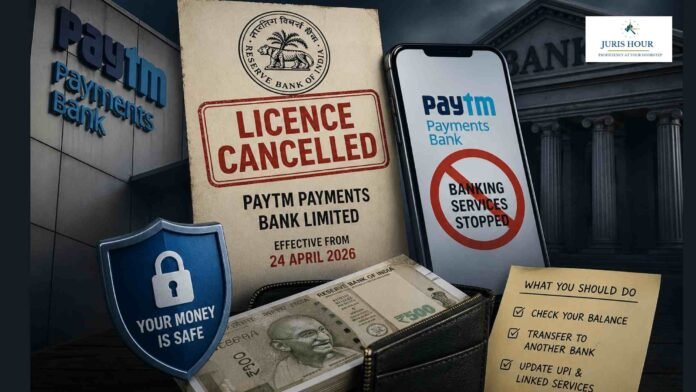
The Reserve Bank of India (RBI) has cancelled the banking licence of Paytm Payments Bank Limited (PPBL) on 24 April 2026, marking one of the most stringent regulatory actions in India’s fintech sector. The decision brings an end to the bank’s operations and initiates the process of winding up under the Banking Regulation Act, 1949. The move follows prolonged regulatory scrutiny and signals a strong enforcement stance on compliance failures.
Background and Reasons for RBI Action
The RBI’s action is the culmination of a series of regulatory interventions over the past few years. Concerns were repeatedly raised regarding deficiencies in Know Your Customer (KYC) compliance, customer due diligence, and technology systems. The regulator also flagged governance issues and irregularities in fund flows.
Earlier restrictions had already been imposed on the bank. In 2022, onboarding of new customers was halted. Subsequently, in January 2024, the RBI directed the bank to stop accepting fresh deposits, wallet top-ups, and credit transactions. By the time the licence was cancelled in April 2026, the bank was effectively operating in a restricted mode, with limited functionality. The RBI concluded that continued operations were not in the interest of depositors or the financial system.
Legal Consequences of Licence Cancellation
With the cancellation of its licence, Paytm Payments Bank can no longer carry out banking activities. The RBI is expected to move the appropriate High Court for formal winding-up proceedings. Once initiated, the bank will cease to exist as a functional banking institution and will operate only for the purpose of settling liabilities and returning customer funds.
Impact on Customers: What Happens to Your Money
A key concern for customers is the safety of their deposits. In this case, regulatory assurance indicates that depositors’ funds are protected. The bank has sufficient liquidity to repay its customers, and deposits are expected to be returned in full during the winding-up process.
Customers can withdraw or transfer their existing balances. However, accounts will not remain operational indefinitely. As the bank proceeds toward closure, savings accounts, wallets, and associated services will be discontinued. It is therefore advisable for customers to move their funds to another bank without delay.
Status of Deposits and Transactions
The ability to make fresh deposits or carry out credit transactions had already been curtailed since early 2024. Following the licence cancellation, no new banking activity is permitted. Only withdrawal or transfer of existing balances is allowed as part of the settlement process.
This effectively means that while customers retain access to their existing funds for withdrawal, the account cannot be used for regular banking purposes.
Effect on Paytm App, UPI, and Digital Services
The cancellation applies specifically to Paytm Payments Bank and not to the broader Paytm ecosystem operated by One97 Communications Limited. The Paytm mobile application continues to function.
Digital payment services such as UPI transactions, bill payments, and merchant payments remain operational. These services are now routed through partner banks instead of Paytm Payments Bank. However, banking services directly linked to PPBL, including savings accounts, wallets tied to the bank, and FASTag services issued by it, will be phased out.
Buy Now: GST E-Magazine Mega Combo (11 Publications)
Steps Customers Should Take
Customers holding accounts with Paytm Payments Bank should take immediate steps to safeguard seamless financial operations. This includes checking account balances, transferring funds to another bank account, and updating UPI IDs linked to PPBL with alternative banks.
Users should also review any services such as FASTag or wallet balances associated with the bank and migrate them to other providers where necessary.
Impact on Paytm as a Company
The regulatory action is limited to the banking arm and does not shut down Paytm as a company. One97 Communications Limited continues its operations in the digital payments space. The company has already been transitioning its services to partner banks, thereby reducing dependence on its payments bank subsidiary.
Conclusion
The cancellation of Paytm Payments Bank’s licence represents a decisive regulatory intervention aimed at protecting depositors and maintaining financial discipline. While the bank will cease operations, customer funds remain secure and accessible for withdrawal.
For account holders, the immediate priority is to transfer funds and shift banking relationships. The broader Paytm ecosystem continues to operate, but without its own banking entity.

