
As the filing season for Assessment Year 2026–27 approaches, many taxpayers are evaluating their income for Financial Year 2025–26 (1 April 2025 to 31 March 2026). For a significant number of individuals, taxable income may fall below the threshold due to deductions, rebates under Section 87A, or relatively lower earnings from freelancing, part-time work, or investment income such as dividends.
This often leads to a common question—if no income tax is payable, is it still necessary to file an Income Tax Return (ITR)? While it may appear optional at first glance, the answer in most practical scenarios is yes. Filing a nil ITR is not merely a compliance exercise; it is a prudent financial decision with long-term benefits.
Filing ITR: More Than Just Paying Taxes
Income tax filing is not limited to discharging tax liability. It serves as an official record of your annual income declared before the Income Tax Department. Even where the tax payable is zero, filing an ITR ensures that your financial records remain transparent, traceable, and formally documented.
With increasing digitisation and the integration of advanced data analytics systems such as the Annual Information Statement (AIS) and Taxpayer Information Summary (TIS), the tax department now tracks a wide range of financial activities. These include high-value transactions, bank interest accruals, securities trading data, dividend income, TDS entries, and other financial movements.
In such a data-driven environment, filing an ITR—even with zero tax liability—helps align your declared income with the department’s records. This reduces the likelihood of discrepancies, automated alerts, or scrutiny notices in the future.
Key Reasons Why Filing a Nil ITR is Beneficial
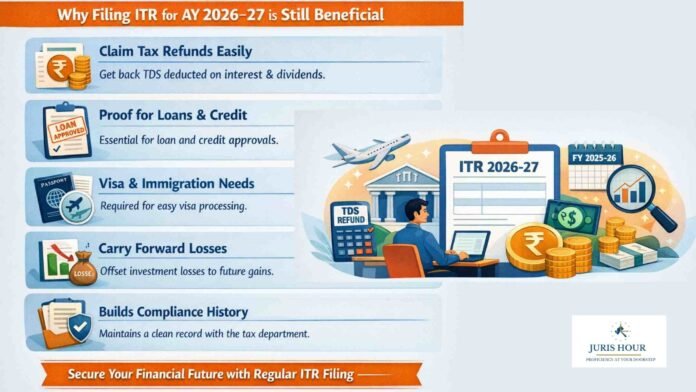
- Enables Smooth Claim of Tax Refunds
Even where your total income is below the taxable limit, tax may still be deducted at source on interest income, freelance payments, fixed deposits, or dividends. Filing an ITR is the only legitimate way to claim a refund of such excess TDS. Without filing, recovering these amounts is not possible.
- Acts as Proof of Income for Loans and Credit Facilities
Financial institutions commonly require ITRs as proof of income when processing loan or credit card applications. A consistently filed nil return can support your financial profile, particularly if your income is irregular. Combined with a strong credit score and repayment history, it enhances your eligibility for loans and other credit facilities.
- Supports Visa and Immigration Applications
Many countries, including the United States, the United Kingdom, and Canada, require ITR records for the past three to five years as part of visa processing. These records help assess financial stability and credibility. Filing ITRs regularly—even with zero tax liability—ensures you are prepared for such requirements without last-minute complications.
- Allows Carry Forward of Losses
If you incur losses in equities, mutual funds, or business activities during the financial year, filing an ITR becomes essential—even if overall income is nil. This is because only a filed return allows you to carry forward such losses and set them off against future income, thereby reducing tax liability in subsequent years.
- Builds a Strong Compliance Track Record
Regular filing of ITRs establishes a consistent compliance history with tax authorities. This becomes particularly valuable in avoiding unnecessary scrutiny or complications arising from minor mismatches in AIS/TIS data or high-value transactions. A clean filing record enhances credibility and reduces the risk of future disputes.
A Small Step with Long-Term Advantages
Filing an ITR despite having zero tax liability may seem like a minor administrative task, but its implications are far-reaching. It strengthens financial documentation, ensures compliance with evolving tax systems, and supports future financial planning—whether it involves loans, investments, or international travel.
In today’s increasingly data-driven tax ecosystem, a nil ITR is not just optional paperwork; it is a strategic financial tool that safeguards your interests and builds long-term credibility.

