
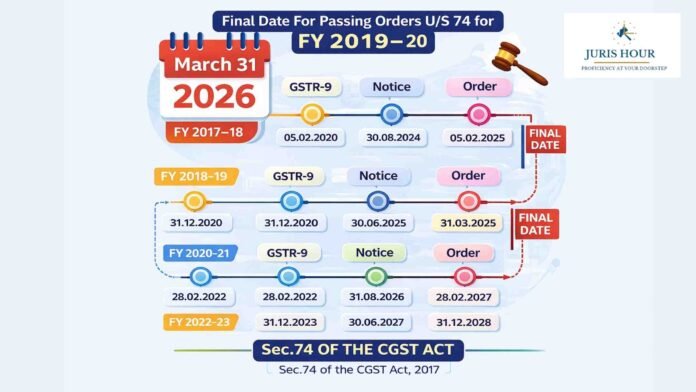
Tax authorities have set March 31, 2026 as the last date for passing orders under Section 74 of the CGST Act for the financial year 2019–20, marking a crucial compliance deadline for taxpayers and businesses across India.
Section 74 of the Central Goods and Services Tax (CGST) Act, 2017 deals with cases involving tax not paid or short paid due to fraud, willful misstatement, or suppression of facts. As per the statutory timelines, authorities are required to complete adjudication proceedings within a prescribed period from the issuance of notice.
For FY 2019–20, notices under this section were issued with deadlines extending into 2025. Consequently, the law mandates that final orders must be passed within six months from the due date of notice completion—placing the cutoff on March 31, 2026.
Businesses that have received notices for FY 2019–20 must ensure timely responses and submissions.
Any pending proceedings are expected to be concluded by the tax department before the deadline.
Failure to resolve disputes before this date may lead to ex-parte decisions or enforcement actions.
Tax experts advise businesses to review their GST records, reconcile discrepancies, and engage with authorities proactively to avoid penalties and litigation risks.
With the deadline approaching, the focus now shifts to both taxpayers and the GST department to ensure closure of long-pending cases within the legal timeframe.
The March 31, 2026 deadline serves as a significant milestone in GST compliance, reinforcing the importance of timely adjudication and resolution of tax disputes under Section 74.
Read More: GST Action Plan for Year-End and Beginning of New FY 2026–27

