
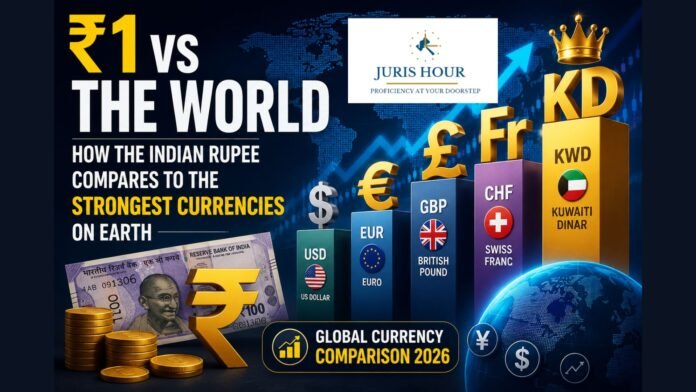
Currencies are a reflection of a country’s economic strength, monetary policy, trade balance, inflation levels, and investor confidence. While many people assume that the U.S. Dollar is the strongest currency in the world, several currencies actually have a higher exchange value than the dollar. At the same time, a currency’s exchange rate alone does not determine the economic strength of a nation.
India, the world’s fifth-largest economy by nominal GDP, uses the Indian Rupee (INR) as its official currency. Despite India’s rapid economic growth, the rupee remains weaker in nominal value compared to many major international currencies. Understanding these differences provides valuable insight into global economic dynamics.
Global Currency Comparison Chart (2026)
The following table compares some of the world’s strongest and most influential currencies against the Indian Rupee.
| Rank | Currency | Code | Approx. Value vs USD | Approx. Value vs INR |
| 1 | Kuwaiti Dinar | KWD | $3.25 | ₹310+ |
| 2 | Bahraini Dinar | BHD | $2.66 | ₹250+ |
| 3 | Omani Rial | OMR | $2.60 | ₹245+ |
| 4 | Jordanian Dinar | JOD | $1.41 | ₹135+ |
| 5 | British Pound Sterling | GBP | $1.35 | ₹129+ |
| 6 | Swiss Franc | CHF | $1.27 | ₹121+ |
| 7 | Cayman Islands Dollar | KYD | $1.20 | ₹114+ |
| 8 | Euro | EUR | $1.17 | ₹111+ |
| 9 | U.S. Dollar | USD | $1.00 | ₹95-96 |
| 10 | Singapore Dollar | SGD | $0.78 | ₹75+ |
(Source: Global currency exchange data and international currency rankings as of 2026.)
Visual Comparison: Value Against the Indian Rupee
Why Are Some Currencies Worth More Than the Rupee?
1. Oil Wealth and Export Surpluses
The Kuwaiti Dinar, Bahraini Dinar, and Omani Rial dominate global currency rankings primarily because their economies benefit from substantial oil and gas exports. Large foreign currency inflows support the value of these currencies.
2. Strong Monetary Management
Countries such as Switzerland and Singapore maintain disciplined monetary policies, low inflation, and strong foreign reserves. This enhances investor confidence and supports currency stability.
3. Reserve Currency Status
The U.S. Dollar remains the world’s most important reserve currency despite not being the highest-valued currency. Most international trade, commodity transactions, and central bank reserves are denominated in dollars. As a result, the dollar enjoys unparalleled global demand.
4. Economic Stability and Investor Confidence
Currencies such as the British Pound and Euro derive strength from large, diversified economies, developed financial markets, and strong institutional frameworks.
How Does the Indian Rupee Compare?
As of June 2026, one U.S. Dollar is worth approximately ₹95-96. The rupee has experienced pressure due to rising energy prices, global geopolitical tensions, and India’s dependence on imported crude oil.
However, a lower exchange rate does not necessarily indicate economic weakness. India’s economy possesses several strengths:
- One of the fastest-growing major economies.
- A population exceeding 1.4 billion people.
- Strong growth in digital payments and technology sectors.
- Expanding manufacturing and services exports.
- Significant foreign exchange reserves.
In fact, many export-oriented economies intentionally avoid excessively strong currencies because weaker currencies can make exports more competitive globally.
Strongest Currency vs Most Powerful Currency
A common misconception is that the “strongest” currency is also the “most powerful.”
| Category | Currency |
| Highest-Valued Currency | Kuwaiti Dinar |
| Most Traded Currency | U.S. Dollar |
| Largest Reserve Currency | U.S. Dollar |
| Most Used International Currency | U.S. Dollar |
| Most Widely Used Emerging Market Currency | Indian Rupee (among South Asia’s largest economies) |
Economists often distinguish between a currency’s exchange value and its global influence. The Kuwaiti Dinar may be worth more per unit, but the U.S. Dollar remains the dominant force in global finance.
Also Read : How to Invest in US Stocks from India?
Why Has the Rupee Depreciated Over Time?
Several factors have contributed to the rupee’s long-term depreciation:
Import Dependence
India imports large quantities of crude oil, electronics, and industrial machinery, increasing demand for foreign currencies.
Inflation Differential
Historically, India’s inflation rate has been higher than that of many developed economies, gradually reducing the rupee’s purchasing power.
Trade Deficit
India generally imports more goods than it exports, creating sustained demand for dollars and other foreign currencies.
Global Market Movements
When investors seek safe-haven assets during periods of uncertainty, capital often flows into the U.S. Dollar and Swiss Franc, placing pressure on emerging-market currencies including the rupee.
Can the Indian Rupee Become Stronger?
The rupee could appreciate if India:
- Increases exports significantly.
- Reduces dependence on imported energy.
- Attracts larger foreign investments.
- Maintains low inflation.
- Expands the use of rupee-based international trade settlements.
India has already taken steps to promote international trade settlement in rupees and reduce dependence on foreign currencies for bilateral trade.
Conclusion
While the Indian Rupee is not among the world’s highest-valued currencies, exchange-rate value alone does not determine economic strength. The world’s strongest currencies by nominal value remain the Kuwaiti Dinar, Bahraini Dinar, and Omani Rial. Meanwhile, the U.S. Dollar continues to dominate international trade and finance.
India‘s growing economic influence, expanding digital economy, and rising global trade participation make the rupee one of the most important emerging-market currencies. The future trajectory of the rupee will depend on India’s ability to sustain high growth, control inflation, boost exports, and strengthen its position in the global economy.
Read More: Agricultural Activities Can’t Be Artificially Taxed Under Multiple Service Categories: CESTAT

