
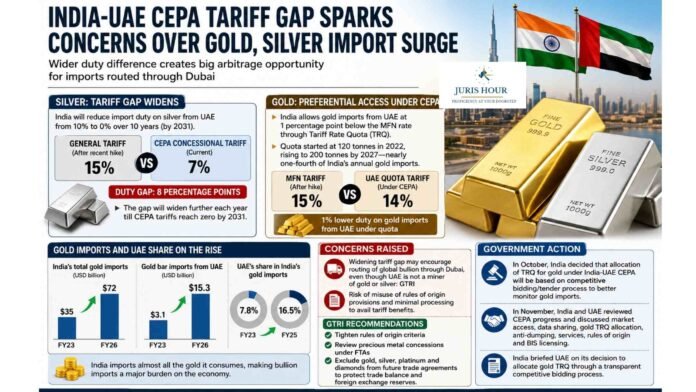
India’s decision to raise customs duties on precious metals has intensified concerns over the growing use of the India–United Arab Emirates Comprehensive Economic Partnership Agreement (CEPA) as a route for lower-duty imports of gold and silver through the United Arab Emirates.
Trade analysts and policy experts warn that the widening gap between India’s standard import duties and the concessional rates available under CEPA could significantly boost bullion inflows via Dubai, putting additional pressure on India’s trade deficit and foreign exchange reserves.
Silver Imports Gain a Significant Cost Advantage
Under the India-UAE CEPA, India agreed to gradually reduce customs duty on silver imports from the UAE from 10 per cent to zero over a 10-year period ending in 2031.
At present, silver imported from the UAE attracts a concessional duty of 7 per cent. Following India’s recent increase in the general customs duty on silver to 15 per cent, the differential between the standard tariff and the CEPA rate has widened to 8 percentage points.
This difference creates a substantial cost advantage for importers sourcing silver through Dubai rather than directly from global suppliers. The margin is expected to increase further each year as CEPA duty rates continue to decline toward zero.
Preferential Gold Imports Under Tariff Rate Quota
Gold imports from the UAE also benefit under CEPA through a Tariff Rate Quota (TRQ) mechanism.
When the agreement came into force in 2022, India permitted imports of up to 120 tonnes of gold annually from the UAE at a duty rate one percentage point lower than the normal Most Favoured Nation (MFN) rate. The quota is scheduled to rise to 200 tonnes by 2027, accounting for nearly one-fourth of India’s annual gold imports.
With India’s revised tariff structure, gold imported under the regular MFN route now attracts an effective duty of 15 per cent, while gold imported under the UAE quota continues to enjoy a concessional rate of 14 per cent.
Gold Imports Double in Three Years
India, which imports nearly all of the gold it consumes, has witnessed a sharp rise in bullion imports in recent years.
According to the Global Trade Research Initiative (GTRI):
- India’s total gold imports increased from USD 35 billion in FY23 to USD 72 billion in FY26.
- Gold bar imports from the UAE surged from USD 3.1 billion to USD 15.3 billion during the same period.
- The UAE’s share in India’s gold imports rose from 7.8 per cent in FY23 to 16.5 per cent in FY25.
These figures suggest that the CEPA concessions have played a significant role in redirecting global bullion trade through Dubai.
GTRI Flags Potential Misuse of Rules of Origin
GTRI has urged the Government of India to reassess tariff concessions granted to precious metals under free trade agreements.
According to Ajay Srivastava, the growing tariff differential may incentivise traders to route gold and silver through Dubai, even though the UAE is not a major producer of either metal.
The think tank also cautioned against potential misuse of Rules of Origin provisions, where minimal processing in the UAE could be used to qualify bullion for concessional tariff treatment.
Recommendations to the Government
GTRI has recommended several policy measures, including:
- Tightening Rules of Origin criteria.
- Reviewing precious metal concessions under existing FTAs.
- Excluding gold, silver, platinum and diamonds from future trade agreements.
According to the organisation, these measures are necessary to safeguard India’s trade balance and conserve foreign exchange reserves.
Government Introduces Competitive Bidding for Gold TRQ
To improve oversight, India decided in October to allocate the CEPA gold TRQ through a transparent competitive bidding and tender process.
During a comprehensive review of the CEPA held in November last year, officials from India and the UAE discussed a range of issues, including:
- Market access concerns.
- Data sharing mechanisms.
- Allocation of gold TRQ.
- Anti-dumping matters.
- Services trade.
- Rules of Origin.
- Bureau of Indian Standards (BIS) licensing.
The Indian side also informed the UAE about the decision to allocate gold TRQ through competitive bidding to enhance transparency and monitoring.

