
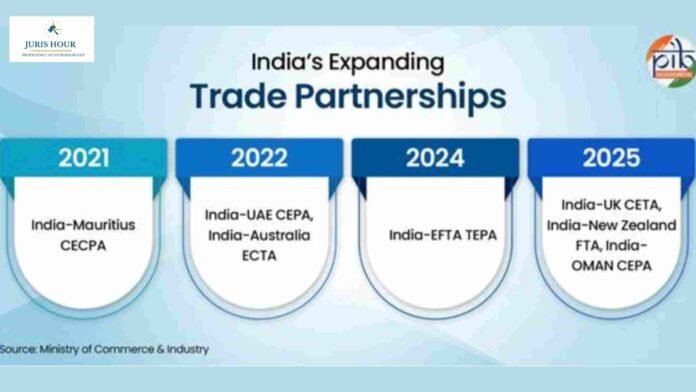
India’s global trade strategy has entered a decisive new phase in 2026, with a series of high-impact Free Trade Agreements (FTAs) and Comprehensive Economic Partnership Agreements (CEPAs) reinforcing the country’s ambition of emerging as a developed economy under the Viksit Bharat vision.
Backed by robust export performance, resilient services trade, and a rapidly expanding network of trade partnerships, India is not only widening its footprint in global commerce but also reshaping its trade architecture to withstand emerging geopolitical and tariff uncertainties.
Table of Contents
Rising Share and Diversified Partnerships
Over the past decade, India has significantly deepened its integration with global markets. According to UNCTAD’s Trade and Development Report 2025, India ranks third among Global South economies in terms of the diversity of its trade partnerships. Notably, its diversity index score surpasses that of all countries in the Global North, underscoring the breadth and resilience of its trade ecosystem.
The diversification of trade partners has strengthened India’s ability to navigate supply-chain disruptions, tariff volatility, and shifting global demand patterns. This strategic outreach reflects a calibrated approach aimed at expanding export markets while safeguarding domestic priorities.
India-EU FTA: A Landmark Economic Milestone
In January 2026, India and the European Union concluded negotiations on a long-pending Free Trade Agreement, widely described as one of India’s most consequential trade deals.
Structured as a modern, rules-based framework, the agreement addresses contemporary global economic challenges while enabling deeper integration between two major economies.
Under the pact:
- 97% of EU tariff lines, representing 99.5% of trade value, will offer preferential access to Indian goods.
- 70.4% of tariff lines, accounting for over 90% of India’s exports, will see immediate duty elimination.
- Additional tariff lines will move to zero duty over three to five years, while select products will receive preferential access through tariff reductions or tariff-rate quotas.
Labour-intensive sectors such as textiles, apparel, leather, marine products, gems and jewellery, sports goods, and processed foods are expected to witness significant gains. Exports from these sectors already exceed ₹2.87 lakh crore (around USD 33 billion) and are projected to grow further with zero-duty access.
On the services front, the EU has made commitments across 144 subsectors, including IT, professional services, education, and business services—providing Indian firms a stable and predictable export environment.
Sensitive agricultural sectors such as dairy, meat, poultry, and cereals remain protected under carefully calibrated liberalisation provisions.
Expanding Trade Footprint: UK, Oman and New Zealand
In FY 2025–26, India further broadened its trade outreach by concluding agreements with the United Kingdom, Oman, and New Zealand.
India-UK Comprehensive Economic and Trade Agreement (CETA)
Signed in 2025, the India-UK CETA is expected to double bilateral trade, currently valued at USD 56 billion, by 2030.
Nearly 99% of India’s exports to the UK will enjoy duty-free access. Key beneficiaries include textiles, leather, engineering goods, marine products, chemicals, and auto components.
A major breakthrough includes eased mobility provisions for Indian professionals in IT, healthcare, finance, and education. Additionally, the Double Contribution Convention eliminates dual social security payments, generating estimated savings of over ₹4,000 crore for Indian companies and professionals.
Agricultural and processed food exports to the UK are projected to grow by more than 50% over the next three years.
India-Oman CEPA
Signed in December 2025, the Comprehensive Economic Partnership Agreement with Oman grants zero-duty access on 98% of Oman’s tariff lines, covering over 99% of India’s exports by value.
The pact opens new opportunities for agriculture, textiles, engineering goods, pharmaceuticals, and MSMEs. It also marks the first time a partner country has extended structured commitments on traditional medicine across all modes of supply, providing a boost to India’s AYUSH and wellness sectors.
Oman has also extended commitments for temporary mobility under key Mode 4 categories, facilitating entry of professionals and business visitors.
India-New Zealand FTA
Concluded in 2025, the agreement eliminates duties on 100% of tariff lines for Indian exports from the date of implementation.
The pact is backed by an investment commitment of USD 20 billion over 15 years and includes an Agricultural Productivity Partnership aimed at strengthening farmers’ integration into global value chains.
It also opens avenues for Indian skilled professionals in IT, engineering, healthcare, education, construction, as well as services such as yoga instruction and culinary arts.
EFTA Agreement Brings Investment-Linked Commitments
The Trade and Economic Partnership Agreement (TEPA) with the European Free Trade Association (EFTA), effective from October 2025, represents India’s first FTA to incorporate direct investment commitments.
EFTA nations have pledged to facilitate USD 100 billion in FDI over 15 years, expected to generate one million direct jobs in India. The agreement ensures that investments are long-term and productive, excluding foreign portfolio investment.
Market access covers 92.2% of tariff lines, accounting for 99.6% of India’s exports, including full coverage for non-agricultural products.
Momentum from Existing Agreements
Earlier agreements continue to deliver measurable gains:
- India-UAE CEPA (2022): Bilateral trade crossed USD 100 billion in FY 2024-25. Non-oil exports grew sharply, with smartphones, electrical machinery, chemicals, and engineering goods emerging as top performers.
- India-Australia ECTA: Indian exports to Australia rose 8% in FY 2024-25. From January 2026, zero-duty access now extends across 100% of Australian tariff lines.
- India-Mauritius CECPA: Provides preferential access for over 300 Indian export products and opens 115 services subsectors.
Domestic Policy Support Strengthens Export Ecosystem
Trade expansion is being reinforced by domestic reforms aimed at enhancing export competitiveness.
Key measures include:
- A digital Tariff Explorer on the Trade Connect platform.
- Launch of the Export Promotion Mission (EPM).
- Credit Guarantee Scheme for Exporters to ensure liquidity.
- RBI’s extension of export credit tenor up to 450 days.
- Extension of export realisation period from nine to fifteen months.
- Removal of the ₹10 lakh cap on courier exports in Union Budget 2026–27.
- Duty-free imports of inputs for leather, synthetic footwear, and seafood exports.
- Factory-to-ship clearance for electronically sealed export cargo.
Together, these steps aim to improve logistics efficiency, reduce compliance costs, and provide working capital flexibility.
Expanding Negotiation Agenda
India’s trade engagement continues to widen with ongoing negotiations involving:
- A framework understanding with the United States for an Interim Trade Agreement.
- Formal launch of India-GCC FTA negotiations in February 2026.
- Progress on India-Israel FTA talks covering fintech, AI, quantum computing, pharmaceuticals, defence, and space.
- Ongoing discussions with Canada for a Comprehensive Economic Partnership Agreement.
- Engagements with Mexico and review discussions under the ASEAN-India Trade in Goods Agreement.
A Strategic Shift in Global Trade Positioning
The breadth of concluded agreements and active negotiations signals a structural transformation in India’s trade diplomacy. Rather than relying on limited bilateral arrangements, India is building a diversified and resilient network of modern trade partnerships aligned with global supply chains.
With expanded market access, strengthened services commitments, investment-linked trade deals, and robust domestic support mechanisms, India is positioning itself as a central player in evolving global trade architectures.
As 2026 unfolds, the country’s trade strategy reflects not just expansion—but consolidation of its role as a trusted, dynamic, and growth-oriented global partner, advancing sustainable development and shared prosperity.

