
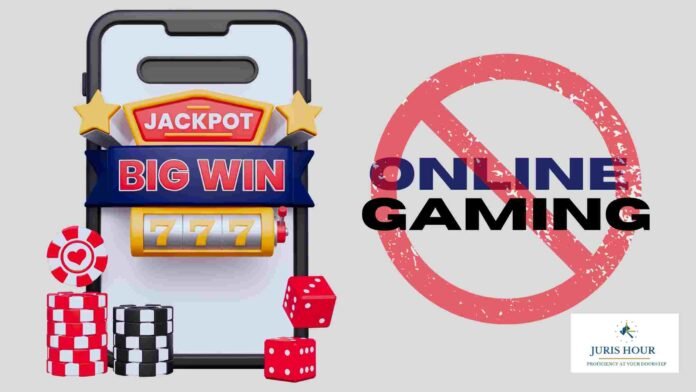
When Parliament enacted the Promotion and Regulation of Online Gaming Act, 2025, it did far more than introduce a new compliance regime—it fundamentally altered the course of one of India’s most dynamic digital sectors. By imposing a nationwide prohibition on real-money online gaming, the legislation dismantled a business model that had powered explosive growth, deep venture capital inflows, and large-scale employment over the past decade.
What had emerged as one of India’s rare consumer internet success stories—homegrown gaming platforms attracting tens of millions of users and billions of dollars in investment—found itself abruptly illegal overnight.
An Industry Comes to a Halt
The immediate fallout was swift and severe. Fantasy sports, online poker, rummy, and cash-prize casual games, which had formed the backbone of the sector’s revenues, were effectively shut down.
- Dream Sports, operator of Dream11 and the country’s largest fantasy sports platform, announced the closure of its real-money operations, asking users to withdraw balances as entry fees and prize pools vanished.
- Mobile Premier League (MPL) suspended all paid contests.
- Casual gaming platforms such as Zupee pulled the plug on cash-based formats.
- Poker and rummy operators, including Nazara Technologies-backed PokerBaazi and Rummy Circle, wound down real-money offerings.
The economic impact was immediate. Layoffs followed, restructuring became unavoidable, and investors began reassessing India’s regulatory risk profile. A sector that had supported hundreds of thousands of direct and indirect jobs and contributed substantial tax revenues was forced into survival mode.
What the Law Allows—and What It Doesn’t
Crucially, the law stopped short of banning gaming altogether. Non-monetary games, esports, and skill-based formats without cash stakes were explicitly permitted, reflecting the government’s attempt to draw a line between digital entertainment and wagering.
That distinction has since become the industry’s lifeline.
However, regulatory ambiguity persists. While non-cash formats are allowed, companies remain uncertain whether platforms can collect money in any form—such as entry fees or subscriptions—and still offer prizes, even if positioned as skill-based or promotional. In the absence of detailed rules, many operators are proceeding cautiously, wary of enforcement action.
The Shift to Free-to-Play and Engagement Economics
With real-money gaming off the table, free-to-play models—long dominant globally but secondary in India—have moved to the forefront.
Platforms such as Zupee have retained their casual games in non-monetary formats, shifting monetisation towards advertising, brand partnerships, and retention-driven engagement strategies. As a result, the industry’s performance metrics have changed. Daily active users, time spent, and repeat engagement have replaced gross gaming revenue as the key indicators of success.
Gaming Meets Entertainment: The Rise of Micro Dramas
Perhaps the clearest illustration of how radically companies are reinventing themselves is Zupee’s entry into micro dramas—short, vertical, serialised storytelling designed for mobile consumption.
According to a RedSeer Strategy Consultants report, micro dramas are at a tipping point, expected to grow at 40–50 percent annually and reach a market size of around ₹4,000 crore by 2026.
Zupee’s newly launched Zupee Studio offers one- to three-minute episodic content across genres such as romance, crime, comedy, and fantasy. The aim is to encourage habitual viewing rather than one-off consumption.
“Micro dramas extend the same philosophy we’ve applied to gaming—building daily habits and deep engagement,” said Govind Mittal, chief spokesperson at Zupee. He noted that the format unlocks multiple monetisation avenues, including branded integrations, premium story arcs, creator-led formats, and eventually subscriptions. More broadly, it positions Zupee within a converging ecosystem of gaming, entertainment, creators, and advertisers, all competing for user attention rather than entry fees.
Overseas Bets and Infrastructure Exports
For some companies, the regulatory clampdown has accelerated international ambitions that had previously remained secondary.
WinZO, for instance, has intensified its focus on overseas markets—particularly parts of the US and Latin America—where real-money gaming is regulated rather than prohibited. However, these investments are currently in a cautious holding pattern.
“A lot of real-money gaming companies are in wait-and-watch mode post the enactment of the Promotion & Regulation of Online Gaming Act, 2025,” said Jay Sayta, a technology and gaming lawyer. “They are waiting for clarity not just on permissible formats such as social games and esports, but also on the Supreme Court’s ruling on past GST liability.”
Other firms have opted for a quieter pivot—monetising their engineering and platform capabilities. By offering SaaS-style gaming infrastructure, compliance tools, payment systems, and engagement layers to overseas operators, they are effectively selling the backbone of the global gaming industry even as the domestic market remains uncertain.
Dream Sports Repositions as a Sports Community Platform
Rather than simply replacing cash contests with free games, Dream Sports has pursued a broader transformation—recasting itself as a sports entertainment and community platform.
In place of paid fantasy leagues, users now participate in creator-led watch rooms, live predictions, polls, chats, and reaction-based interactions during matches. Monetisation flows from advertising, brand partnerships, and premium fan experiences.
“The regulation changed the format, not fan behaviour,” said Harsh Jain, co-founder and CEO of Dream11, in a recent interview. “Sport has always been social. Fans want to watch, react, discuss, and celebrate together.”
Esports Finds a Regulatory Opening
The law’s explicit exclusion of non-monetary competitive gaming has placed esports in a relatively favourable regulatory position. Sponsor-funded tournaments and professionally organised leagues are seeing renewed interest from brands, creators, and advertisers seeking compliant ways to reach India’s massive youth audience.
The underlying demand for gaming remains strong. While India has only around 10 million gaming consoles, it boasts nearly 750 million smartphones, ensuring that mobile-first gaming formats will continue to find scale.
The GST Shadow Still Looms Large
Even as companies pivot operationally, the industry remains haunted by a far larger unresolved issue—the GST dispute.
Since 2023, gaming firms have been contesting the government’s move to levy 28 percent GST on the full face value of bets, rather than on platform commissions. Tax demands running into tens of thousands of crores have been issued, creating a parallel crisis that predates the ban but remains unresolved.
The Supreme Court has reserved judgment after hearing arguments in August 2025. Until a verdict is delivered, capital allocation remains frozen, exits are delayed, and investor confidence continues to cool—even for companies that have exited real-money gaming altogether.
Legal Challenges and Market Fragmentation
Some players have chosen to contest the ban itself. A23, one of India’s largest skill-gaming platforms, has moved the Karnataka High Court, arguing that the law fails to adequately distinguish between games of skill and gambling.
At the fringes, a small number of users have migrated to overseas betting platforms such as 1xBet, often routing money through informal or mule accounts. Meanwhile, enforcement actions against illegal betting websites have intensified.
A Sector in Recalibration, Not Collapse
Six months after the law came into force, investment into Indian gaming startups has slowed, talent has dispersed into adjacent sectors, and the industry’s original growth narrative has been fundamentally rewritten.
Yet the story is not one of collapse.
Free-to-play gaming, esports, micro dramas, SaaS exports, and social watch-party experiences are emerging as the pillars of a reimagined gaming economy. The final—and most consequential—piece of the puzzle remains the GST verdict.
For founders and investors still navigating regulatory shock, the lesson is stark but familiar: in India’s digital economy, adaptability is survival. The rules may change abruptly, but the game—reshaped, redefined, and recalibrated—continues.

