
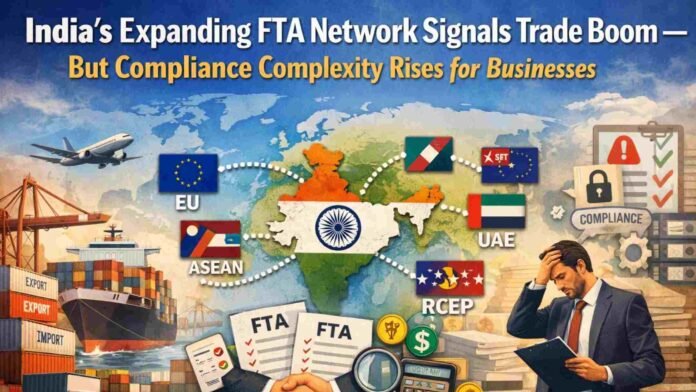
As India sharpens its trade diplomacy, a new phase of global economic integration is unfolding — one that could significantly reshape export competitiveness, supply chains and cross-border compliance strategies for Indian businesses.
India’s trade engagement has accelerated on multiple fronts. The conclusion of the India–EU Free Trade Agreement with the European Union, the revival of negotiations with the Gulf Cooperation Council, and interim trade arrangements with the United States collectively signal a decisive shift in India’s global market strategy. These developments are expected to widen market access for Indian goods and services, deepen supply-chain integration, and improve competitiveness across Europe, the Gulf region and North America.
Table of Contents
A Strategic Pivot in Trade Policy
The expanding network of Free Trade Agreements (FTAs) reflects a clear recalibration in India’s trade posture. Policymakers are now prioritising tariff rationalisation, enhanced market access, harmonised rules of origin, and the reduction of non-tariff barriers. Alongside this, investment facilitation and supply-chain resilience are emerging as central pillars of trade negotiations.
Key sectors poised to benefit include manufacturing, textiles, chemicals, engineering goods, energy and services. For export-oriented industries, these agreements are expected to lower duty burdens, improve price competitiveness, and create new production linkages across geographies.
Trade experts note that FTAs are increasingly becoming instruments of strategic economic positioning rather than mere tariff-reduction tools. By integrating more deeply with major trading blocs, India is aiming to anchor itself in global value chains while attracting investment into domestic manufacturing ecosystems.
Rising Compliance Complexity
However, the expansion of India’s FTA footprint brings with it heightened compliance obligations. Businesses must now contend with stricter origin criteria, varying Harmonised System (HS) classifications across jurisdictions, corridor-specific regulatory requirements, and extensive documentation norms.
With multiple trade agreements operating simultaneously, companies face growing operational complexity. Divergent product classifications, evolving customs procedures, and sector-specific standards demand stronger governance frameworks and real-time oversight mechanisms.
Industry observers point out that merely signing FTAs does not automatically translate into trade gains. Enterprises must possess the internal systems and capabilities to identify preferential duty opportunities, validate origin eligibility, and ensure documentation accuracy to fully realise the benefits.
Technology Takes Centre Stage
Against this backdrop, AI-enabled trade automation platforms are gaining prominence. Solutions such as EY Global Trade Automation (EY GTA) are being positioned as integrated tools to manage the entire EXIM lifecycle — from classification and origin analysis to customs validation and shipment tracking.
These platforms use artificial intelligence to assess HSN codes, analyse FTA eligibility, validate customs declarations, and flag potential compliance gaps before shipments cross borders. By identifying preferential duty opportunities upfront and reducing manual intervention, organisations can minimise litigation exposure while unlocking measurable cost savings.
Experts emphasise that proactive trade governance — powered by AI — is replacing reactive compliance models. Instead of addressing customs queries or disputes after they arise, companies are increasingly seeking systems that provide structured, audit-ready processes and real-time exception management.
Enhancing Visibility and Coordination
Beyond compliance, integration and visibility are emerging as critical differentiators. Advanced trade automation platforms offer real-time tracking of shipments, documentation and milestones across borders, creating a unified interface for internal teams and external stakeholders.
By linking supply-chain, tax, finance and logistics functions with customs brokers, freight forwarders, banks and government portals, such systems aim to reduce bottlenecks and eliminate silos. The result is faster clearances, tighter control over demurrage and detention costs, and improved working capital efficiency.
For enterprises operating across multiple jurisdictions, standardised workflows and data-driven coordination are becoming essential as trade volumes grow and regulatory expectations intensify.
From Fragmentation to Unified Trade Management
As India’s trade corridors expand, businesses are being compelled to transition from fragmented processes to unified, technology-driven trade management systems. Modular adoption models allow companies to begin with targeted interventions — such as product validation or customs clearance automation — before scaling to end-to-end digital trade management.
In a global environment marked by shifting tariff regimes, regulatory scrutiny and supply-chain realignments, technology-backed trade governance is increasingly viewed as a strategic necessity rather than an operational add-on.
With India positioning itself as a central player in global value chains, the real test now lies not just in signing agreements, but in equipping enterprises to convert policy ambition into measurable trade growth.
Read More: How Tax Practitioners Can Increase Their Network Using AI?

