
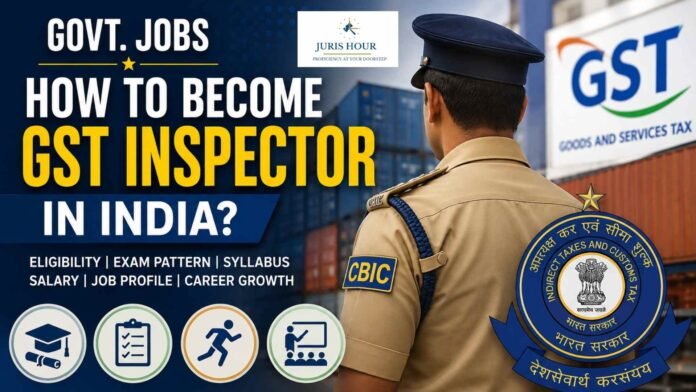
For thousands of graduates aspiring to secure a prestigious government job, the position of GST Inspector remains one of the most attractive career options in India. Working under the Central Board of Indirect Taxes and Customs (CBIC), a GST Inspector plays a crucial role in the administration and enforcement of the Goods and Services Tax regime.
The post offers a combination of field investigations, office-based tax administration, job security, attractive pay, and significant opportunities for promotion within the Department of Revenue under the Ministry of Finance.
The introduction of GST transformed India’s indirect tax structure and significantly enhanced the responsibilities of officers tasked with ensuring compliance. As a result, GST Inspectors today occupy an important position in the country’s tax administration system.
Who is a GST Inspector?
A GST Inspector is a Group ‘B’ Non-Gazetted officer working under CBIC. These officers are responsible for monitoring compliance with GST laws, scrutinizing tax returns, examining records maintained by businesses, assisting in audits and investigations, and detecting cases of tax evasion. They also participate in enforcement actions involving fake invoicing, fraudulent input tax credit claims, and other violations of indirect tax laws.
Depending upon the posting, a GST Inspector may be assigned both field duties and office responsibilities. The role often provides direct exposure to investigations, intelligence gathering, tax administration, and revenue collection.
Eligibility Criteria
The minimum educational qualification required for becoming a GST Inspector is a bachelor’s degree from a recognized university. Candidates from any stream, including commerce, science, arts, engineering, law, or management, are eligible to apply. While knowledge of taxation and finance can be advantageous, there is no requirement that an applicant possess a specialized degree in these fields.
The age limit generally prescribed for the post is between 18 and 30 years, although age relaxations are available for candidates belonging to reserved categories in accordance with Government of India rules. Candidates must also satisfy the nationality conditions specified in the SSC Combined Graduate Level Examination notification.
The SSC CGL Route to Becoming a GST Inspector
The primary route to becoming a GST Inspector is through the Staff Selection Commission Combined Graduate Level Examination, commonly known as SSC CGL. Every year, SSC conducts this nationwide competitive examination to recruit candidates for various posts in central government departments, including Inspector (CGST) under CBIC.
The examination is highly competitive, attracting lakhs of applicants from across the country. Candidates aspiring for the GST Inspector post generally need to secure a high rank because the position is considered one of the most preferred posts available through SSC CGL.
What Should You Study to Become a GST Inspector?
One of the most common misconceptions among aspirants is that they need to study GST law extensively before applying for the GST Inspector post. In reality, recruitment is conducted through the SSC Combined Graduate Level (SSC CGL) Examination, which primarily tests a candidate’s aptitude, reasoning ability, language skills, and general awareness rather than professional knowledge of taxation. Therefore, candidates must first focus on clearing the SSC CGL examination before worrying about departmental GST training.
Quantitative Aptitude
Quantitative Aptitude is one of the most important sections of the SSC CGL examination and often plays a decisive role in determining the final rank. Aspirants should develop a strong foundation in arithmetic, including percentage, profit and loss, ratio and proportion, average, simple and compound interest, time and work, speed and distance, and mensuration. Topics such as algebra, geometry, trigonometry, statistics, and data interpretation are also regularly tested. Consistent practice and speed-building are essential because the examination is highly competitive.
English Language and Comprehension
A strong command of English is crucial for scoring well in SSC CGL. Candidates should focus on grammar, vocabulary, sentence correction, reading comprehension, synonyms, antonyms, idioms, and one-word substitutions. Since GST Inspectors are required to examine documents, prepare reports, and communicate through official correspondence, proficiency in English also becomes valuable after selection.
General Intelligence and Reasoning
Reasoning tests a candidate’s analytical and problem-solving abilities. Aspirants should prepare topics such as coding-decoding, analogy, classification, blood relations, syllogisms, number series, logical sequences, puzzles, and non-verbal reasoning. Regular practice helps improve accuracy and speed, both of which are critical in competitive examinations.
General Awareness and Current Affairs
General Awareness is often the highest-scoring section for well-prepared candidates. Aspirants should study Indian history, geography, polity, economics, science, environment, and important national and international developments. Current affairs relating to government schemes, budget announcements, taxation reforms, economic developments, and major judicial decisions are particularly useful. Reading newspapers and following government policy updates can provide a significant advantage.
Computer Knowledge
The SSC CGL examination includes questions relating to computer fundamentals. Candidates should understand basic computer operations, operating systems, internet concepts, Microsoft Office applications, networking, cybersecurity basics, and digital communication. As tax administration is increasingly technology-driven, computer literacy is essential both for the examination and for future departmental work.
Basic Understanding of GST and Taxation
Although GST law is not a major part of the SSC CGL syllabus, having a basic understanding of India’s tax system can be beneficial. Candidates may familiarize themselves with concepts such as indirect taxes, Goods and Services Tax, Input Tax Credit (ITC), GST registration, GST returns, customs duties, and the role of the Central Board of Indirect Taxes and Customs (CBIC). This knowledge can be particularly helpful during interviews, training, and the initial stages of service.
STUDY MATERIAL BUY NOW: GST E-Magazine Mega Combo (11 Publications)
Importance of Mock Tests and Previous Year Papers
Success in SSC CGL depends not only on knowledge but also on examination strategy. Solving previous years’ question papers helps candidates understand the pattern and difficulty level of the examination. Regular mock tests improve time management, identify weak areas, and build confidence. Most successful candidates dedicate a significant portion of their preparation to practice and revision rather than merely studying theory.
Focus on Ranking, Not Just Qualification
Since GST Inspector is one of the most preferred posts under SSC CGL, merely passing the examination is not enough. Candidates must secure a high rank in the final merit list to obtain allocation to the Inspector (CGST) post. Therefore, aspirants should aim for excellence in every subject and maintain consistency throughout their preparation journey.
In short, the key to becoming a GST Inspector lies in mastering the SSC CGL syllabus, building strong aptitude and reasoning skills, staying updated with current affairs, and consistently practicing mock examinations. Knowledge of GST law can be acquired during departmental training after selection, but a strong SSC CGL score is what ultimately opens the door to the post.
Understanding the Selection Process
The selection process begins with the Tier-I examination, which serves as a screening stage. This examination evaluates candidates in subjects such as General Intelligence and Reasoning, General Awareness, Quantitative Aptitude, and English Language. Performance in this stage determines eligibility for the next phase of recruitment.
Candidates who qualify proceed to the Tier-II examination, which carries significant importance in the final merit list. The examination tests advanced quantitative abilities, English language skills, reasoning ability, general studies, and computer knowledge. Since the final allocation of posts is heavily influenced by performance in Tier-II, candidates seeking the GST Inspector post must aim for exceptionally high scores.
After clearing the written examinations, shortlisted candidates undergo document verification and other eligibility checks before receiving appointment offers.
Physical Standards and Endurance Requirements
Unlike many purely desk-based government positions, the GST Inspector post requires candidates to meet certain physical standards and endurance criteria. The nature of the job occasionally involves field investigations, inspections, and enforcement activities, making physical fitness an important aspect of the recruitment process.
Male candidates are generally required to satisfy prescribed standards relating to height and chest measurements, while female candidates must meet specified height and weight requirements. In addition, endurance tests involving walking and cycling may be conducted as part of the verification process. These standards ensure that officers are capable of performing field assignments effectively.
Training After Selection
Candidates selected as GST Inspectors undergo professional training before assuming their duties. Training is conducted through the National Academy of Customs, Indirect Taxes and Narcotics (NACIN) and other designated training centers.
The training programme familiarizes newly recruited officers with GST law, customs procedures, departmental regulations, audit techniques, investigation methodologies, intelligence gathering, and legal procedures. Practical exposure is also provided to help officers understand the operational aspects of tax administration and enforcement.
Salary and Benefits
One of the major attractions of the GST Inspector post is its remuneration package. The post falls under Pay Level-7 of the Seventh Central Pay Commission, carrying a basic pay of GST Inspector is ₹44,900 per month. In addition to the basic salary, officers receive Dearness Allowance, House Rent Allowance, Transport Allowance, medical facilities, pension benefits, leave travel concessions, and other government benefits.
The actual in-hand salary varies depending on the city of posting and applicable allowances. Officers posted in metropolitan cities generally receive higher overall compensation due to increased HRA and other benefits.
Nature of Work
The work profile of a GST Inspector is a combination of administrative and investigative functions. In office assignments, officers examine GST returns, verify tax records, conduct data analysis, scrutinize taxpayer information, and assist in departmental audits. These responsibilities require attention to detail and a strong understanding of tax laws.
Field assignments involve inspections of business premises, verification of registrations, investigation of suspected tax evasion, examination of documents, and collection of intelligence relating to fraudulent transactions. Officers may also participate in search and seizure operations conducted under the GST law.
The balance between field work and office work often depends upon the particular zone, commissionerate, and assignment allocated to the officer.
Career Growth and Promotion Opportunities
The GST Inspector post offers a well-defined promotional hierarchy and significant opportunities for advancement. With experience, departmental examinations, and satisfactory service records, an officer can progress to higher ranks within CBIC.
The typical promotional path begins with Inspector and advances to Superintendent, Assistant Commissioner, Deputy Commissioner, Joint Commissioner, Additional Commissioner, and eventually Commissioner. The possibility of reaching senior leadership positions within the indirect tax administration makes the post attractive to ambitious candidates seeking long-term career growth.
Why the Post is Highly Preferred
Among all posts available through SSC CGL, GST Inspector consistently ranks among the most preferred choices. The combination of respectable salary, investigative responsibilities, authority under tax laws, opportunities for field exposure, and strong promotion prospects contributes to its popularity.
The position also provides officers with direct involvement in the implementation of one of India’s most significant tax reforms. As GST continues to evolve and expand, the role of GST Inspectors remains central to ensuring compliance and safeguarding government revenue.
Conclusion
The journey to becoming a GST Inspector begins with obtaining a graduate degree and successfully clearing the SSC CGL examination. Candidates who perform well in the competitive selection process, satisfy the prescribed physical standards, and complete departmental training can enter one of the most respected positions in India’s tax administration system.
For graduates seeking a stable government career that combines authority, public service, financial administration, and long-term growth opportunities, the GST Inspector post continues to be one of the most rewarding career options available in the country.
Read More: JURISHOUR | TAX LAW DAILY BULLETIN : 22 June, 2026

