
Goods and Services Tax (GST) registration is one of the most important legal requirements for businesses operating in India. It is not merely a procedural formality but a gateway to lawful tax collection, seamless input tax credit (ITC), and participation in the formal economy. Without GST registration, a business cannot legally collect GST, issue tax invoices, or claim ITC on purchases, which directly impacts pricing, competitiveness, and compliance.
With the increasing digitisation of tax administration, GST registration has become a fully online process. However, despite simplification, businesses often face confusion regarding eligibility, documentation, procedure, and especially the time required for approval. Understanding the process in detail is essential to avoid delays and ensure smooth registration.
Who Is Required to Obtain GST Registration?
GST registration is governed primarily by Sections 22 and 24 of the CGST Act. A person becomes liable for registration when their aggregate turnover exceeds the prescribed threshold limit. However, certain categories of persons are required to obtain registration compulsorily, irrespective of turnover.
The responsibility lies on the taxpayer to determine whether they fall under mandatory registration. Failure to register on time can result in penalties and denial of input tax credit.
BUY NOW: E-Magazine: 500 Landmark GST Judgments (2018–2025)
Threshold Limits for GST Registration Under Law
For most states in India, the threshold limit for GST registration is ₹20 lakh for service providers and ₹40 lakh for suppliers of goods. For special category states, the threshold is generally lower, at ₹10 lakh.
Aggregate turnover includes taxable supplies, exempt supplies, exports, and inter-state supplies, calculated on an all-India basis under a single PAN.
Categories Where GST Registration Is Mandatory Irrespective of Turnover
Certain persons must obtain GST registration regardless of turnover. These include inter-state suppliers, e-commerce operators, persons supplying through e-commerce platforms, non-resident taxable persons, casual taxable persons, input service distributors, and those required to deduct or collect tax at source.
This provision ensures tax compliance in high-risk or complex transactions where tracking revenue is essential.
Voluntary GST Registration: When and Why Businesses Opt In
Even if a business does not cross the threshold limit, it can opt for voluntary registration. This is often beneficial for startups and small businesses that want to claim input tax credit, expand operations across states, or enhance business credibility.
However, once registered voluntarily, the business must comply with all GST provisions, including return filing and tax payments.
Legal Time Limit to Apply for GST Registration
A person liable for GST registration must apply within 30 days from the date on which they become liable. Casual taxable persons and non-resident taxable persons must apply at least five days before commencing business.
If the application is filed within the prescribed period, registration is granted from the date of liability. Otherwise, it becomes effective from the date of grant of registration.
Pre-Requisites Before Starting the GST Registration Process
Before applying, the applicant must have a valid PAN, mobile number, and email address. These are used for OTP-based verification. Additionally, documents relating to the business constitution, place of business, bank account, and identity of promoters should be ready in digital format.
Ensuring that all documents are accurate and legible is critical, as discrepancies can lead to delays or rejection.
Step-by-Step Process to Apply for GST Registration Online
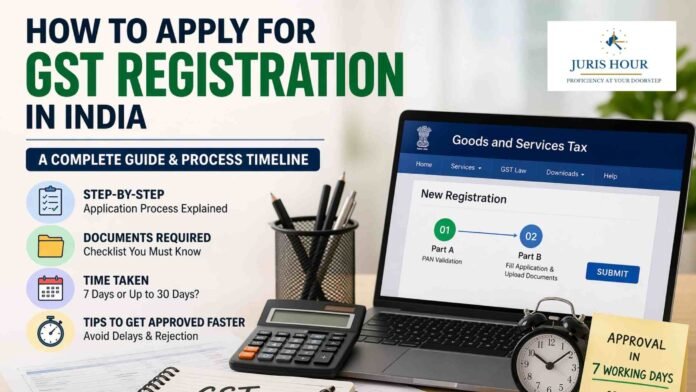
GST registration is completed online through the GST portal. The process is divided into two parts: Part A and Part B of Form GST REG-01.
The applicant must first access the registration section, fill in basic details, verify them through OTP, and then proceed to complete the detailed application form.
Part A of Form GST REG-01: PAN Validation and TRN Generation
In Part A, the applicant provides PAN, mobile number, email address, and state. These details are verified through OTP authentication. Upon successful verification, a Temporary Reference Number (TRN) is generated.
The TRN allows the applicant to proceed to the next stage and complete the application at their convenience.
Part B of Form GST REG-01: Filing Detailed Application and Uploading Documents
Part B involves entering detailed information such as business name, constitution, address, details of promoters or partners, authorized signatory, and nature of goods or services supplied. Supporting documents must be uploaded at this stage.
The application is submitted using Digital Signature Certificate (DSC), e-sign, or Electronic Verification Code (EVC), depending on the type of taxpayer.
Documents Required for GST Registration
The documents required vary based on the nature of the entity. Generally, applicants must provide proof of business constitution, identity and address proof of promoters, photograph, bank account details, and proof of principal place of business.
Incorrect or incomplete documentation is one of the most common reasons for delay in GST registration.
Proof of Principal Place of Business: Key Requirements
For owned premises, documents such as property tax receipt, electricity bill, or municipal records are acceptable. For rented premises, a rent agreement along with ownership proof of the landlord is required.
In cases where the premises are used with consent, a consent letter along with ownership proof and identity proof of the owner must be provided.
Business Constitution Documents: Entity-Wise Requirements
Different entities must submit different documents. Proprietorships rely on PAN and identity proof. Partnerships must submit a partnership deed. Companies require a certificate of incorporation and related documents.
Ensuring that these documents match the details entered in the application is essential to avoid discrepancies.
Aadhaar Authentication and Its Impact on Processing Time
Aadhaar authentication plays a crucial role in determining how quickly a GST registration is processed. Applicants opting for Aadhaar authentication generally experience faster approval.
Failure to complete Aadhaar authentication may result in additional verification requirements and extended timelines.
Biometric Verification and GST Suvidha Kendra Visit
In certain cases, applicants may be required to undergo biometric verification and visit a GST Suvidha Kendra. This includes capturing photographs and verifying original documents.
Such requirements usually arise in cases flagged as high-risk or where Aadhaar authentication is not completed.
Acknowledgement and Tracking of GST Application Status
Once the application is submitted, an acknowledgement is issued in Form GST REG-02. The applicant can track the status of the application using the ARN (Application Reference Number).
Regular tracking helps in responding promptly to any notices or queries raised by the department.
GST Registration Processing Timeline: Normal Cases
In standard cases where the application is complete and no risk is identified, GST registration is typically granted within 7 working days.
This timeline applies where Aadhaar authentication is successful and no further clarification is required.
GST Registration Timeline in Case of Risk Flags or Physical Verification
If the application is flagged for risk or requires physical verification, the processing time may extend up to 30 days.
Physical verification involves inspection of the business premises by the tax officer, which naturally increases the time required.
What Happens If the Department Raises a Query (REG-03 Notice)?
If discrepancies are found, the department may issue a notice in Form GST REG-03 seeking clarification or additional documents.
This is a common stage where delays occur, especially if the initial application is not properly prepared.
Time Limit to Respond to GST Notices and Consequences of Delay
The applicant must respond to the notice within 7 working days. Failure to respond within this period may lead to rejection of the application.
A proper and timely response is essential to ensure approval.
Physical Verification of Business Premises: When and Why It Happens
Physical verification is conducted in cases where the officer is not satisfied with the application or where risk parameters are triggered.
The officer verifies the existence of the business and uploads a report along with photographs.
Deemed Approval of GST Registration: What It Means
If the officer does not act within the prescribed time limit, the application is deemed approved.
This provision ensures that genuine applicants are not subjected to unnecessary delays.
Issue of GST Registration Certificate (GST REG-06)
Upon approval, the GST registration certificate is issued in Form GST REG-06. It can be downloaded from the GST portal.
There is no physical certificate issued; everything is digitally accessible.
Effective Date of GST Registration and Its Importance
If the application is filed within 30 days of liability, registration is effective from the date of liability. Otherwise, it is effective from the date of approval.
This affects tax liability and compliance for past transactions.
GST Registration for Casual Taxable Persons and Non-Residents
Casual taxable persons and non-resident taxable persons must apply in advance and deposit tax before registration is granted.
This ensures tax compliance for temporary or foreign businesses operating in India.
Common Reasons for Delay or Rejection of GST Applications
Delays usually occur due to incorrect documents, mismatch in details, incomplete applications, or failure to respond to notices.
Poor quality uploads and vague address details are also frequent causes.
Practical Tips to Get GST Registration Approved Faster
Applicants should ensure that all documents are accurate, clear, and consistent with application details. Aadhaar authentication should be completed promptly, and any notice should be responded to within the prescribed time.
Proper preparation significantly reduces processing time.
Conclusion: How Long GST Registration Really Takes in Practice
In practice, GST registration usually takes about 7 working days in straightforward cases. However, if verification, notices, or biometric checks are involved, the timeline may extend up to 30 days.
The key to faster approval lies in accurate documentation, timely compliance, and understanding the procedural requirements. With proper preparation, businesses can complete GST registration smoothly and begin operations without unnecessary delays.

