
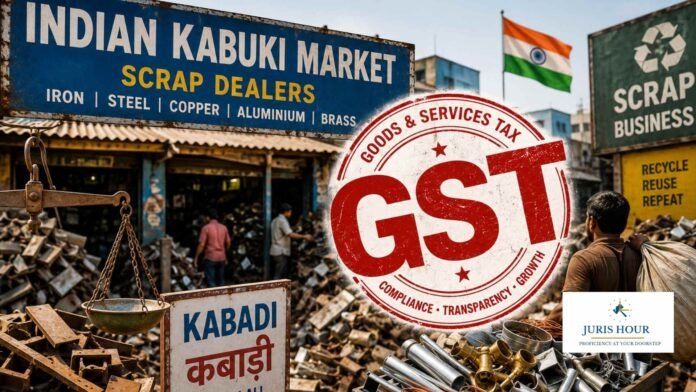
The GST framework governing metal scrap transactions has undergone a significant change with the introduction of mandatory GST TDS on B2B scrap purchases and Reverse Charge Mechanism (RCM) on purchases from unregistered suppliers. These provisions, effective from 10 October 2024, aim to improve tax compliance and reduce revenue leakage in the metal scrap sector.
However, many businesses continue to confuse when 2% GST TDS applies and when 18% GST under Reverse Charge (RCM) becomes payable.
Here’s a detailed explanation.
Buy Now: FAO Versus JAO Matters Remanded Back To HC : CASE COMPILATION & LITIGATION GUIDE
Background
Based on the recommendations of the GST Council, the Government issued:
- Notification No. 25/2024-Central Tax introducing GST TDS on B2B supplies of metal scrap between registered persons.
- Notification No. 06/2024-Central Tax (Rate) making registered recipients liable to pay GST under Reverse Charge when purchasing specified metal scrap from unregistered suppliers.
Both provisions became effective from 10 October 2024.
Scenario 1: Registered Buyer Purchases Scrap from Registered Supplier
This is the most common B2B transaction.
GST Treatment
- Supplier charges GST in the invoice.
- Buyer pays invoice value after deducting GST TDS wherever applicable.
- Buyer deducts 2% GST TDS.
When is GST TDS Applicable?
GST TDS applies where:
- Both supplier and buyer are registered under GST.
- Supply consists of notified metal scrap falling under Chapters 72 to 81 of the Customs Tariff.
- Value of supply under the contract exceeds ₹2.5 lakh (excluding GST).
- Other prescribed conditions under Section 51 are satisfied.
Rate of GST TDS
- 1% CGST + 1% SGST (intra-State supply)
- 2% IGST (inter-State supply)
The deduction is made only on the taxable value, excluding GST shown separately in the invoice.
Example
A registered manufacturer purchases steel scrap worth ₹5,00,000 from a registered scrap dealer in the same State.
- Taxable value: ₹5,00,000
- GST @18%: ₹90,000
- Invoice value: ₹5,90,000
GST TDS:
- 2% of ₹5,00,000 = ₹10,000
The buyer pays ₹5,80,000 to the supplier and deposits ₹10,000 as GST TDS with the Government.
Scenario 2: Registered Buyer Purchases Scrap from Unregistered Supplier
This transaction does not attract GST TDS.
Instead, the buyer becomes liable to pay GST under the Reverse Charge Mechanism (RCM).
GST Treatment
- Supplier does not charge GST.
- Buyer pays GST directly to the Government.
- Buyer can subsequently claim Input Tax Credit (ITC), subject to eligibility.
This provision specifically applies to notified metal scrap falling under Chapters 72 to 81 supplied by an unregistered person to a registered person.
Example
A registered steel manufacturer purchases iron scrap worth ₹2,00,000 from an unregistered scrap collector.
Supplier invoice:
- Scrap value: ₹2,00,000
- GST: Nil
Buyer’s obligation:
- GST under RCM @18% = ₹36,000
- Deposit ₹36,000 in cash through Electronic Cash Ledger.
- Claim ITC after payment, subject to normal conditions.
Scenario 3: Unregistered Buyer Purchases Scrap from Registered Supplier
Where the buyer is not registered:
- Supplier charges normal GST.
- No GST TDS applies.
- No Reverse Charge applies.
The supplier remains responsible for payment of GST in the ordinary course.
Scenario 4: Unregistered Buyer Purchases Scrap from Unregistered Supplier
If both parties are unregistered:
- GST TDS does not apply.
- Reverse Charge does not apply.
- GST registration requirements will continue to depend upon the turnover threshold and other provisions of the CGST Act.
Quick Comparison
| Transaction | GST TDS | Reverse Charge (RCM) | Who Pays GST? |
| Registered Buyer → Registered Supplier | Yes (subject to conditions and threshold) | No | Supplier charges GST; buyer deducts 2% GST TDS |
| Registered Buyer → Unregistered Supplier | No | Yes | Buyer pays GST under RCM |
| Unregistered Buyer → Registered Supplier | No | No | Supplier pays GST normally |
| Unregistered Buyer → Unregistered Supplier | No | No | Normal GST registration provisions apply |
Important Compliance Points
For GST TDS
- Applicable only on notified metal scrap covered under Chapters 72–81.
- Contract value should exceed ₹2.5 lakh.
- TDS is deducted on taxable value excluding GST.
- Deducted amount is deposited through GSTR-7 within the prescribed time.
- Supplier receives credit of the deducted amount in the electronic cash ledger.
For Reverse Charge
- Applicable only where the supplier is unregistered and the recipient is registered.
- GST must be paid through the Electronic Cash Ledger.
- ITC can be availed after payment, subject to fulfilment of statutory conditions.
Common Mistakes Businesses Should Avoid
- Treating GST TDS and Reverse Charge as applicable simultaneously on the same transaction.
- Deducting GST TDS from purchases made from unregistered suppliers.
- Ignoring RCM liability merely because the supplier is below the GST registration threshold.
- Deducting TDS on invoice value including GST instead of taxable value.
- Assuming these provisions apply to all scrap without verifying whether the goods fall under the notified Customs Tariff Chapters 72 to 81.
Conclusion
The GST regime now distinguishes metal scrap transactions based on the GST registration status of the buyer and seller. Where both parties are registered, the transaction generally attracts 2% GST TDS (subject to the prescribed conditions, including the ₹2.5 lakh contract threshold). Conversely, where a registered buyer purchases notified metal scrap from an unregistered supplier, GST is payable by the buyer under the Reverse Charge Mechanism, and no GST TDS is deducted. Understanding these distinctions is essential for avoiding compliance lapses, interest, and penalties while ensuring seamless input tax credit availability.

