
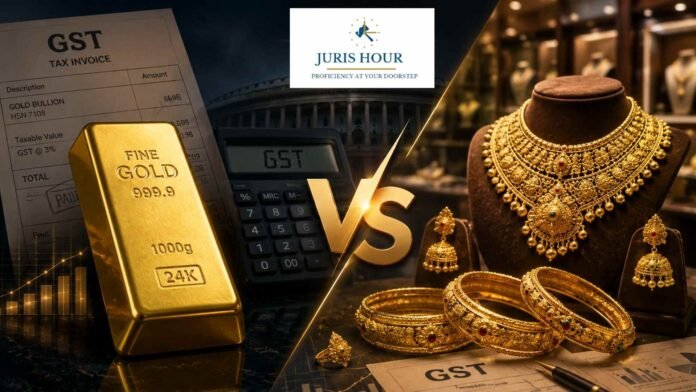
Gold is emotional for Indian households, but its GST treatment is often misunderstood. Many buyers believe that gold jewellery and gold biscuit are taxed differently because jewellery involves craftsmanship, making charges and wastage, while a gold biscuit is merely bullion. The legal position, however, is more nuanced.
Under GST, both gold biscuit/bullion and gold jewellery broadly attract 3% GST. The real difference is not merely the rate, but the value on which GST is charged, the HSN classification, the invoicing method and the treatment of making/job-work charges.
GST on Gold Biscuit
A gold biscuit, bar or bullion generally falls under HSN 7108, covering gold in unwrought or semi-manufactured form. The applicable GST rate is 3%, generally split as 1.5% CGST and 1.5% SGST in intra-State supply, or 3% IGST in inter-State supply.
Example: If a gold biscuit is sold for ₹1,00,000, GST will be ₹3,000. Total invoice value becomes ₹1,03,000.
There is usually no making charge component in bullion sales. Therefore, GST is straightforward: 3% on the sale value of gold.
GST on Gold Jewellery
Gold jewellery generally falls under HSN 7113. It also attracts 3% GST. However, jewellery includes design, labour, wastage, making charges and sometimes stone value. This is where confusion begins.
The GST Council’s gems and jewellery FAQ clarifies that when jewellery is sold to the end consumer, GST is payable at 3% on the total transaction value of jewellery, whether making charges are shown separately or not.
Example: If jewellery value is ₹1,00,000 and making charges are ₹10,000, GST is generally charged at 3% on ₹1,10,000, i.e. ₹3,300.
The Expose: Same GST Rate, Different Consumer Burden
The headline rate is the same: 3%. But the actual GST burden on jewellery becomes higher because GST applies on the total jewellery invoice value, including making charges. A gold biscuit buyer pays GST only on bullion value, while a jewellery buyer pays GST on gold value plus craftsmanship value.
This means the tax difference is not in the GST rate, but in the taxable base.
Job Work vs Retail Jewellery Sale
A common mistake is to apply 5% GST on making charges in a retail jewellery bill. The official clarification says that where jewellery is sold to the end consumer, GST is 3% on total transaction value.
However, if a jewellery manufacturer sends gold to a job worker and the job worker returns finished jewellery, the job worker charges GST at 5% on job charges only. The manufacturer may take input tax credit, subject to GST law.
So, 5% applies to job-work service between businesses, not normally to the final jewellery sale invoice to the consumer.
Comparison Chart: Gold Jewellery vs Gold Biscuit
| Point | Gold Biscuit / Bullion | Gold Jewellery |
| Common HSN | 7108 | 7113 |
| GST Rate | 3% | 3% |
| Taxable Value | Gold/bullion sale value | Total jewellery transaction value |
| Making Charges | Usually not applicable | Included in taxable value |
| GST on Making Charges in Retail Sale | Not applicable | 3% as part of total jewellery value |
| Job Work Treatment | Not relevant to buyer | Job worker charges 5% on job charges to manufacturer |
| Consumer Impact | Lower taxable base | Higher taxable base due to making charges |
| Investment Use | Preferred for investment/storage | Preferred for personal use, wedding, gifting |
| Resale Loss | Usually lower spread | Higher due to making/wastage deductions |
| Main Risk | Purity and source invoice | Purity, making charges, wastage, stone value, buyback terms |
Practical Example
| Particulars | Gold Biscuit | Gold Jewellery |
| Gold Value | ₹1,00,000 | ₹1,00,000 |
| Making Charges | Nil | ₹10,000 |
| Taxable Value | ₹1,00,000 | ₹1,10,000 |
| GST Rate | 3% | 3% |
| GST Payable | ₹3,000 | ₹3,300 |
| Final Cost | ₹1,03,000 | ₹1,13,300 |
Key Takeaway
Gold biscuit and gold jewellery both attract 3% GST, but jewellery becomes costlier because GST is calculated on the entire jewellery value, including making charges. For investment, bullion may be tax-efficient and resale-friendly. For personal use, jewellery carries emotional and design value, but buyers must carefully check GST, making charges, wastage and buyback conditions before paying.
Read More: Is GST Applicable on Commission Paid to an Unregistered Person?

