
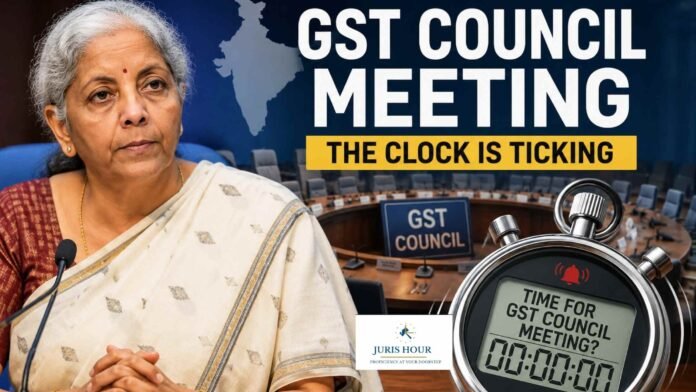
The Goods and Services Tax (GST) Council is the constitutional body entrusted with making recommendations on critical aspects of India’s GST framework, including tax rates, exemptions, model GST laws, principles of levy and place of supply, threshold limits and other matters relating to GST.
As of 17 August 2026, the last meeting of the GST Council was the 56th meeting, held in New Delhi on 3 and 4 September 2025. The official GST Council record confirms the 56th meeting and its recommendations.
The prolonged gap has renewed an important legal question: How frequently is the GST Council required to meet, and what does the Constitution actually provide if a meeting is not convened within the prescribed period?
The answer requires a distinction between the Constitutional provisions contained in Article 279A and the Procedure and Conduct of Business Regulations of the GST Council framed pursuant to that constitutional provision.
Buy Now: 130 GST Judgments – E-Magazine July 2026
GST Council Was Created Through the 101st Constitutional Amendment
The constitutional foundation of the GST Council lies in the Constitution (One Hundred and First Amendment) Act, 2016.
The Amendment Act received the President’s assent on 8 September 2016. The Government subsequently brought Article 279A into force with effect from 12 September 2016. The official GST Council website records that the notification bringing Article 279A into force was issued on 10 September 2016.
Article 279A(1) specifically provided that the President would, within 60 days from the commencement of the 101st Constitutional Amendment Act, constitute a Council called the Goods and Services Tax Council.
Thus, the Constitution itself prescribed an outer limit for the creation of the Council.
The GST Council was ultimately constituted on 15 September 2016, only a few days after Article 279A came into force. The Government has repeatedly recorded 15 September 2016 as the date of constitution of the Council.
The first GST Council meeting was then held on 22 and 23 September 2016.
What Is the Exact Constitutional Provision Regarding Meetings?
A crucial point is that Article 279A does not itself say that the GST Council must meet once every quarter.
This distinction is important.
Article 279A(8) states that:
“The Goods and Services Tax Council shall determine the procedure in the performance of its functions.”
In other words, the Constitution creates the Council and lays down its composition, functions, quorum and voting mechanism, but leaves the Council to determine its detailed procedure.
The Constitution does, however, prescribe a quorum.
Under Article 279A(7), one-half of the total number of members of the GST Council constitutes the quorum for its meetings.
Therefore, there are two separate concepts:
Constitutional requirement: Article 279A establishes the Council and provides the constitutional framework, including quorum and voting.
Procedural requirement: The Council’s own Procedure and Conduct of Business Regulations prescribe how and how frequently meetings are to be conducted.
Rule 6: GST Council Shall Meet at Least Once Every Quarter
The important provision for the present controversy is Rule 6 of the Procedure and Conduct of Business Regulations of the GST Council.
Rule 6 provides that:
“The Council shall meet at least once in every quarter of the financial year.”
The provision has previously been specifically cited in public discussions concerning delays in convening GST Council meetings. It is framed as a requirement governing the Council’s procedure and was made pursuant to Article 279A(8).
This means that the legal framework contemplates at least one GST Council meeting in each quarter of a financial year.
The expression “at least once” is significant. It does not prescribe a maximum of one meeting per quarter. The Council can meet more frequently whenever necessary.
Indeed, the early years of GST demonstrate that the Council often met much more frequently than once every three months because the GST regime had to be designed and implemented within a very short period.
Does “Once Every Quarter” Mean Exactly Every Three Months?
Not necessarily.
The wording of Rule 6 is “at least once in every quarter of the financial year.”
The financial year is divided into four quarters:
- April–June
- July–September
- October–December
- January–March
The language therefore focuses on ensuring that each quarter has at least one Council meeting.
It is somewhat different from a provision saying that the Council must meet “once every three months from the date of its previous meeting.”
This distinction matters when calculating compliance.
For example, if a meeting is held in September and the next meeting is held in October, the two meetings may be only a few weeks apart, but they fall in different financial-year quarters.
Conversely, if the Council meets in September and then does not meet until January, there would be no meeting in the October–December quarter.
Therefore, the better legal reading is that the rule creates a quarter-wise frequency requirement, rather than a rolling 90-day statutory clock.
When Was the GST Council Last Held?
The 56th GST Council Meeting was held in New Delhi on 3 and 4 September 2025.
The official recommendations released by the Ministry of Finance confirm that the 56th meeting was held on 3 September 2025 and continued into 4 September 2025.
The meeting was particularly significant because the Council recommended wide-ranging GST reforms, including rate rationalisation and various trade-facilitation measures.
Among the major recommendations was a move towards a simplified GST structure with a standard rate of 18% and merit rate of 5%, along with a special 40% de-merit rate for specified goods and services. The Council also recommended substantial changes in GST rates for goods and services.
How Much Time Has Elapsed Since the Last Meeting?
As of 17 August 2026, the last meeting ended on 4 September 2025.
That means approximately:
11 months and 13 days have elapsed since the conclusion of the 56th GST Council meeting.
In terms of days, the gap is approximately 347 days.
Therefore, the Council has gone through:
- the October–December 2025 quarter without a meeting;
- the January–March 2026 quarter without a meeting;
- the April–June 2026 quarter without a meeting; and
- by 17 August 2026, the July–September 2026 quarter is also nearing completion without a meeting.
This makes the present gap substantially longer than the quarterly frequency contemplated by Rule 6.
What Does This Mean Legally?
This is where caution is necessary.
It would be too broad to state simply that “the Constitution has been violated because the GST Council has not met every three months.”
That statement is legally imprecise.
The Constitution itself does not contain a direct three-month or quarterly meeting mandate. Article 279A(8) instead empowers the Council to determine its procedure.
The quarterly requirement comes from the Procedure and Conduct of Business Regulations, specifically Rule 6.
Therefore, the more accurate formulation is:
The present gap raises a question of compliance with the Council’s own prescribed procedural requirement to meet at least once in every quarter of the financial year.
This distinction becomes particularly important if the issue is examined judicially.
Is Rule 6 Mandatory or Directory?
Another important legal question is whether the words “shall meet” in Rule 6 automatically mean that every decision taken by the GST Council becomes invalid if the Council does not meet in a particular quarter.
There is no basis to automatically reach such a conclusion.
Article 279A(10) itself provides an important safeguard. It says that no act or proceedings of the GST Council shall be invalid merely because of:
- a vacancy or defect in the constitution of the Council;
- a defect in appointment of a member; or
- a procedural irregularity that does not affect the merits of the case.
This provision demonstrates that the Constitution itself distinguishes between substantive defects and procedural irregularities.
Therefore, a failure to hold a meeting within the quarterly period would not automatically mean that every subsequent recommendation or decision of the Council is constitutionally void.
Whether a particular procedural breach has legal consequences would depend on the nature of the breach, the applicable regulations and the circumstances in which a particular decision was taken.
Why the Distinction Matters for GST Rate Notifications
The GST Council is a recommendatory constitutional body.
Its recommendations are important because the Central and State Governments undertake legislative and executive action in the GST field on the basis of the constitutional and statutory framework governing GST.
For example, the 56th Council’s recommendations were subsequently followed by changes in GST rates and related implementation measures.
The Council itself does not simply function as a tax-collecting authority. Its constitutional role is primarily one of coordinating and recommending a harmonised GST framework between the Union and the States.
Article 279A(4) expressly lists matters on which the Council is to make recommendations, including:
- goods and services that may be subjected to or exempted from GST;
- model GST laws;
- principles of levy and apportionment;
- place-of-supply principles;
- threshold exemption limits;
- GST rates;
- special rates during natural calamities or disasters; and
- other GST-related matters.
Consequently, regular Council meetings have considerable practical significance even though the Council does not itself issue every GST notification.
The Council’s Role Is Broader Than Rate Changes
The importance of holding regular meetings goes beyond GST rate rationalisation.
The Council is also the institutional forum in which the Union and States discuss:
GST law and amendments: Difficult interpretational and legislative issues can be placed before the Council.
GST rates: Changes in rates, exemptions and classifications can be considered.
Input Tax Credit: Policy questions relating to credit mechanisms and restrictions can be examined.
Refunds: Structural problems concerning refund mechanisms can be considered.
Compliance: Registration, return filing, e-invoicing, e-way bills and other compliance mechanisms can be reviewed.
Litigation: Issues involving recurring disputes and divergent interpretations can be placed before the Council.
Federal coordination: GST fundamentally involves both Union and State taxation powers, making the Council an important mechanism for cooperative federalism.
The Present Gap Is Particularly Significant Because GST Has Entered Its Tenth Year
The GST Council was constituted on 15 September 2016.
As of 17 August 2026, approximately 9 years, 11 months and 2 days have elapsed since its constitution.
The Council will complete 10 years on 15 September 2026.
This is therefore not merely a question of a meeting being delayed by a few weeks. The Council is approaching the tenth anniversary of its constitutional creation after an unusually long gap following its 56th meeting.
The Government’s own historical record shows how active the Council was during the initial implementation phase. By October 2018, the Council had already conducted 30 meetings after its constitution in September 2016.
The contrast is striking: during the initial GST rollout, meetings were held at a very high frequency, while the present gap has extended to nearly a year.
The Early GST Period Shows How Frequently the Council Can Meet
The Council’s first year provides an important illustration.
After its constitution on 15 September 2016, the Council held its first meeting on 22–23 September 2016.
During the period leading up to the GST launch on 1 July 2017, the Council met repeatedly to finalise the legal and administrative architecture.
A Government account records that the Council held 18 meetings between its constitution and the GST rollout.
This demonstrates that the quarterly requirement is a minimum frequency, not an upper limit.
What About the 57th GST Council Meeting?
As of 17 August 2026, the official GST Council website does not show a completed 57th meeting. Its official “What’s New” page continues to identify the 56th GST Council meeting and its recommendations as the latest meeting-related material.
There have been public expectations and calls for the 57th meeting to be convened, particularly because several GST policy and implementation issues remain pending. Recent reporting has specifically highlighted the prolonged gap following the September 2025 meeting.
However, unless an official notice fixes a date, speculation about the exact date of the 57th meeting should not be treated as an officially announced schedule.
Does the Absence of a Meeting Automatically Stop GST?
No.
This is another important distinction.
The GST regime does not become legally inoperative merely because the Council has not met during a quarter.
Existing GST laws, rules, notifications and orders continue to operate unless amended, withdrawn, struck down or otherwise rendered inapplicable.
Similarly, the Central Government and State Governments continue to administer GST under the existing statutory framework.
The Council’s meeting frequency is therefore principally an issue of constitutional governance, cooperative federalism and policy-making, rather than a mechanism that automatically determines whether GST itself remains legally enforceable.
Can a Taxpayer Challenge a GST Notification Merely Because the Council Did Not Meet?
Not automatically.
A taxpayer challenging a GST notification cannot simply assume that a long gap between Council meetings invalidates the notification.
The legal analysis would have to examine:
- Whether the notification legally required a GST Council recommendation;
- Whether the relevant recommendation was actually made;
- Whether the Government acted within the statutory power granted by the relevant GST law;
- Whether the prescribed procedure was followed;
- Whether the alleged procedural defect caused a legally relevant prejudice; and
- Whether Article 279A(10) protects the proceeding from being invalidated because of a procedural irregularity.
Thus, the quarterly meeting provision is significant, but it should not be confused with a rule that automatically nullifies GST legislation or notifications.
Article 279A Also Emphasises Cooperative Federalism
The constitutional design of the GST Council is particularly important.
Article 279A(6) provides that while performing its functions, the Council must be guided by the need for:
“a harmonised structure of goods and services tax”
and
“the development of a harmonised national market for goods and services.”
The Council therefore represents a constitutional mechanism through which the Union and States participate jointly in GST policy.
Regular meetings are important to this design because GST is not exclusively a Union tax or exclusively a State tax. It is a shared fiscal architecture.
The Council provides the institutional forum for continuous coordination.
Voting Mechanism Makes the Council Different From an Ordinary Government Committee
Article 279A(9) establishes a special voting mechanism.
If a matter is put to vote:
- the Central Government has one-third of the total votes cast; and
- all State Governments together have two-thirds of the total votes cast.
A proposal requires at least three-fourths of the weighted votes of members present and voting to pass.
This structure was deliberately designed to require a high degree of agreement between the Centre and the States.
In practice, the GST Council has generally operated through consensus rather than frequent formal voting. The official GST Council website also notes its consensus-based approach.
This further underlines why regular meetings matter: the Council is intended to be a continuing forum for negotiated fiscal policy between different levels of government.
What Is the Legal Position as of 17 August 2026?
The position can be summarised as follows:
| Issue | Legal/Official Position |
| Constitutional basis | Article 279A |
| 101st Amendment received Presidential assent | 8 September 2016 |
| Article 279A commenced | 12 September 2016 |
| GST Council constituted | 15 September 2016 |
| Constitutional deadline for constitution | Within 60 days of commencement |
| First GST Council meeting | 22–23 September 2016 |
| Constitutional quorum | One-half of total members |
| Detailed meeting procedure | Determined under Article 279A(8) |
| Quarterly meeting requirement | Rule 6 of Procedure & Conduct of Business Regulations |
| Minimum frequency | At least once in every quarter of the financial year |
| Last completed meeting | 56th Meeting |
| Last meeting dates | 3–4 September 2025 |
| Position on 17 August 2026 | No 57th meeting yet recorded officially |
| Gap since last meeting ended | Approximately 347 days |
| Time since Council constitution | Approximately 9 years, 11 months |
A Constitutional Institution Approaching Its Tenth Anniversary
The GST Council will complete ten years of existence on 15 September 2026.
It was created as one of the most significant institutional innovations accompanying India’s transition to GST. In less than a year after its constitution, it helped construct the framework for the nationwide GST rollout on 1 July 2017. Since then, it has become the principal forum for Centre-State coordination on indirect taxation.
The present gap between the 56th and 57th meetings therefore assumes significance not simply because taxpayers are waiting for rate changes or clarifications, but because the Council’s own procedural framework contemplates regular quarterly deliberation.
The central legal question is consequently not whether GST has stopped functioning—it has not—but whether the prolonged absence of a Council meeting is consistent with the quarterly meeting requirement contained in Rule 6 of the Procedure and Conduct of Business Regulations, and what legal consequences, if any, should follow from non-compliance.
Until the 57th meeting is formally convened, the issue will remain relevant for taxpayers, States and the broader debate over the functioning of India’s GST federal structure.
Read More: S. 129 Penalty Can’t Be Imposed on Stock Transfer Without E-Way Bill: GSTAT

