

The Article pertaining to “ANTI-NARCOTICS DRIVE IN KERALA – RECOVERY OF SYNTHETIC DRUGS FROM A WOMAN’S PRIVATE PART – THE APPLICABILITY OF SECTION 50 OF THE NDPS ACT, 1985” is written by Shri SRINIVASAN GOPAL, ASSISTANT DIRECTOR(RETD.), NATIONAL ACADEMY OF CUSTOMS INDIRECT TAXES AND NARCOTICS, PALASAMUDRAM.
The article analyses the recovery of MDMA concealed in a woman’s vaginal cavity during Kerala Police’s Operation Toofan, examines the applicability of Section 50 of the NDPS Act alongside the constitutional rights embedded under Article 21, and lays down a procedure to be followed to build a foolproof case and secure conviction.
It has been widely reported in various newspapers, including The Hindu, The Hindustan Times, and Deccan Herald1, that during an anti‑narcotics drive by the District Anti‑Narcotic Special Action Force (DANSAF) of the Kerala Police, a case was reported involving the recovery and seizure of 2 grams of MDMA (with 10 grams or more constituting a commercial quantity under the NDPS Act) from one of the two women occupants of a car intercepted at a checkpoint in Thrissur. The DANSAF team found the behaviour of the occupants suspicious, and under these circumstances, 2 grams of MDMA were recovered from the private parts (vaginal cavity) of the accused woman. It was further stated in the article that a female officer was involved in the search. In this case, cumulatively 308 grams—30 times the commercial quantity—were recovered, and there can be no dispute regarding the recovery or the splendid job the Kerala Police has been doing under Operation Toofan.
Buy Now: Supreme Court Judgements E-Compilation – May 2026
Unlike other criminal statutes, the NDPS Act operates on a different footing and this being an exception to the normal criminal jurisprudence, the Legislature in its wisdom has introduced the concept of reverse burden. Under the NDPS Act, it is for the accused to prove and establish that he or she has not indulged in illicit drug trafficking upon the prosecution proving the foundational facts of recovery. In terms of Section 35 of the NDPS Act, there is a presumption of guilt, which is rebuttable in nature under Section 54 of the NDPS Act. The primary reason for having the reverse burden jurisprudence for the NDPS Act is because of the damage it causes to the society and the requirement for diversion of resources for allied functions, including rehabilitation. The reverse burden under NDPS Act is akin to the smuggling of goods i.e. gold, silver, fire crackers, cigarettes, etc, notified under Section 123 of the Customs Act, 1962
The Statutory Safeguards Under Section 50 of the NDPS Act
In a case of this kind wherein a woman hides drugs (mainly MDMA) in her private parts, it is essential to understand as how the provisions of Section 50 of the NDPS Act operates.
A woman suspect (she is a suspect before recovery) must be served with a Notice under Section 50 apprising her of the legal rights to be searched before the nearest Gazetted Officer (of the empowered departments) or the nearest Magistrate. The Notice ibid should be served in the language known to the suspect lest she take a diametrically opposite view in the remand or trial proceedings. Failure to extend this option completely vitiates the recovery of that specific contraband.
A reading of Section 50 in a wholesome manner reveals that Section 50(1) reveals that
“When any officer duly authorised under section 42 is about to search any person under the provisions of section 41, section 42 or section 43..”, it is only an empowered officer who can effect a search of a suspect , albeit after issuing a Notice, as discussed in para Supra.
Section 50(4) specifically deals with the search of a female. Under other criminal Acts, another female officer can conduct the search. Since the provisions of BNSS, 2023 have been made applicable to the NDPS Act by virtue of Section 51, provided they are not inconsistent, and as the provisions of BNSS, 2023 are inconsistent with Section 50 of the NDPS Act, they are inapplicable. Hence, empowered officers should remember that only an empowered female officer of and above the rank of Head Constable is eligible to carry out the search. Needless to mention here that the empowerment at the State level depends upon the situation and the consequent Notification issued by the respective State Governments. In formations under CBIC, except CBN, the empowerment starts of the rank of Inspector and known by different names by virtue of the place of posting. In NCB and CBN, the empowerment starts at the level of sub-Inspector.
The Critical Distinction: “Search” vs. “Extraction”
Section 50 of the NDPS Act is restrictive in nature in as much it is used for search of a person – be it a man/woman suspected of concealing drugs on his/her person. Physical Search, after issuance of a Notice under Section 50 is required to be understood between external search and “extraction”. Search generally includes the external examination of a person’s outer attire, pat-downs, or checking pockets and undergarments. Section 50 perfectly fits in at this operational stage. In contrast, extraction does involve the removal of the drug (in this case MDMA) from the biological bodily concealment. When contraband is inserted inside a biological body cavity, the process ceases to be a mere “search.” As envisaged under Section 50 of the NDPS Act. Extraction shifts into an invasive medical zone that directly threatens the suspect’s guaranteed constitutional protections under Article 21 (Right to Life, Dignity, and Bodily Integrity). It is a fact that empowered officers functioning under the Central Government or State Governments do not possess skill having not undergone any clinical training, to execute physical extractions from inside a human body, particularly the female body.
Difference between Male Private Parts vs. Vaginal Cavity
The physical nature of concealment varies extensively by gender, creating distinct legal and medical ramifications. Insofar as a male in concerned and having hidden drugs in his private, we refer to the judgment dated 24 March 2021 in the case of 2NCB v. Micheal Webuda (in JC) decided by the Ld. Special Judge (NDPS), Patiala House Courts, New Delhi in Case No. SC/9512/2016. Micheal Webuda hid contraband externally within his undergarments or taped near his groin area. In such instances, the contraband remains outside the body structure. Uncovering it simply requires an external search of the clothing and underwear, which remains safely within the boundaries of a standard Section 50 personal search. However, in respect of secreting drugs in the vaginal cavity, it is required to be remembered that the vagina is an internal biological organ. It is highly sensitive and prone to severe trauma if improperly handled. Improper handling may lead to tearing and associated risks. Compounding the problem is the availability of female witnesses.
Assuming but admitting that the personal search under Section 50 extends to extraction, it is always advisable to get it ‘extracted’ through medical procedure. It is always required to be kept in mind that the health and safety of the suspect (since not recovered) is of utmost and a duty has been cast on the empowered officers, under Section 56 of BNSS, 2023, to take care of them notwithstanding the fact that the likely offence would entail a punishment of minimum of 10 years in commercial quantity cases.
Forcible internal probing by an empowered officer—even by a female officer who is legally empowered—presents huge risks, including infection. Hence, keeping in view the fact that the disadvantages outweigh advantages, the female empowered officer should always prefer the medical route.
Conversely, it may also be case wherein a female suspect is searched and drugs (here also MDMA, being the recovered and seized by the empowered officers continuously in Kerala) being initially recovered from the bag being carried. During medical procedure, the attending doctor recovers from the vaginal concealment commercial quantity of the female accused. A Government doctor is not an empowered officer under the NDPS Act and the recovery being made in the absence of the empowered female officer, the validity of the recovery can be legally challenged. The case of Anila Raveendran v. State of Kerala – Neutral Citation 2025:KER:71680 refers in this regard. It is of utmost importance to note what has been recorded by the Hon’ble High Court of Kerala in Para 9 of the bail order under this Neutral Citation:
“9. In the instant case, on a perusal of the case diary, it is noticed that the grounds for arrest have been communicated to the petitioner as per the arrest memo, wherein there is specific reference to the petitioner being in possession of 36.86 grams of MDMA, which was recovered from her handbag. However, the final report alleges that she was in possession of 77.30 grams of MDMA. The excess quantity mentioned in the final report was 40.44 grams of MDMA, which was recovered from her vagina during her medical examination. ….”
In a situation where MDMA recovered from the handbag is less than 10 grams and the vaginal recovery being contested as recovery at the back of the female empowered officer (the point being not pressed in this case), the case would be decided on the recovery of MDMA from the hand bag, which is an intermediate quantity. Consequently, the offence becomes bailable and the proceedings of Chapter VA of the NDPS become statutorily inapplicable until the Ld. Court imposes the maximum sentence of 10 years for intermediate quantity.
Nevertheless, the accused was also detained under PITNDPS Act, 1988 and the Detention Order was not quashed or set aside by the Hon’ble High Court as per reported decision in the case of Sanilkumar v. State of Kerala -Neutral Citation 2026:KER:583 refers.
Considering the above, the importance of proper recovery need not be over emphasized.
The Best Practice: Protocol for Cavity Recoveries
To avoid severe physical harm to the accused and to prevent the legal case from collapsing during trial due to procedural illegality, the empowered officer must implement a rigorous, sequentially sound standard operating procedure. The following steps can be put into practice to withstand legal scrutiny:
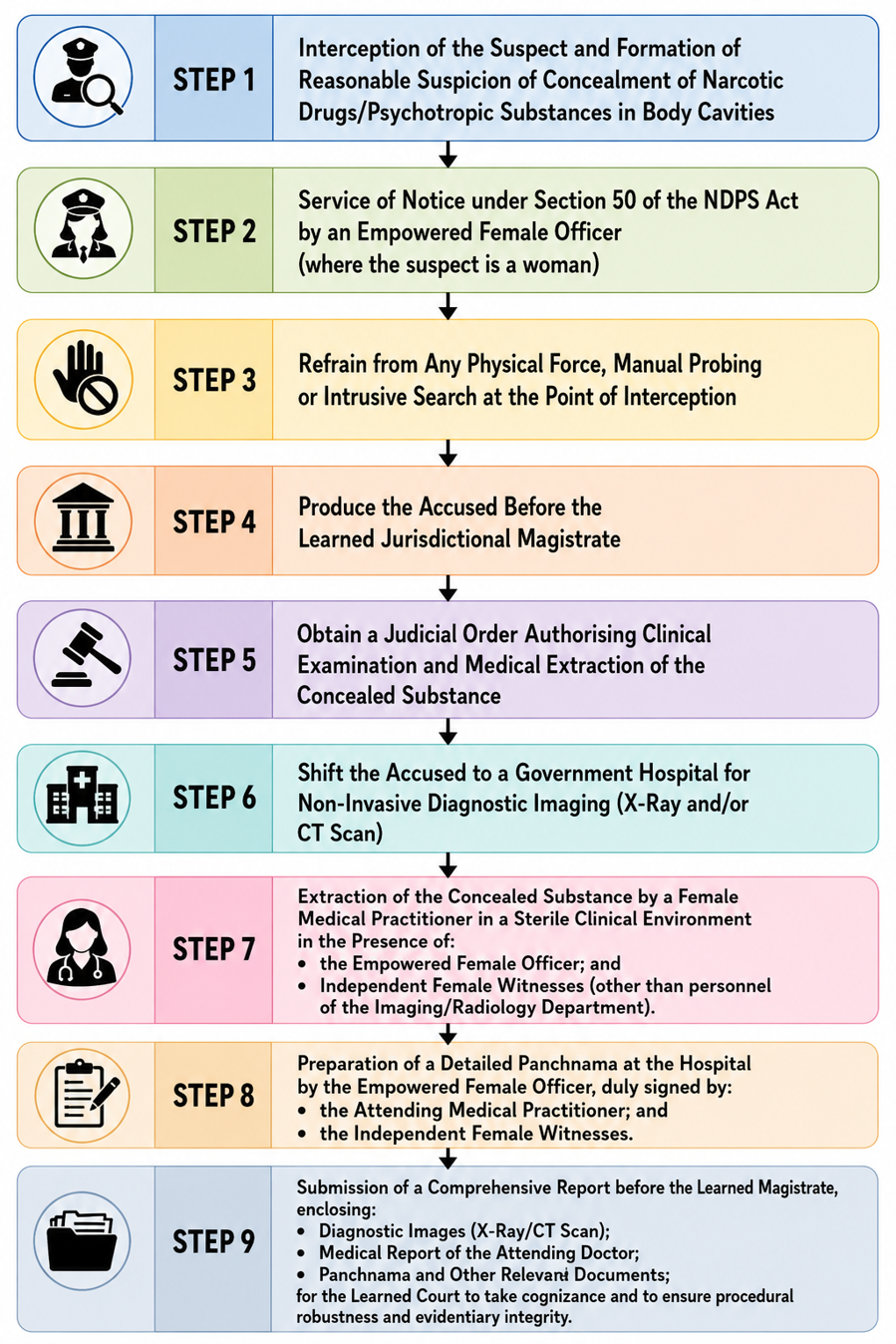
By ensuring that cases are handled strictly as a court-ordered medical procedure rather than a routine search, the empowered department/officer instill confidence in adopting a fair, transparent and just court-monitored method to rule out foul play. It also simultaneously exhibits the empowered department to the constitutional safeguards enshrined under Article 21.
Read More: China Plans New Gold Import Rules as Bullion Imports Surge

