
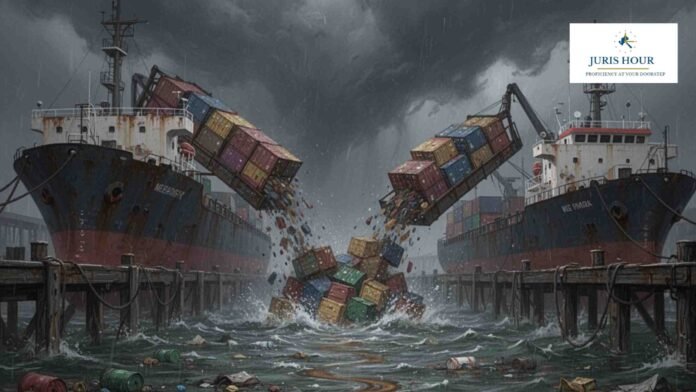
Indian Exporters has feared cargo dumping at random ports amid persian gulf shipping disruptions.
Indian exporters have expressed concern that shipping lines may begin offloading export consignments at unintended ports as disruptions in the Persian Gulf continue to affect maritime logistics. While the government has moved swiftly to simplify procedures and support exporters during the crisis, industry stakeholders fear that uncontrolled diversion or return of cargo could disrupt supply chains and cause congestion at major Indian ports.
Exporters are expected to raise these concerns with the government on Monday, particularly after the customs department and the shipping ministry announced a series of temporary relaxations aimed at facilitating cargo movement. Industry representatives warn that if returning containers are not managed efficiently, major gateways such as Jawaharlal Nehru Port and Mundra Port could face severe congestion, potentially slowing exports destined for key markets such as the United States and Europe.
According to Federation of Indian Export Organisations Director General Ajay Sahai, the government’s decision to facilitate the handling of returned cargo is timely given the uncertainty in shipping routes. However, he cautioned that efficient port management will be critical. “The initiative to facilitate returned export cargo is welcome in the present circumstances. However, it will be important to ensure that it does not result in congestion at key gateway ports that handle a large share of India’s trade with West Asia,” Sahai said, emphasizing the need to maintain smooth export supply chains.
On Sunday, the Central Board of Indirect Taxes and Customs issued detailed instructions to its field formations outlining procedures to deal with ships returning to Indian ports amid disruptions in the Strait of Hormuz. The disruption has created what officials described as an “exceptional situation” affecting several global shipping routes. The customs circular covers both vessels carrying export cargo that remain within India’s territorial waters and ships that are returning after having departed for overseas destinations.
As part of the temporary relief measures valid for 15 days, customs authorities have been instructed to manually recover any export incentives already disbursed, including Integrated GST refunds and duty drawback, if cargo is returned to India. Transshipment of cargo will continue to be handled according to existing provisions under customs law.
The Ministry of Ports, Shipping and Waterways has also directed ports to reduce storage and other charges for cargo that remains stranded due to the disruption. These measures aim to limit financial losses for exporters whose consignments are delayed or rerouted because of the geopolitical situation in West Asia.
In another supportive move, the Directorate General of Foreign Trade announced relaxations for exporters operating under export promotion schemes. In a public notice issued on Saturday, the DGFT said that exporters holding Advance Authorisations or Export Promotion Capital Goods (EPCG) licences with export obligations expiring between March 1 and May 31, 2026, will automatically receive an extension until August 31, 2026. The extension will be granted without the payment of any composition fee, providing breathing space for exporters struggling with delays caused by the shipping disruptions.
Despite the challenges, there are early signs that the movement of goods through the region may gradually improve. However, several major global shipping lines, including Maersk and Mediterranean Shipping Company, remain cautious and are still avoiding certain routes through the Persian Gulf due to security and operational risks.
Meanwhile, global logistics operator DP World has introduced temporary alternative routing arrangements for cargo destined for Gulf markets. Under the new plan, containers will be discharged at nearby regional hubs such as Khor Fakkan Port or Fujairah Port instead of the heavily used Jebel Ali Port. From these ports, containers will be transported by bonded road transit to Jebel Ali for final customs clearance and delivery.
Industry participants say these arrangements are helping to keep trade moving, though at a much slower pace. According to exporters, freight rates have surged sharply due to the disruption. Some shipping lines have resumed carrying containers, but with freight charges reportedly increasing by nearly 300 percent.
Exporters also report that cargo movement through Gulf ports remains significantly below normal levels. Limited volumes are being handled as containers are discharged only at ports that are currently operational, with congestion slowing onward movement.
Danish Shah of Pune-based Sanghar Exports said that shipping activity currently stands at only around 25–30 percent of normal levels. However, rising prices in Gulf markets due to reduced imports have partially offset the cost pressures. “Prices across Gulf markets have increased by nearly 300 percent due to lower imports. So despite the high freight costs, exports can still remain viable if deliveries are completed,” he said.
With the situation evolving rapidly, exporters are closely monitoring developments in shipping routes and port operations. Industry bodies have urged the government to continue coordinating with logistics providers and port authorities to prevent bottlenecks and ensure that India’s export supply chains remain resilient during the ongoing geopolitical uncertainty.
Read More: Port Procedures Relaxed for Returned Export Cargo Amid Strait of Hormuz Disruptions

