
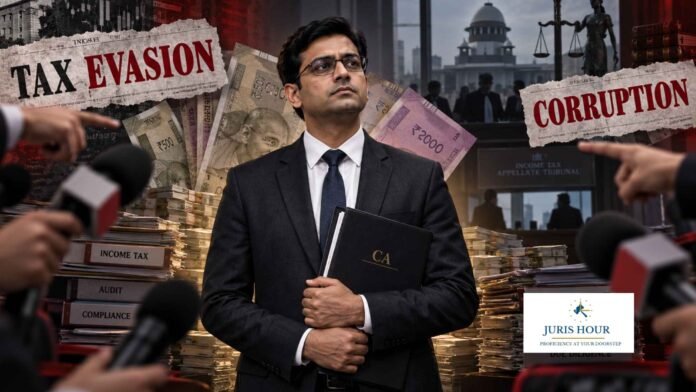
Congress leader Shaktisinh Gohil has alleged that chartered accountants played a significant role in facilitating a large-scale income-tax evasion racket involving registered unrecognised political parties, but no disciplinary or prosecutorial action was initiated against them despite recommendations reportedly made by Income Tax officials.
Addressing a press conference at the All India Congress Committee headquarters in New Delhi, Gohil claimed that more than ₹10,000 crore of black money had been generated through transactions involving registered unrecognised political parties, commonly referred to as RUPPs.
Buy Now: E-Magazine: Top 100 GST ITC Judgements (2024–25)
He alleged that around 3,260 such political parties were used to enable individuals and companies to wrongfully claim income-tax deductions against political donations. According to him, the recipient parties or their intermediaries allegedly retained a commission ranging from 2% to 15% before returning the remaining money to the donors in cash.
The allegations have not been independently established through a final judicial finding. No response from the Union Government, the Income Tax Department, the BJP or the Institute of Chartered Accountants of India to Gohil’s latest charges was immediately available.
CAs Accused of Facilitating Tax-Evasion Arrangements
Gohil alleged that certain chartered accountants were instrumental in structuring and facilitating the transactions through which taxpayers obtained deductions for political contributions while allegedly receiving most of the donated money back in cash.
He claimed that Income Tax officials examining such cases had explicitly recommended action against the chartered accountants allegedly involved. However, according to the Congress leader, no directions for initiating such action were issued by senior authorities.
Gohil used the expression “C team” while alleging that the professionals concerned enjoyed political protection. He accused the Modi government of shielding persons allegedly connected with the transactions and preventing the authorities from taking appropriate action against them.
The accusations were directed against the alleged involvement of particular professionals and did not concern the chartered accountancy profession as a whole.
Alleged Misuse of Political-Donation Deductions
Political contributions made by eligible taxpayers may qualify for deductions under the Income Tax Act, subject to prescribed conditions. Section 80GGB deals with contributions made by Indian companies to political parties or electoral trusts, while Section 80GGC covers qualifying contributions made by persons other than specified entities.
Gohil alleged that these provisions were misused by routing funds through registered unrecognised political parties. The taxpayers would allegedly make donations through banking channels, claim deductions in their income-tax returns and subsequently receive a substantial part of the donated amount back in cash.
The political party or persons controlling it would allegedly retain a percentage of the amount as commission. Such an arrangement, if proved, could result in the generation and circulation of unaccounted money while reducing the donor’s legitimate tax liability.
The Congress leader claimed that taxpayers falling within the highest income bracket could otherwise face an effective tax burden exceeding 42% after the applicable surcharge and cess. The alleged donation-and-cash-return mechanism was therefore used, he said, to avoid a substantial portion of the tax payable.
ITAT’s Observations Invoked
Gohil also referred to observations attributed to the Income Tax Appellate Tribunal concerning the wider consequences of organised tax evasion. He said the Tribunal had treated such conduct as seriously damaging to the country because the generation of black money could weaken both the national economy and national security.
He argued that the Tribunal’s observations demonstrated the gravity of the alleged transactions and warranted action not merely against the taxpayers and political entities but also against intermediaries and professionals who knowingly assisted in executing them.
The specific ITAT order relied upon during the press conference was not identified in the material accompanying the statement.
Congress Questions Absence of Penalty and Prosecution
Gohil claimed that tax authorities and appellate forums had detected instances of deliberate tax evasion involving false or accommodation entries. He questioned why the cases had not resulted in the imposition of stringent penalties or the launch of criminal prosecution against all persons allegedly involved.
Referring to Sections 276C(1) and 277 of the Income Tax Act, he said wilful attempts to evade tax and the making of false statements or declarations could attract prosecution. Depending on the applicable provision and the amount involved, the law may prescribe imprisonment and a fine.
He further alleged that the authorities had failed to impose the enhanced penalty that could become applicable where income is under-reported as a consequence of misreporting.
Whether a particular penalty or prosecution provision applies would, however, depend upon the evidence, the relevant assessment year, the statutory provision then in force and a finding that the prescribed conditions had been satisfied.
Election Commission’s Role Questioned
The Congress leader also questioned the Election Commission’s enforcement of transparency requirements applicable to political parties.
He referred to guidelines issued in 2014 concerning transparency and accountability in political funding. Gohil alleged that requirements relating to the disclosure of donations, expenditure and financial information had not been adequately enforced in the cases highlighted by him.
He demanded an investigation into the formation, management and financial activities of the political parties allegedly used for routing the transactions. He also sought action against taxpayers, party functionaries, intermediaries and professionals found to have knowingly participated in the alleged arrangement.
Government Accused of Shielding Those Involved
Gohil accused the Modi government of adopting a selective approach towards black money. He alleged that while the government publicly claimed to be acting against undisclosed income, persons associated with the political-donation transactions were being protected from prosecution and professional disciplinary proceedings.
He claimed that the absence of action despite findings or recommendations at the departmental level raised questions about whether enforcement authorities were being prevented from proceeding against influential persons.
The Congress leader called for a comprehensive investigation and disclosure of the action taken in cases where political donations were allegedly used as a device for claiming tax deductions and converting accounted funds into cash.
The allegations form part of a wider Congress claim that more than ₹10,000 crore was routed through registered unrecognised political parties for generating black money and evading income tax. Available reporting confirms that Gohil made these accusations at the Delhi press conference, but the claims remain allegations unless established through assessment, disciplinary, prosecution or judicial proceedings.
Read More: Gujarat High Court Quashes GST Refund Proceedings Initiated After Omission of R. 96(10)

