
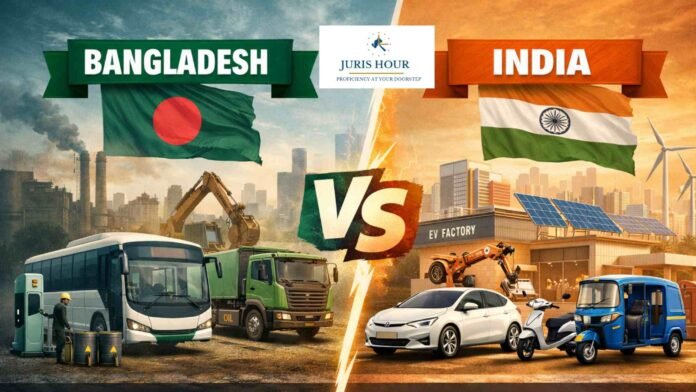
Bangladesh and India present two very different stages of electric vehicle (EV) transition, shaped by their policy priorities, market maturity, and industrial ecosystems. While Bangladesh is attempting to correct structural barriers to EV adoption, India has already moved into a scale-up phase driven by sustained policy support and growing consumer demand.
Bangladesh’s EV market remains at a nascent stage. Adoption levels are extremely low, with only a few hundred units imported annually, and the country is still largely dependent on imports. The government’s current push is driven primarily by rising fuel import costs and an ongoing energy crisis. The commerce ministry’s proposal to reduce import duties on electric buses, trucks, and heavy equipment reflects a broader strategy to cut fossil fuel dependence and lower operational costs in logistics and industrial sectors. However, the existing tax regime has been a major deterrent, with EVs often facing significantly higher duties than conventional vehicles.
In contrast, India’s EV market has witnessed rapid expansion over the past few years. EV sales have crossed the two-million mark annually, with penetration steadily increasing across segments. This growth has been supported by a combination of central and state-level incentives, including subsidies, reduced GST, and policy initiatives aimed at both demand generation and domestic manufacturing. India’s approach has been proactive and multi-layered, targeting not just adoption but also long-term industrial development.
Taxation policies highlight a key divergence between the two countries. Bangladesh has historically imposed higher import duties on EVs compared to internal combustion engine (ICE) vehicles, making them less attractive despite their long-term cost benefits. India, on the other hand, has reduced GST on EVs to a much lower rate and offers additional financial incentives, making EVs more competitive in terms of upfront cost. As a result, India has been able to stimulate consumer demand more effectively.
The composition of the EV market also differs significantly. Bangladesh is focusing primarily on commercial and heavy vehicles such as buses, trucks, and construction equipment, aiming to reduce fuel consumption in high-impact sectors. India’s EV growth, however, has been driven largely by two-wheelers and three-wheelers, which account for the majority of sales due to their affordability and suitability for urban mobility. Passenger vehicles are also gaining traction, though at a slower pace.
Another major point of contrast lies in domestic manufacturing capabilities. Bangladesh’s EV ecosystem is still developing, with limited local production and heavy reliance on imported vehicles and components. Industry stakeholders have emphasized the need for lower duties on parts and stronger incentives for local assembly. India, by comparison, has built a relatively strong manufacturing base, supported by production-linked incentive schemes and the presence of major domestic and global players such as Tata Motors, Mahindra & Mahindra, and BYD. This has enabled India to move towards a more self-reliant EV supply chain.
Infrastructure remains a challenge in both countries, though the gap is wider in Bangladesh. Charging infrastructure is still limited, and broader energy constraints further complicate EV adoption. India has made more progress in expanding charging networks across urban areas and highways, although infrastructure gaps still persist and remain a key bottleneck to faster adoption.
The underlying drivers of EV adoption also differ. Bangladesh’s push is largely motivated by the need to manage energy costs and reduce reliance on imported fuels. India’s transition is driven by a combination of environmental goals, energy security, and the ambition to become a global manufacturing hub for EVs. These differing motivations have influenced the design and implementation of policies in each country.
Both markets face challenges. Bangladesh must address high upfront costs, policy uncertainty, and infrastructure deficits, while also building a domestic manufacturing base. India, despite its progress, continues to face uneven adoption across segments, infrastructure limitations, and affordability concerns, particularly in the passenger vehicle segment.
In summary, Bangladesh is at an early stage of EV transition, focusing on removing policy barriers and initiating adoption, whereas India has already established momentum through comprehensive incentives, industrial policy support, and market-driven growth. Bangladesh can accelerate its transition by aligning taxation, promoting local manufacturing, and investing in infrastructure, drawing lessons from India’s more advanced EV ecosystem.
Comparative Snapshot: Bangladesh vs India EV Market
| Parameter | Bangladesh | India |
| Market Stage | Early-stage, import-driven | Scaling phase, growing adoption |
| EV Adoption | Very low (hundreds of units annually) | High and growing (millions annually) |
| Policy Approach | Duty reduction, early incentives | Subsidies, tax cuts, manufacturing push |
| Tax Structure | Higher taxes on EVs than ICE (currently) | Lower GST and incentives for EVs |
| Market Focus | Commercial vehicles (buses, trucks) | Two-wheelers, three-wheelers, growing PVs |
| Manufacturing | Limited, emerging | Strong and expanding ecosystem |
| Key Players | Few domestic + foreign tie-ups | Tata Motors, Mahindra & Mahindra, BYD |
| Infrastructure | Limited charging network | Expanding but still developing |
| Key Driver | Energy crisis, fuel import reduction | Climate goals, industrial growth |
| Major Challenge | High cost, weak ecosystem | Infrastructure gaps, uneven adoption |
Read More: Jewellery Stocks Rally as Govt. Cuts Gold, Silver Import Prices

