
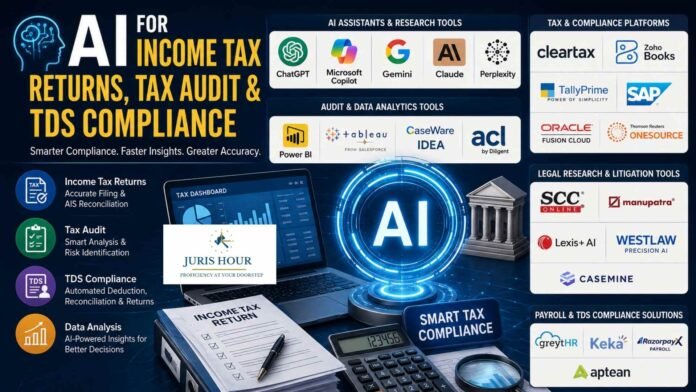
Artificial Intelligence (AI) is no longer a futuristic concept in taxation. It has rapidly emerged as one of the most disruptive technologies impacting tax administration, compliance, audits, and litigation across the globe. In India, where tax laws are becoming increasingly data-driven and compliance-intensive, AI is transforming the way Income Tax Returns (ITRs), Tax Audits, and TDS compliances are prepared, reviewed, and monitored.
From automated reconciliation of financial records to predictive tax risk analysis, AI is changing the traditional role of tax professionals. However, while AI offers unprecedented efficiency and accuracy, it also raises concerns regarding data privacy, accountability, professional judgment, and regulatory compliance.
This article explores how AI is reshaping direct tax compliance and what professionals must know before integrating AI into their practice.
The Rise of AI in Tax Compliance
The Indian tax ecosystem has undergone a significant digital transformation over the last decade. The introduction of:
- Faceless Assessments
- Annual Information Statements (AIS)
- Taxpayer Information Summaries (TIS)
- E-Verification Systems
- Data Analytics by the Income Tax Department
- PAN-Aadhaar Integration
- Real-Time TDS Reporting
has generated enormous amounts of taxpayer data.
Traditional manual review processes are often unable to effectively handle such volumes. AI-powered solutions bridge this gap by analyzing vast datasets in seconds, identifying inconsistencies, and generating actionable insights.
AI in Income Tax Return Filing
Automated Data Collection and Processing
Modern AI systems can automatically extract and classify information from:
- Bank statements
- Financial statements
- Form 16
- Form 26AS
- AIS
- TIS
- Capital gains reports
- Mutual fund statements
- Foreign asset disclosures
Instead of manually entering information, AI tools can gather and organize the data with minimal human intervention.
Benefits
- Reduced data entry errors
- Faster return preparation
- Improved accuracy
- Better document management
AI-Based Income Classification
One of the most time-consuming aspects of return filing is classification of income under appropriate heads.
AI tools can identify and categorize:
- Salary income
- Business income
- Capital gains
- House property income
- Other sources
The software can suggest tax treatment based on historical transactions and applicable provisions.
Detection of AIS and 26AS Mismatches
A common reason for scrutiny notices is mismatch between:
- Income reported in ITR
- AIS data
- Form 26AS
- TDS statements
AI-powered reconciliation engines can automatically identify:
- Missing income entries
- Incorrect TDS credits
- Duplicate reporting
- Unreported transactions
This significantly reduces the risk of notices from the Income Tax Department.
Capital Gains Computation
Computing capital gains from multiple equity, mutual fund, crypto, or property transactions can be highly complex.
AI systems can:
- Apply FIFO principles
- Compute indexed cost
- Identify exempt transactions
- Calculate STCG and LTCG
- Generate transaction-wise reports
What traditionally took several hours can now be completed within minutes.
AI in Tax Audits
Automated Ledger Scrutiny
Tax audits involve examining thousands of accounting entries.
AI can review:
- Sales ledgers
- Purchase ledgers
- Expense accounts
- Journal entries
- Related party transactions
and identify unusual patterns requiring further examination.
Identification of High-Risk Transactions
AI algorithms can detect:
Round Tripping
Repeated movement of funds among related entities.
Unusual Expense Claims
Abnormal expenses compared to industry standards.
Revenue Leakage
Unrecorded sales patterns or suspicious adjustments.
Related Party Risks
Transactions requiring disclosure under Income Tax Act provisions.
This enables auditors to focus on high-risk areas instead of routine verification.
Clause-Wise Tax Audit Review
Tax audit reporting under Form 3CD contains numerous disclosure requirements.
AI systems can assist in verifying compliance related to:
- Section 40A(3)
- Section 43B
- Section 269SS
- Section 269T
- Section 194 series
- MSME disclosures
- Depreciation schedules
The software can generate alerts wherever supporting documentation appears inadequate.
Document Review and Analysis
AI-powered document review tools can analyze:
- Agreements
- Invoices
- Loan documents
- Lease agreements
- Board resolutions
and highlight clauses having tax implications.
This significantly reduces review time during audits.
AI in TDS Compliance
Automated TDS Determination
One of the most frequent compliance challenges is identifying the correct TDS section.
AI can analyze:
- Nature of payment
- Vendor profile
- Historical deductions
- Contract terms
and suggest applicable sections such as:
- Section 192
- Section 194C
- Section 194J
- Section 194Q
- Section 194R
- Section 194S
This minimizes classification errors.
Vendor Compliance Monitoring
AI systems can continuously monitor:
- PAN validity
- Return filing status
- Lower deduction certificates
- Exemption certificates
This helps organizations apply appropriate TDS rates.
Detection of Short Deduction Risks
AI can compare:
- Invoice values
- Payment records
- TDS deductions
to identify instances where TDS may have been deducted at an incorrect rate.
Such proactive identification can help avoid:
- Interest liability
- Penalties
- Disallowances
under the Income Tax Act.
Automated TDS Return Preparation
AI-driven platforms can generate:
- Form 24Q
- Form 26Q
- Form 27Q
- Form 27EQ
after reconciling payroll and vendor payment data.
This reduces compliance timelines significantly.
How the Income Tax Department Uses AI
The government itself is increasingly leveraging AI and data analytics.
Risk-Based Scrutiny Selection
The Income Tax Department uses sophisticated algorithms to identify:
- High-risk taxpayers
- Under-reporting of income
- Abnormal deductions
- Suspicious financial transactions
for potential scrutiny.
Data Matching Across Sources
AI enables cross-verification of taxpayer information from:
- Banks
- Stock Exchanges
- Mutual Funds
- GST Returns
- Property Registries
- Foreign Financial Institutions
This has enhanced the Department’s ability to detect tax evasion.
Fraud Detection
Machine learning models can identify:
- Bogus deductions
- Shell entities
- Accommodation entries
- Circular transactions
with greater efficiency than traditional methods.
Benefits of AI for Tax Professionals
Increased Efficiency
Tasks that once required days can now be completed in hours.
Better Accuracy
Reduction in human error improves compliance quality.
Enhanced Client Service
Professionals can focus more on advisory and strategic planning rather than routine compliance.
Cost Reduction
Automation lowers operational costs for firms and businesses.
Scalability
A single professional can manage significantly larger volumes of work.
Challenges and Risks of AI in Tax Practice
Lack of Professional Judgment
AI can process data but cannot replace professional expertise.
Tax law frequently involves:
- Interpretation
- Judicial precedents
- Commercial substance analysis
which require human judgment.
Data Privacy Concerns
Tax records contain highly sensitive information.
Professionals must ensure:
- Secure storage
- Encryption
- Access controls
- Compliance with privacy laws
before uploading data to AI platforms.
Hallucination Risks
Generative AI tools occasionally generate incorrect legal conclusions.
Blind reliance on AI-generated responses may result in:
- Incorrect tax positions
- Wrong legal citations
- Defective compliance
Every AI-generated output must be independently verified.
Regulatory Uncertainty
Currently, there are no comprehensive regulations specifically governing AI usage in tax practice.
Questions remain regarding:
- Professional liability
- Data ownership
- Accountability for errors
- Ethical standards
The Future of AI in Taxation
The next generation of AI systems is expected to provide:
Real-Time Tax Compliance
Continuous monitoring instead of annual compliance reviews.
Predictive Tax Advisory
Forecasting future tax liabilities and opportunities.
Intelligent Litigation Support
AI-powered research of judicial precedents and legal arguments.
Voice-Based Tax Assistants
Natural language interfaces for taxpayers and professionals.
Automated Tax Risk Scoring
Early warning systems for compliance failures.
AI Softwares That Can Help You
ChatGPT: The Most Popular AI Assistant for Tax Professionals
One of the most widely adopted AI tools today is ChatGPT. Tax professionals are increasingly using ChatGPT to draft replies to notices, prepare legal submissions, summarize judgments, create compliance checklists, generate client advisories, and simplify complex tax provisions.
For example, a professional can upload a lengthy assessment order and obtain a concise summary of the issues involved. Similarly, tax audit clauses can be explained in simple language, and draft responses to notices can be generated within seconds.
However, while ChatGPT can significantly improve productivity, professionals must independently verify all legal conclusions and statutory references before relying on them in practice.
Microsoft Copilot: AI Inside Excel and Word
Microsoft Copilot has become particularly useful for tax practitioners who work extensively with spreadsheets and documents. Integrated directly into Microsoft Excel, Word, Outlook, and PowerPoint, Copilot can analyze financial data, generate reports, identify anomalies, summarize financial statements, and automate repetitive tasks.
For tax audit assignments involving large datasets, Copilot can quickly highlight unusual transactions, prepare summaries, and assist in generating audit documentation. Firms dealing with high volumes of TDS reconciliations and compliance reviews can benefit significantly from its integration with Microsoft Office applications.
Google Gemini for Tax Research and Compliance Updates
Google Gemini has emerged as a strong research-oriented AI platform. Tax professionals can use Gemini to analyze CBDT notifications, summarize Finance Act amendments, explain tax provisions, and review legal developments.
Its strength lies in accessing and organizing information available on the internet, making it particularly useful for staying updated on changes in tax laws and compliance requirements.
Claude AI: Ideal for Reviewing Large Documents
Among legal and tax professionals, Claude AI has gained popularity due to its ability to process lengthy documents with remarkable accuracy.
Tax practitioners can use Claude to review:
- Tax audit reports
- Assessment orders
- Appeal memoranda
- Financial statements
- Agreements and contracts
- Judicial decisions running into hundreds of pages
Its larger context window often makes it more effective than conventional AI tools when dealing with voluminous litigation files.
Perplexity AI: Research with Sources
Unlike many AI tools that provide answers without references, Perplexity AI provides responses along with source citations.
This feature makes it particularly useful for:
- Tax research
- CBDT circular verification
- Recent amendments
- Budget announcements
- International tax developments
Professionals can verify the source material before relying on the AI-generated analysis.
AI-Based Tax Compliance Platforms
ClearTax: AI for Return Filing and TDS Compliance
ClearTax has integrated AI into several compliance functions including income tax return preparation, TDS compliance, GST compliance, and AIS reconciliation.
Its AI-driven features help taxpayers and professionals identify mismatches between AIS, Form 26AS, and return data before filing. This significantly reduces the risk of notices and compliance disputes.
For businesses managing large vendor networks, AI-assisted TDS compliance can reduce errors relating to short deduction, incorrect section selection, and missed deductions.
Zoho Books and Zia AI
Zoho Books includes an AI assistant called Zia that helps businesses manage accounting and tax-related functions.
Zia can assist with:
- Expense categorization
- Financial trend analysis
- Invoice processing
- Business insights
- Tax-ready bookkeeping
Small and medium-sized businesses can particularly benefit from such automation.
TallyPrime and AI Integrations
Tally Solutions remains one of India’s most widely used accounting platforms. While Tally itself is primarily an accounting software, several AI-powered integrations now enable advanced analytics, automated reconciliations, and exception reporting.
These tools can assist professionals in identifying unusual ledger entries, mismatches, and compliance risks during audits and return preparation.
AI Tools for Tax Audits
Power BI and Data Analytics
Microsoft Power BI has become increasingly important for tax auditors. It enables professionals to visualize financial data, identify patterns, detect anomalies, and perform advanced analytical reviews.
Using Power BI, auditors can:
- Identify abnormal expense trends
- Detect revenue inconsistencies
- Analyze vendor payments
- Review related-party transactions
- Generate management reports
As tax audits become more risk-focused, data analytics tools are likely to become indispensable.
IDEA and ACL Analytics
Audit professionals frequently use tools such as CaseWare IDEA and Diligent ACL Analytics for forensic reviews and large-scale transaction testing.
These platforms can analyze millions of transactions, identify duplicate entries, detect suspicious payments, and support audit documentation.
AI for TDS Compliance
Payroll and ERP-Based AI Solutions
Modern ERP and payroll systems increasingly rely on AI for TDS compliance.
Examples include:
These platforms can automatically determine TDS applicability, validate PAN details, track vendor compliance, and generate statutory reports.
The result is reduced compliance risk and improved accuracy in TDS filings.
AI for Tax Litigation and Legal Research
SCC Online AI and Manupatra AI
Tax litigation requires extensive research and precedent analysis. AI-powered legal databases now significantly reduce research time.
Professionals can leverage:
- SCC Online
- Manupatra
- Lexis+ AI
- Westlaw Precision AI
- CaseMine
These platforms help identify relevant precedents, track judicial trends, analyze citations, and prepare litigation strategies.
How the Income Tax Department Uses AI
Interestingly, tax authorities themselves are among the largest users of artificial intelligence.
The Income Tax Department increasingly employs AI and advanced analytics to identify:
- High-risk taxpayers
- Under-reporting of income
- Mismatches in AIS and returns
- Suspicious financial transactions
- Shell entities
- Accommodation entries
Data is now being matched across multiple sources, including banks, stock exchanges, mutual funds, property registries, GST databases, and international reporting systems. As a result, the probability of detecting discrepancies has increased substantially.
Conclusion
Artificial Intelligence is transforming Income Tax Return filing, Tax Audits, and TDS compliance at an unprecedented pace. It offers substantial benefits in terms of efficiency, accuracy, and scalability while helping professionals manage increasingly complex compliance requirements.
However, AI should be viewed as a powerful assistant rather than a replacement for professional judgment. Tax laws involve interpretation, ethics, and strategic decision-making that still require human expertise. The most successful tax professionals in the coming decade will not be those who compete against AI, but those who learn to effectively collaborate with it.
As India’s tax ecosystem becomes more technology-driven, the integration of AI into tax practice is no longer optional—it is becoming an essential component of modern tax compliance and advisory services.
Read More: CA Firms Now Eligible Under PM Internship Scheme; Interns to Receive Rs. 9,000 Monthly Stipend

