
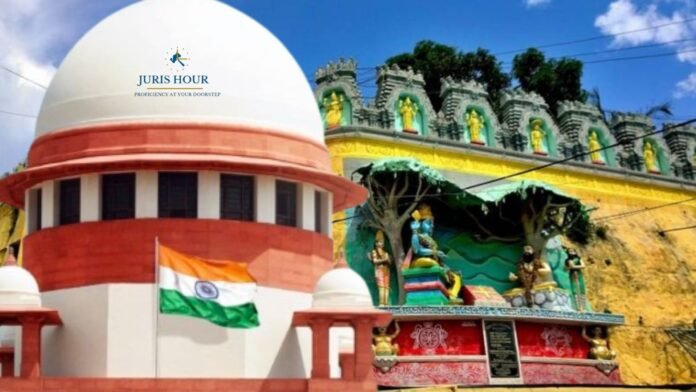
The Supreme Court has set aside the removal of the Mahant (Mathadhipati) of Sri Swamy Hathiramji Mutt, Tirupati, holding that the proceedings conducted by the Andhra Pradesh Dharmika Parishad were fundamentally flawed due to serious violations of procedural fairness.
The bench of Justice J.K. Maheshwari held that the removal proceedings suffered from multiple infirmities, including failure to supply relied-upon documents, denial of adequate opportunity to defend, and concerns regarding bias in the inquiry process.
The bench consequently quashed the removal order, the government’s confirmation of that order, and related consequential actions.
Table of Contents
Background of the Dispute
The case arose from the removal of the incumbent Mathadhipati of Sri Swamy Hathiramji Mutt, a prominent religious institution in Tirupati. The appellant had been associated with the Mutt since the 1970s and was formally appointed as the permanent Mahant in 2000 under the Andhra Pradesh Charitable and Hindu Religious Institutions and Endowments Act, 1987.
Over the years, disputes emerged regarding the management of the Mutt and its extensive properties. In 2023, the Dharmika Parishad framed sixteen charges against the Mahant, suspended him from office, appointed a Fit Person to administer the institution, and subsequently ordered his removal after finding all charges proved. These charges ranged from alleged mismanagement of Mutt properties and financial irregularities to violations of monastic traditions and failure to protect institutional assets.
The Andhra Pradesh High Court largely upheld the findings and removal order, leading the Mahant to approach the Supreme Court.
Core Issue Before the Supreme Court
The principal question before the Court was whether the proceedings leading to the Mahant’s removal complied with the principles of natural justice mandated under Section 51 of the Andhra Pradesh Charitable and Hindu Religious Institutions and Endowments Act, 1987.
The appellant contended that neither the complete charge memo nor the voluminous documents relied upon by the authorities were ever supplied to him before the inquiry. He further alleged that the inquiry committee was biased and that the entire process had been predetermined.
Supreme Court Finds Violation of Natural Justice
The Supreme Court emphasized that removal of a Mathadhipati is not an ordinary administrative action but one involving significant civil, religious, and constitutional rights. It observed that the requirement of fairness under Article 14 of the Constitution applies with full force to such proceedings.
The Court noted that the charge memo consisted of 27 pages and was supported by 29 documents running into more than 600 pages. However, these materials were not properly supplied to the appellant before the inquiry was conducted.
Rejecting the authorities’ argument that service had been effected by affixing documents at the Mutt premises, the Court observed that the authorities themselves had already taken possession of those premises and the Mahant had been removed from the location. Service through affixation under such circumstances could not be treated as valid notice.
The Bench held that a meaningful opportunity to defend oneself is impossible unless the person facing charges receives all materials relied upon against him.
Inquiry Committee’s Conduct Criticised
The Court also found fault with the inquiry process itself. It recorded that the appellant had repeatedly sought copies of documents and requested reasonable time to prepare his defence. Those requests were ignored, and the inquiry was proceeded with ex parte.
The judgment observed that the inquiry committee displayed a disregard for procedural fairness by refusing to provide the requested materials and by not granting sufficient opportunity to contest the allegations.
Concerns Over Bias and Predetermination
Another significant aspect of the ruling relates to the composition and conduct of the Dharmika Parishad.
The Court noted that before charges were even framed, the Dharmika Parishad had passed a resolution authorising preparation of charges and suspension proceedings against the Mahant. According to the Bench, such pre-decisional conduct created a reasonable apprehension that the outcome of the proceedings had been predetermined.
The Court further observed that members of the Dharmika Parishad who had participated in earlier decisions subsequently became involved in the inquiry process, raising concerns under the doctrine of nemo judex in causa sua—the principle that no person should be a judge in their own cause.
High Court’s Approach Found Unsustainable
The Supreme Court held that the Andhra Pradesh High Court erred in presuming that the appellant possessed the necessary documents merely because he had responded to the charges in detail.
The Bench stated that once a foundational defect in the inquiry process is established, the issue is not whether some charges could otherwise have been sustained, but whether the inquiry itself was conducted fairly and in accordance with law. The High Court, while exercising appellate jurisdiction, ought to have addressed the procedural violations independently and set aside the proceedings.
Article 142 Invoked for a Unique Solution
Ordinarily, the Court noted, the matter would have been remanded to the Dharmika Parishad for a fresh inquiry.
However, considering the peculiar circumstances of the case, the pending challenge to aspects of the statutory framework, the concerns regarding institutional bias, the absence of a clear independent inquiry mechanism under the Act, and the prolonged litigation history, the Court invoked its extraordinary powers under Article 142 of the Constitution.
The Bench held that a mere remand would not adequately protect the rights of the appellant or ensure a fair process.
Retired District Judge Appointed to Conduct Fresh Inquiry
To ensure impartiality, the Supreme Court constituted a one-man independent inquiry committee headed by retired District Judge Mr. Boddepalli Rama Rao.
The Court directed that:
- All documents relied upon by the authorities must be supplied to the inquiry committee and thereafter to the appellant.
- The appellant must be given at least four weeks to submit his defence.
- Full opportunity must be granted to examine documents, cross-examine witnesses, and adduce evidence.
- The inquiry must strictly comply with principles of natural justice.
- The inquiry report should be submitted within one year.
Importance of the Office of a Mathadhipati
The judgment contains an extensive discussion on the constitutional and religious significance of the office of a Mathadhipati.
Relying on earlier landmark precedents, the Court reiterated that a Mahant is not merely an administrator of temple or Mutt properties but also the spiritual head of the institution. The religious and secular aspects of the office are intertwined and cannot ordinarily be separated.
The Bench emphasized that any deprivation of such an office must occur only through procedures that are demonstrably fair, neutral, and constitutionally compliant.
Allowing the appeal, the Supreme Court set aside the Andhra Pradesh High Court judgment dated 9 May 2025; the removal order dated 24 November 2023; the State Government’s confirmation order dated 8 December 2023; the consequential order dated 19 January 2024; and the inquiry report dated 1 August 2023.
The Court directed that a fresh inquiry be conducted by an independent retired judicial officer, thereby reaffirming that adherence to natural justice is indispensable, particularly when proceedings affect religious offices and institutions of public significance.
Case Details
Case Title: Arjun Dass Versus The State Of Andhra Pradesh And Ors.
Citation: JURISHOUR-1487-SC-2026
Case No.: SLP (Civil) No. 38500 OF 2025
Date: 29/05/2026
Read More: Rs. 11 Lakh Compensation for Illegal Detention After Parole Order: Supreme Court

