
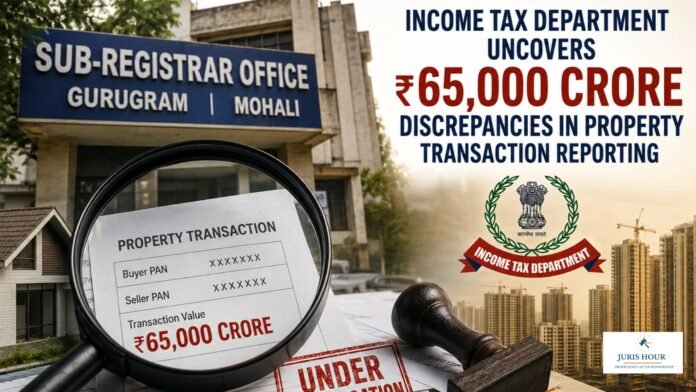
The Income Tax Department conducted survey and spot verification operations at sub-registrar offices in Gurugram and Mohali after receiving intelligence inputs regarding significant lapses in the reporting of high-value real estate transactions.
The action was initiated by the Directorate of Intelligence and Criminal Investigation (I&CI), Chandigarh, with teams reaching the offices early in the morning to examine transaction records and reporting practices.
Massive Irregularities Detected
Preliminary findings have revealed discrepancies involving property transactions worth approximately ₹65,000 crore.
- Gurugram Tehsil: Around ₹45,000 crore in irregular transactions
- Mohali Tehsil: Approximately ₹20,000 crore in discrepancies
Officials indicated that this is one of the largest instances of reporting irregularities uncovered in such proceedings anywhere in India.
Legal Requirement for Reporting Property Transactions
Under the Income Tax Act, sub-registrar offices are designated as reporting entities and are required to submit a Statement of Financial Transactions (SFT) to the department.
These reports must contain details of all immovable property transactions valued above ₹30 lakh, including:
- PAN of buyers and sellers
- Transaction value
- Complete buyer-seller mapping
This data is used by the department to match property purchases and sales with income disclosures made by taxpayers in their income tax returns.
Nature of Discrepancies Found
During the verification exercise, Income Tax officials compared the data available in state registry management systems with the information furnished to the department.
The analysis revealed widespread deficiencies, including:
- Non-reporting of eligible transactions
- Missing PAN details
- Incorrect PAN entries
- Wrongly mapped buyer and seller information
- Incomplete or inaccurate uploading of records
Officials noted that in numerous cases, PAN details were either absent or entered incorrectly, making it difficult to identify the parties involved and trace the financial trail.
In several other instances, buyer and seller information was not properly linked, significantly reducing the utility of the data for tax profiling and compliance monitoring.
Importance of Third-Party Reporting
The Income Tax Department increasingly relies on third-party reporting from institutions such as banks, registrars, mutual funds, and other designated entities to detect possible concealment or under-reporting of income.
Once accurate information is received, it is electronically matched with taxpayers’ filed returns. In cases where discrepancies are identified, taxpayers are typically encouraged through compliance campaigns to voluntarily update or correct their returns.
Focus on Data Integrity and Voluntary Compliance
Officials clarified that the primary objective of the operations was to improve the quality and reliability of information being submitted by reporting authorities rather than to initiate immediate enforcement action against taxpayers.
However, once corrected data is received, the department may scrutinize cases involving significant financial mismatches.
The emphasis, officials said, remains on promoting voluntary compliance and enabling taxpayers to file updated returns where necessary.
Corrected Records to Be Sought
Following the survey operations, the department is expected to direct the sub-registrar offices in Gurugram and Mohali to furnish corrected and complete transaction records.
This will allow the information to be effectively used for:
- Taxpayer verification
- Compliance monitoring
- Detection of unreported income
- Data-driven risk assessment
Strengthening Transparency in Real Estate Sector
The Income Tax Department has also stepped up outreach efforts through sensitization programmes and meetings with reporting entities, including state revenue authorities.
These initiatives are aimed at ensuring strict adherence to reporting standards prescribed under the Income Tax Act and improving data accuracy.
Officials believe that such exercises will:
- Enhance transparency in the real estate sector
- Strengthen voluntary tax compliance
- Improve the efficiency of non-intrusive tax administration
The latest action underscores the department’s increasing use of technology and data analytics to identify irregularities and ensure that high-value transactions are properly reported and taxed.

