
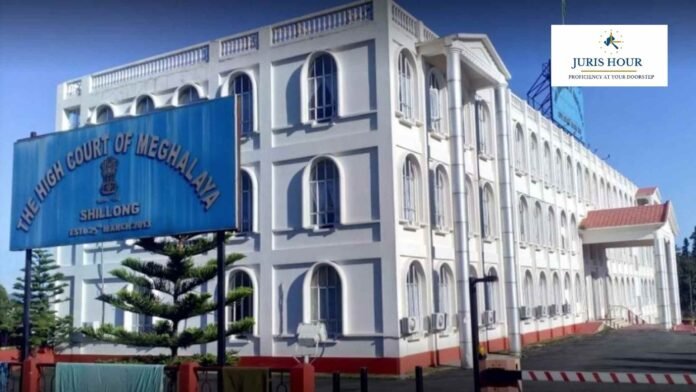
The Meghalaya High Court has declined to entertain a petition filed by the Union of India challenging an order of the Central Administrative Tribunal (CAT), Guwahati Bench, holding that the Tribunal’s order was a consent order and that the Union had an alternative efficacious remedy before the CAT itself.
The Bench of Chief Justice Revati Mohite Dere and Justice W. Diengdoh disposed of the petition without examining the merits of the subsequent decision taken by the Customs authorities.
The proceedings arose from Original Application before the CAT, Guwahati Bench. The Union of India and senior Customs authorities approached the Meghalaya High Court seeking modification of the CAT’s order dated September 13, 2024.
Buy Now: 70+ Judgements Indirect Tax – July 2026 | E-Magazine
The Union sought permission to reconsider the issue concerning the pay entitlement of the respondents and to pass a fresh speaking order. Essentially, the petitioners wanted the High Court to permit them to revisit the matter instead of allowing the consequences of the CAT proceedings and the subsequent administrative decision to stand.
The High Court noted that the CAT had not adjudicated the merits of the original application. Instead, by its September 13, 2024 order, the Tribunal directed the Commissioner of Customs, North East Region, Shillong, to consider the representations submitted by the employees.
The representations dated April 25, 2018, May 29, 2018, May 2, 2024 and May 3, 2024 were required to be considered within three months from the receipt of the certified copy of the CAT’s order.
A significant factor before the High Court was that the Union’s counsel before the CAT had no objection to the proposal that the concerned authority be directed to decide the representations. The High Court therefore treated the CAT’s order as a consent order.
Pursuant to the CAT’s direction, the Ministry of Finance, Department of Revenue, through the Office of the Commissioner of Customs (Preventive), passed an order on April 30, 2025.
The said order was issued after consideration of the employees’ representations and was stated to have been made in terms of the recommendations of the 7th Pay Commission. The High Court recorded that the order had been passed pursuant to the earlier CAT direction.
The respondents argued that if the Union was aggrieved by the April 30, 2025 decision, its proper course was to approach the CAT rather than challenge the earlier consent order before the High Court. The High Court found merit in this contention.
The Division Bench emphasised that the CAT’s September 13, 2024 order had been passed without entering into the merits of the original dispute. The Tribunal had merely directed the competent authority to consider the representations.
Importantly, the Union’s counsel had consented to such a direction before the CAT. In these circumstances, the High Court held that it was not open to the Union to subsequently challenge the consent order before the High Court.
The ruling therefore underscores the significance of a party’s position before a judicial or quasi-judicial forum. Where a party has consented to a procedural direction and the order is subsequently acted upon, it cannot ordinarily seek to challenge that very consent order in a subsequent proceeding.
The High Court also declined to examine the merits of the April 30, 2025 administrative order. Instead, it held that the petitioners had an alternative efficacious remedy available under law.
According to the Bench, the Union was free to approach the CAT if it had any grievance against the decision taken pursuant to the Tribunal’s earlier order. The existence of this alternative remedy was another reason for the High Court to decline interference in the writ petition.
The Meghalaya High Court held that it was not inclined to entertain the writ petition. The Court clarified that the petitioners remained free to take appropriate steps in accordance with law before the appropriate forum.
The petition was accordingly disposed of on these terms, with the parties permitted to act on the authenticated copy of the order.
Membership Required to Access Case Details & Order Copy
To view the complete Case Details and Download Order Copy, you must have an active membership. Please subscribe to continue.
Read More: GST Officers Can’t Keep Business Premises Sealed After Search Ends: Gauhati HC

