
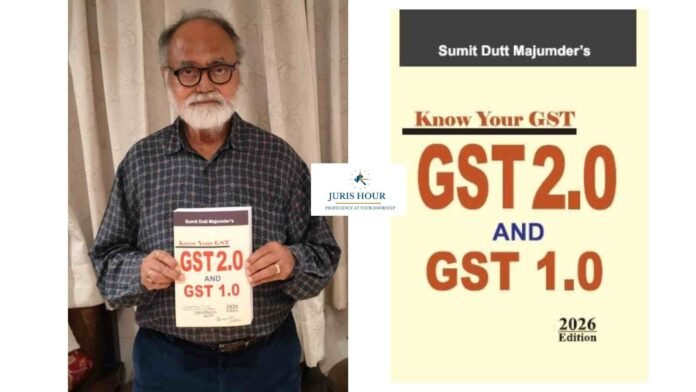
GST – Explained for Common Man is a thoughtfully written guide that simplifies India’s Goods and Services Tax regime for a wide audience. Authored by Sumit Dutt Majumder, a former Chairman of the Central Board of Excise and Customs, the book carries both authority and clarity.
The preface, as reflected in the provided pages, highlights the long journey of Goods and Services Tax from its conceptual discussions in 2006 to its rollout in July 2017 and beyond. The author situates GST not merely as a tax reform but as a structural transformation of India’s indirect taxation system, shaped by years of negotiation between the Centre and states.
Table of Contents
Writing Style and Accessibility
The book explains the transition from GST 1.0 to GST 2.0, why changes are needed, and how they affect the economy and people. The government plans major GST changes called “GST 2.0”: Tax slabs reduced from four to two: 5% and 18% ; Essential items will become cheaper; “Sin goods” will be taxed at 40%.
The current GST system (since 2017) is referred to as GST 1.0 in the book.
The book starts by explaining GST 2.0, then explains GST 1.0 basics to build understanding; includes 31 articles by the author explaining how GST 1.0 developed and worked. Finally returns to GST 2.0 analysis, including real-world experiences during its implementation period
This is the author’s sixth book on GST, written with help from colleagues, friends, and family.
This section presents a reflective and critical overview of the Goods and Services Tax (GST) framework, highlighting both its achievements and structural concerns.
The author begins by appreciating the simplification of GST rate structures—from multiple slabs to a more streamlined system—as a positive reform that boosted consumption and revenue collection. However, caution is raised about the sustainability of this growth, noting that any decline in demand could directly reduce GST revenues and strain the Centre’s ability to compensate states.
A major concern highlighted is the treatment of small businesses (MSMEs). The author argues that bringing small businesses under GST may be counterproductive due to compliance burdens, low revenue contribution, and increased risks of inefficiency and corruption. Instead, a higher exemption threshold (suggested around ₹60 lakh) is recommended to keep most small businesses outside GST, while easing regulatory provisions if they are included.
The text also emphasizes the interdependence between GST and economic performance. Since GST is a tax on supply, weak economic conditions reduce demand, supply, and ultimately tax collections. Thus, GDP growth and GST revenues are closely linked and influence each other.
Another key point is the role of enforcement and anti-evasion measures. Institutions like GST intelligence and enforcement wings have contributed to improved compliance and increased taxpayer participation. Strengthening these bodies is seen as essential to curb tax evasion.
The importance of audit mechanisms is also underlined. While GST is built on trust and self-compliance, the presence of fraudsters necessitates a robust audit and anti-evasion framework to maintain system integrity.
On the technological front, the author praises digitisation (GSTN) for simplifying tax administration, improving data analytics, and enhancing efficiency, despite initial implementation challenges.
Finally, the inclusion of petroleum and alcohol under GST is identified as a pending and politically sensitive reform, with likely resistance from state governments.
Coverage of GST Concepts
The book provides a comprehensive overview of GST fundamentals. It explains essential concepts such as supply, taxability, input tax credit, registration, and return filing in a structured manner. It also touches upon more nuanced areas like the reverse charge mechanism, composition scheme, and inter-state transactions under IGST.
What makes the coverage effective is the balance between breadth and simplicity. While it does not overwhelm the reader with excessive technical detail, it still manages to give a clear understanding of how GST operates in practice.
Historical Context and Evolution
A key strength of the book, evident from the preface, is its detailed account of the evolution of GST in India. The author traces the policy journey from early discussions and political negotiations to implementation challenges such as GSTN portal glitches and compliance issues.
He also reflects on the transition into what he refers to as “GST 2.0,” emphasizing the need for continuous reforms even after the initial rollout. This historical perspective adds depth and helps readers understand the rationale behind various provisions and changes.
Practical Relevance
The book is designed with practical utility in mind. It caters to a diverse readership, including taxpayers, students, professionals, and government officers. By focusing on real-world application rather than purely theoretical discussion, it becomes a useful reference for understanding day-to-day GST compliance and procedures.
The inclusion of simplified explanations of business processes makes it especially helpful for small business owners and individuals new to taxation.
Limitations
While the book is highly effective as an introductory and conceptual guide, it has certain limitations. Some portions may not fully reflect the latest amendments and evolving jurisprudence in GST. It is not intended to serve as a detailed professional reference for complex litigation or advanced tax planning.
Readers seeking in-depth legal analysis or case law may need to supplement it with more technical resources.
Final Assessment
GST – Explained for Common Man stands out as a clear, authoritative, and reader-friendly guide to one of India’s most significant tax reforms. Sumit Dutt Majumder, as a former Chairman of the Central Board of Excise and Customs, brings insider perspective and credibility, successfully bridging the gap between complex legislation and practical understanding.
The book is particularly valuable for beginners and those seeking conceptual clarity. It also serves as a useful starting point before moving on to more advanced GST literature.
Buy the Book
You can purchase the book here:
https://www.amazon.in/Sumit-Majumder-Guide-Nandy-Books/dp/9347298522

