
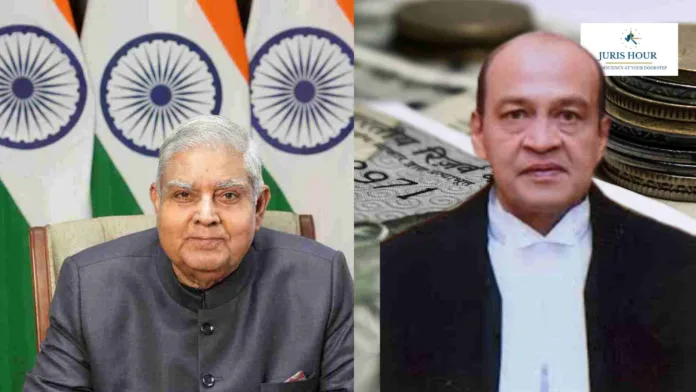
Vice-President of India Jagdeep Dhankhar on Monday publicly questioned the legitimacy and effectiveness of the in-house investigation into allegations of corruption against Justice Yashwant Varma, calling the inquiry constitutionally unsound and legally inconsequential.
Speaking at the launch event of the book The Constitution We Adopted, edited by Senior Advocate Vijay Hansaria, Dhankhar voiced strong criticism of the three-judge committee—comprising Chief Justice Sheel Nagu, Chief Justice GS Sandhawalia, and Justice Anu Sivaraman—that had probed the matter. The Vice-President highlighted the lack of constitutional or statutory backing for the committee, noting that such inquiries, undertaken on the court’s administrative side, do not carry binding legal authority.
“Just imagine the effort that went into this process involving Chief Justices of two High Courts—one of which covers two states and a union territory—all for an inquiry that lacks constitutional premise and legal sanctity. Most importantly, it is inconsequential,” Dhankhar said.
He raised concerns about the opacity surrounding the investigation, pointing out that the public remains uninformed about critical aspects, such as whether any electronic evidence was recovered, the origin and purpose of the seized cash, or the identification of others involved.
“For a week, a country of 1.4 billion people was kept in the dark. Just imagine how many such instances may have occurred. Every such case erodes public trust and impacts the common man,” he added.
Vice-President Dhankhar lauded former Chief Justice of India Sanjiv Khanna for making the initial inquiry report public, calling it a step toward restoring institutional credibility. The report, which indicted Justice Varma following the recovery of a large sum of cash from his Delhi residence, was forwarded by CJI Khanna to both the President and the Prime Minister on May 8 after Varma declined to resign.
Dhankhar called for a re-evaluation of the 1991 Supreme Court judgment in K Veeraswami v. Union of India, which laid the groundwork for the in-house probe mechanism. He argued that the ruling creates a legal shield for judges, which in the present case curtailed the powers of both the judiciary and the executive.
“A scaffolding of impunity has emerged, one that neutralises all efforts aimed at ensuring accountability and transparency,” he warned, urging for a systemic overhaul.
The Vice-President underlined the need for a “thorough and scientific” investigation, insisting that justice must be seen to be done in order to repair the public’s faith in the judiciary.
“Names are floating, and reputations are hanging in the balance. The system will be cleansed and regain its integrity only when the guilty are held accountable. Everyone is innocent until proven guilty, but this incident is a glaring example of the systemic issues we must confront today,” he concluded.
The controversy surrounding Justice Varma has reignited debate over the transparency and accountability of the judiciary, with Dhankhar’s remarks signalling an urgent call for institutional reform.
Read More: Penalty U/S 114AA Of Customs Act Applicable Prospectively: CESTAT

