
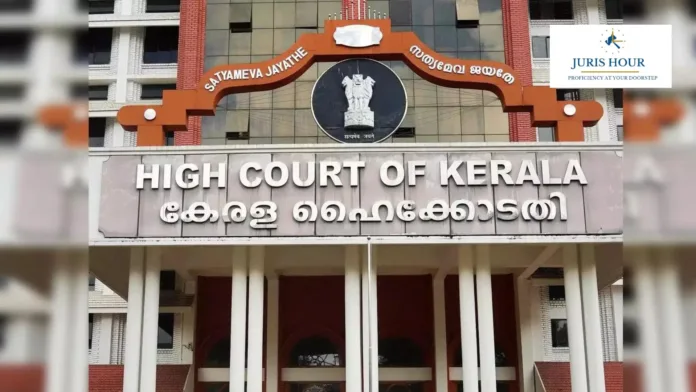
The Kerala High Court has extended the GST adjudication deadline citing interim order passed in the writ petition staying further proceedings under Section 74 of the GST Act.
The bench of Justice A.K.Jayasankaran Nambiar and Justice Easwaran S. has observed that going by the time limit prescribed under sub-Section (10) of Section 74 of the CGST Act/SGST Act, the adjudication has to be completed by 8.2.2025. However, in view of the interim order passed in the writ petition staying further proceedings under Section 74, which was in operation for a period of seven days, the Revenue will get the benefit of the stay and the period of adjudication will expire only on 15.2.2025.
The respondent/assessee approached the writ court by filing the writ petition challenging show cause notice issued under Section 74 of the GST Act, 2017. The assessee is engaged in the business of sale of gold, silver and diamond ornaments.
The appellant conducted a search in the premises of the writ petitioner and collected certain data from the software “Gold Mine”, which was used by the assessee for billing purposes. Later, a notice was issued requiring the assessee to show cause as to why an amount of Rs.4,88,56,298/- shall not be assessed as short paid on detection of suppression of outward supply for the periods 2017-18 to 2023-24 and a further amount of Rs.11,85,843/- shall not be imposed as flood cess.
Pointing out various discrepancies in the notice to show cause, the assessee preferred reply. Placing reliance on the on the order of the Single Judge who considered the writ petition ordered that the authorities under the SGST Act, 2017 will consider the preliminary issue raised by the petitioner against the invocation of Section 74, especially with regard to the contention of the petitioner/assessee that a part of the alleged suppressed turnover belongs to a separate entity belonging to her husband with a separate registration.
Read More: General Store Exposed As Epicenter Of ₹67 Crore GST Fraud
The State in this appeal contending primarily that the scheme of the CGST Act/SGST Act does not envisage separate orders being passed in the nature which has been directed by the Single Judge.
The issue raised was whether the direction of the learned Single Judge can be sustained in the light of the statutory scheme envisaged under CGST Act/SGST 2017.
Section 74(1) of the CGST Act/SGST Act authorises the proper officer to issue a notice to show cause. Sub-Section (2) of Section 74 envisages that such notice shall be issued six months prior to the time limit specified under sub-Section (10) of Section 74.
The court held that there is no provision enabling either the assessee to claim adjudication in stages nor has any power being conferred upon the proper officer to adjudicate the lis in stages.
When a request is made by the assessee either before the authorities or before the court to have their lis adjudicated in part, then, before granting such request, the authority or the court should ask themselves whether such threshold part adjudication is really necessary and whether it will not lead to other drastic consequences.
The court held that it is rather in the interest of the assessee that a complete adjudication of the issue is done by the proper officer under Section 74 of the CGST Act/SGST Act because of the accumulation of the interest factor on the tax that may be ultimately found due from him.
The court held that the jurisdiction of the High Court under Article 226 of the Constitution of India cannot be allowed to be exploited by those who can afford to wait to the detriment to those who cannot afford to wait by dragging the latter to the court for adjudication on peripheral issues, avoiding decision on the issues more vital to them. Article 226 of the Constitution of India is not meant to be used to break the resistance of the Revenue in this fashion. In exercise of jurisdiction, the High Court is required to refrain from issuing directions to the authorities under the taxation statute to decide issues in stages or on a preliminary basis.
Case Details
Case Title: The Deputy Commissioner (Intelligence) Versus Minimol Sabu
Case No.: WA NO. 238 OF 2025
Date: 6/02/2025
Counsel For Petitioner: Resmitha Ramachandran
Counsel For Respondent: Akhil Suresh

