
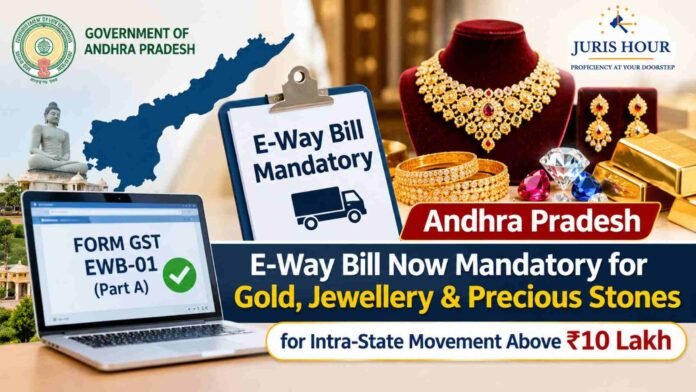
The Government of Andhra Pradesh has made the generation of e-way bills mandatory for the intra-State movement of gold, jewellery, precious metals and specified precious and semi-precious stones where the consignment value exceeds ₹10 lakh.
New Rule 138F requirement applies to intra-State movement of specified precious goods, including movements for job work, polishing, hallmarking, repair and exhibition; only Part A of FORM GST EWB-01 is required.
The requirement has come into force with effect from November 21, 2026. Alongside the proceedings, the Commercial Taxes Department has also issued Trade Circular No. 01/2026 dated November 21, 2026, prescribing detailed operational guidelines and clarifications for implementation.
E-Way Bill Mandatory for Consignments Exceeding ₹10 Lakh
Under the new requirement, every registered person causing the intra-State movement of specified goods covered under Serial Nos. 4 and 5 of the Annexure to Rule 138(14) of the APGST Rules, 2017, must furnish the prescribed information in Part A of FORM GST EWB-01 electronically before commencement of the movement, where the consignment value exceeds ₹10 lakh.
The requirement applies to movements undertaken in relation to a supply, for reasons other than supply, and pursuant to inward supply received from an unregistered person.
The specified goods include natural or cultured pearls, precious and semi-precious stones, precious metals, metals clad with precious metals, jewellery, goldsmiths’ and silversmiths’ articles and other goods covered under the relevant entries of Rule 138(14).
Only Part A of FORM GST EWB-01 Required
An important clarification provided by the Andhra Pradesh Government is that furnishing Part B of FORM GST EWB-01 is not required for movements covered under Rule 138F.
Upon furnishing the prescribed information in Part A, the e-way bill will be generated electronically on the common portal in accordance with the applicable provisions.
The requirement applies irrespective of whether the goods are transported by the registered person himself or through a transporter, courier agency or e-commerce operator. In cases involving e-commerce operators or courier agencies, such operators or agencies may furnish the information in Part A in accordance with the applicable provisions of Rule 138F.
Interestingly, the requirement also applies to the movement of specified goods through non-motorised conveyances, subject to the prescribed threshold and other applicable conditions.
Job Work, Hallmarking, Polishing and Repair Also Covered
The Trade Circular specifically clarifies that the e-way bill requirement is not restricted to movements involving the sale of goods.
It also covers movements undertaken for purposes other than supply, including:
- Job work.
- Stone fixation and polishing.
- Testing and hallmarking.
- Repair and maintenance.
- Exhibition and display.
Where goods are successively entrusted to different persons for job work, hallmarking, polishing or similar processing, each movement must be supported by the prescribed documents.
The persons concerned must maintain records of quantities received or held, quantities entrusted or returned and the balance remaining in their possession. A fresh e-way bill must be generated for every subsequent movement wherever Rule 138F requires it.
Special Clarification for Retail B2C Transactions
The Trade Circular provides relief in respect of certain over-the-counter retail transactions.
Where a registered seller makes an over-the-counter B2C sale, hands over the goods to an unregistered customer and transfers title at the point of sale, the requirement under Rule 138F will not apply to the seller in respect of subsequent movement independently undertaken by the customer.
However, this relaxation will not apply where the registered seller itself causes or arranges the subsequent movement of the goods.
Consignment Value: How the ₹10 Lakh Threshold Is Determined
The consignment value must be determined in accordance with the Explanation to Rule 138F of the APGST Rules, 2017.
It shall comprise the value determined under Section 15 of the GST law and declared in the relevant invoice, bill of supply or delivery challan, including the Central Tax, State Tax or Union Territory Tax charged in the document.
Where an invoice covers both taxable and exempt goods, the value of exempt goods must be excluded for determining the applicable consignment value.
Accordingly, the requirement is triggered where the relevant consignment value exceeds ₹10 lakh.
Documents Must Accompany the Goods
The specified goods must be accompanied by the relevant tax invoice, bill of supply, delivery challan or any other document prescribed under the APGST Act and Rules.
Where goods are moved for purposes other than supply, such as job work, hallmarking, polishing, repair or testing, the e-way bill, wherever required, must be generated before commencement of movement. A delivery challan must also accompany the goods wherever prescribed.
For exhibition, exchange melas or display-cum-sale activities through travelling salespersons or representatives, the registered person must generate the e-way bill before commencement of movement, wherever applicable, and maintain accurate stock and transaction records showing the quantities taken, received, sold, returned and remaining.
A copy of the registration certificate may also be kept available to facilitate verification.
Cancellation of E-Way Bill Within 24 Hours
The Trade Circular reiterates that where an e-way bill has been generated but the goods are not transported or are not transported in accordance with the details furnished in the e-way bill, it may be cancelled electronically on the common portal within 24 hours of its generation.
However, cancellation will not be permitted where the e-way bill has already been verified in transit under Rule 138B.
Exemptions for Certain Customs-Related Movements
The Circular also clarifies that no e-way bill is required under Rule 138F for specified movements connected with customs clearance, including:
- Movement from a customs port, airport, air cargo complex or land customs station to an inland container depot or container freight station for customs clearance.
- Movement under customs bond from an inland container depot or container freight station to a customs port, airport, air cargo complex or land customs station.
- Movement from one customs station or customs port to another under the prescribed conditions.
- Movement under customs supervision or under customs seal.
Clarification on Intra-State Movement and Place of Supply
The original proceedings clarify that the requirement applies irrespective of the place of supply, including situations where the place of supply is outside Andhra Pradesh.
However, Trade Circular No. 01/2026 specifically clarifies that the notification applies to physical movement taking place wholly within Andhra Pradesh and does not extend the requirement to physical inter-State movement of goods.
Thus, the physical movement of goods within Andhra Pradesh remains the determining factor, even where the place of supply is outside the State.
GST Officers Authorised to Verify Documents During Transit
The proper officers may verify the e-way bill and accompanying documents during transit in accordance with the provisions of the APGST Act and Rules.
Registered persons have been instructed to ensure the correct declaration of HSN, consignment value and other prescribed particulars while furnishing information in Part A of FORM GST EWB-01.
The Chief Commissioner has also directed field formations to ensure wide publicity of the notification, facilitate voluntary compliance, maintain uniform implementation throughout the State and avoid unnecessary inconvenience to genuine taxpayers.
Effective Date
The mandatory e-way bill requirement and the corresponding operational guidelines have taken effect from November 21, 2026.
Membership Required to Access Notification Details & Copy
To view the complete Notification Details and Download Copy, you must have an active membership. Please subscribe to continue.

