
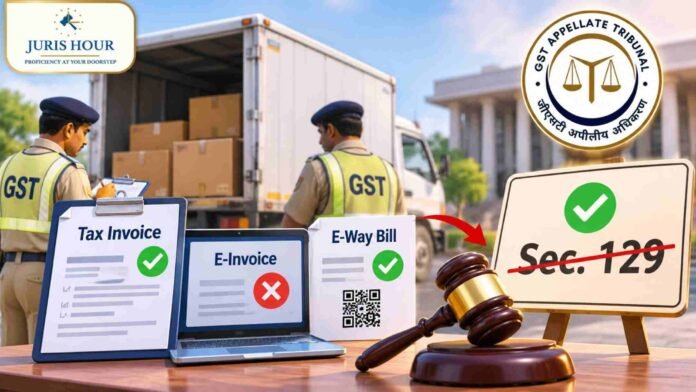
The Goods and Services Tax Appellate Tribunal (GSTAT), Thiruvananthapuram Division Bench, has held that mere failure to generate an e-invoice under Rule 48(4) of the CGST Rules, 2017, cannot invite proceedings under Section 129 of the CGST/SGST Act in the absence of any allegation or evidence of tax evasion.
The bench of Subramanya Rayaprol (Vice President) and Ramamoorthi Sriram (Technical Member) has observed that proceedings under Section 129 cannot be initiated merely because an e-invoice was not generated under Rule 48(4) of the CGST/KGST Rules, 2017, when there is no allegation or evidence suggesting an intention to evade tax.
Buy Now: All 200+ GSTAT Judgements Till November 2026 | Comprehensive E-Magazine
The appellant/assessee is engaged in the manufacture and trade of ice cream and allied dairy products. Since its aggregate annual turnover exceeded the prescribed threshold under Notification No. 13/2020-Central Tax dated March 21, 2020, as amended, the company was required to generate e-invoices under Rule 48(4) of the CGST Rules, 2017.
The dispute arose when the company supplied an ice cream-making machine to M/s South Shore Pvt. Ltd.
On September 10, 2021, the Assistant State Tax Officer, Mobile Squad No. 1, Kollam, intercepted the vehicle carrying the goods and initiated detention proceedings by issuing Forms GST MOV-01 to MOV-07.
The sole ground for detention was that the taxpayer had not generated the mandatory e-invoice under Rule 48(4) of the CGST Rules, 2017.
Although the consignment was accompanied by a regular tax invoice and an e-way bill, the authorities proceeded under Section 129 of the CGST/KGST Act.
The State Tax Officer subsequently passed an order in Form GST MOV-09 dated December 14, 2021, confirming a demand of ₹1,23,624 towards CGST and SGST, along with an equal penalty of ₹1,23,624.
The taxpayer challenged the order before the Joint Commissioner of State Tax (Appeals), Ernakulam. However, the first appellate authority dismissed the appeal, following which the taxpayer approached GSTAT.
Before the Tribunal, the taxpayer argued that the goods were accompanied by a valid tax invoice satisfying the requirements of Section 31 and Rule 46 of the CGST Rules, 2017, along with a duly generated e-way bill.
It was contended that the failure to generate an e-invoice was a procedural lapse under Rule 48(4) and could not automatically be treated as a substantive violation warranting detention and penalty under Section 129.
The taxpayer further submitted that the non-generation of the e-invoice on the particular occasion was attributable to a technical snag in its IT system and was not a deliberate attempt to suppress the transaction or evade payment of tax.
It was also argued that the department had not disputed the genuineness of the tax invoice or the e-way bill. The transaction was already reflected on the GST common portal through the e-way bill, thereby demonstrating that the movement of goods had not been concealed.
The taxpayer relied upon the judgment of the Kerala High Court in OSEL Devices Limited v. Assistant Enforcement Officer [2024 (12) TMI 209 – Kerala High Court], along with other judicial precedents, to contend that proceedings under Section 129 require circumstances indicating an attempt to evade tax.
The departmental representative opposed the appeal, contending that the taxpayer was admittedly covered by the mandatory e-invoicing provisions but had transported taxable goods without generating the prescribed e-invoice.
It was submitted that an ordinary tax invoice and an e-way bill cannot substitute for the separate statutory requirement of generating an e-invoice under Rule 48(4).
The Revenue further argued that Section 129 applies whenever goods are transported in contravention of the provisions of the Act or Rules and that the provision does not require proof of mens rea for initiating proceedings.
Accordingly, the department maintained that the detention and penalty proceedings were legally justified.
After examining the submissions of both parties, the Tribunal observed that certain material facts were undisputed.
The taxpayer was required to generate an e-invoice under Rule 48(4) because its turnover exceeded the prescribed threshold. At the time of interception, the goods were accompanied by a tax invoice issued under Section 31 and an e-way bill generated under the applicable provisions.
However, the consignment was not accompanied by an e-invoice.
Importantly, the Tribunal recorded that the only contravention alleged against the taxpayer was the non-generation of the e-invoice and that there was absolutely no evidence concerning evasion of tax.
The Tribunal observed that the central question was whether the mere failure to generate an e-invoice could attract proceedings under Section 129(1) of the CGST/KGST Act.
The Tribunal held that the issue was no longer res integra in view of the decision of the Kerala High Court in OSEL Devices Limited v. Assistant Enforcement Officer [2024 (12) TMI 209 – Kerala High Court].
While reproducing the relevant portions of the High Court’s decision, the Tribunal also referred to the judgment in T.P. Metal Roofings v. Assistant Tax Officer and Others, 2024 SCC OnLine Ker 4951.
In the said decision, the Kerala High Court had clarified that Section 129 does not authorise the imposition of tax and penalty in cases involving only minor discrepancies unless such violations may lead to tax evasion, are committed with an intention to evade tax, or involve repeated violations.
The High Court had further observed that in other cases, the authorities should consider imposing penalties under Sections 122 and 126 of the CGST/SGST Acts, as applicable.
The Tribunal found that the principles laid down by the Kerala High Court were directly applicable to the present dispute.
Applying the principles laid down by the jurisdictional High Court, the Tribunal observed that the only contravention in the present case was the non-issuance of an e-invoice.
There was no allegation whatsoever regarding any intention on the part of the taxpayer to evade tax.
The Tribunal held that the decision in OSEL Devices Limited applied mutatis mutandis to the present case.
In accordance with the law laid down by the jurisdictional High Court and the principles of judicial discipline, the Tribunal answered the question of law in the negative.
It specifically held, “In the absence of any allegation/evidence with respect to evasion of tax, action cannot be initiated under section 129 of the CGST / SGST Act, 2017 against a tax payer for the failure to generate an e-invoice as specified under Rule 48(4) of the CGST / KGST Rules, 2017.”
Membership Required to Access Case Details & Order Copy
To view the complete Case Details and Download Order Copy, you must have an active membership. Please subscribe to continue.

