
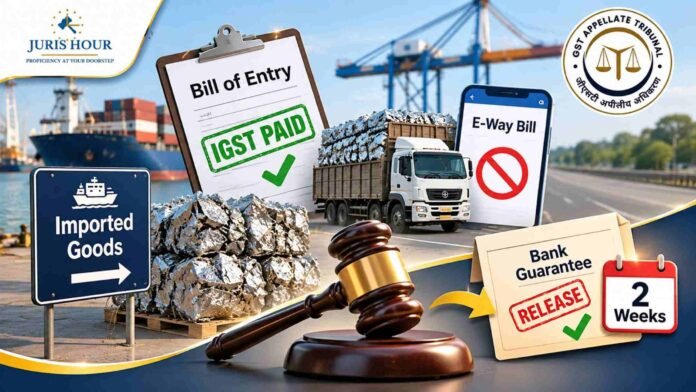
The GST Appellate Tribunal, Ernakulam Bench, has held that the non-generation of an e-way bill for imported goods, on which IGST had already been paid, was a procedural lapse that did not establish an intention to evade tax.
The bench of Subramanya Rayaprol (Vice-President) and Ramamoorthi Sriram (Technical Member) directed the GST department to release the bank guarantee furnished by the taxpayer within two weeks.
Buy Now: All 200+ GSTAT Judgements Till November 2026 | Comprehensive E-Magazine
The appellant had imported Aluminium Scrap under Bill of Entry No. 5902047 dated April 9, 2018, through Cochin Port. The applicable customs duty and Integrated Goods and Services Tax (IGST) had already been paid at the time of clearance.
Thereafter, the imported goods, weighing approximately 25.10 MT and valued at ₹25,08,839, were transported from Cochin Port to the appellant’s place of business at Palakkad through a truck.
On April 25, 2018, the State Tax Officer, Intelligence Squad-II, SGST Department, Ernakulam, intercepted the vehicle at Eloor Signal Junction.
During verification, the authorities found that the vehicle was not accompanied by a valid e-way bill. Although the consignment was accompanied by the Bill of Entry and a delivery note in Form 15 prescribed under the erstwhile Kerala VAT regime, the department proceeded to detain the goods and the vehicle under Section 129 of the GST Act.
The goods were subsequently released upon furnishing a bond and bank guarantee.
The appellant contended that the non-generation of the e-way bill was merely a procedural lapse, particularly when the imported goods had already suffered IGST and all relevant import documents were available.
The departmental representative opposed the appeal, arguing that the consignment was not accompanied by a valid e-way bill as mandated under Rules 138 and 138A of the CGST/KSGST Rules, 2017.
It was submitted that the appellant had admittedly failed to generate an e-way bill before commencement of the movement of goods and had relied upon Form 15, which was a document prescribed under the repealed KVAT regime.
The department further argued that the subsequent generation of an e-way bill on April 26, 2018, after interception of the vehicle, could not cure the original statutory violation.
Accordingly, the department maintained that detention and penalty proceedings under Section 129 were justified and that the appeal deserved dismissal.
The Tribunal observed that the central issue was the transportation of imported Aluminium Scrap without an e-way bill, despite the goods having been cleared from Customs after payment of IGST.
The Tribunal specifically noted that the Bill of Entry contained the details of the imported goods, their quantity and the appellant’s place of delivery at Palakkad.
Importantly, the Tribunal observed that the payment of IGST on the imported goods was undisputed. Further, the appellant had generated an e-way bill dated April 26, 2018, and submitted the same to the authorities while the goods were still under detention.
The Tribunal found that neither the State Tax Officer nor the Joint Commissioner (Appeals) had properly considered these material facts.
It held that the non-preparation of the e-way bill in the circumstances of the case was procedural in nature and had not resulted in any evasion of tax or suppression of facts.
The Tribunal further observed that a general penalty could have been proposed and imposed, but no such proposal under Section 122 had been made.
The Tribunal emphasised that the scheme, object and language of the relevant statutory provisions must be examined while determining whether mens rea is necessary for imposing a penalty.
It observed that although mens rea is ordinarily not an essential requirement for imposing penalties for breach of civil obligations, there are cases under Section 129 where the presence of an intention to evade tax becomes material.
In the present case, the Tribunal found no material establishing an intention to evade tax. The imported goods had already suffered IGST, the Bill of Entry disclosed the relevant particulars, and the appellant had subsequently generated the e-way bill while the goods were still detained.
The Tribunal observed that the imposition of penalty must be supported by proper reasoning and that mere rejection of a post-detention e-way bill, without establishing a nexus with an intention to evade tax, could not justify the punitive action in the facts of the case.
It further emphasised that technical errors without potential financial implications should not automatically become grounds for imposing penalties.
Membership Required to Access Case Details & Order Copy
To view the complete Case Details and Download Order Copy, you must have an active membership. Please subscribe to continue.

