
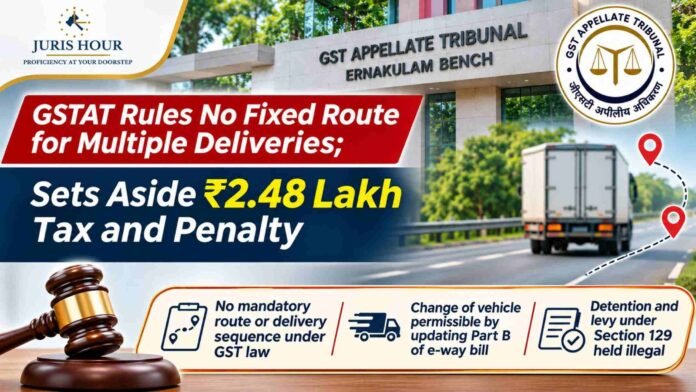
The Goods and Service Tax Appellate Tribunal (GSTAT) Ernakulam Bench has held that a transporter is free to choose the sequence of deliveries and take a convenient route, provided goods are accompanied by valid tax invoices and e-way bills.
The bench of Subramanya Rayaprol (Vice-President) and Ramamoorthi Sriram (Technical Member) that GST law does not prescribe any fixed or mandatory route for transportation of goods during multiple deliveries and ruled that merely taking a different or convenient route cannot be a ground for detention of goods or imposition of tax and penalty under Section 129(3) of the CGST/KGST Act, 2017.
Buy Now: All 200+ GSTAT Judgements Till November 2026 | Comprehensive E-Magazine
The appellant/assessee is a manufacturer and supplier of electric accumulators, dispatched battery consignments from its Bengaluru branch to three destinations in Kerala under six valid tax invoices accompanied by corresponding e-way bills. IGST was duly charged on the supplies.
The consignments were initially transported in vehicle on October 19, 2020. However, owing to the late arrival of the vehicle at Sulthan Bathery, the deliveries to the Wayanad customers could not be completed.
Consequently, the vehicle proceeded to Exide’s warehouse at Pathirankavu, Kozhikode, where the goods intended for the warehouse were unloaded. Due to COVID-related operational constraints and non-availability of labour, the remaining consignments could not be reloaded on the same day.
On October 21, 2020, the remaining goods meant for the customers in Wayanad were loaded into another vehicle bearing registration. The appellant duly updated Part B of the relevant e-way bills with the new vehicle number and place of dispatch before commencing further transportation.
However, during transit, the vehicle was intercepted by the State GST authorities at Lakkidi, Kerala.
The department alleged that the goods were originally transported from Bengaluru to Wayanad, whereas the intercepted vehicle was moving from Kozhikode towards Wayanad.
It was further alleged that the consignments had earlier crossed the Muthanga border on October 20, 2020, raising suspicion that the same invoices and e-way bills had been used for multiple transactions.
Although physical verification recorded no discrepancy in the goods, the authorities detained the goods and conveyance under Section 129 of the CGST/KGST Act and issued proceedings in Form GST MOV-09.
Tax and equivalent penalties of ₹98,728 and ₹1,49,720 were imposed in the two matters, respectively. The appellant paid the amounts under protest to secure the release of the goods.
The Joint Commissioner (Appeals)-III, SGST Department, Ernakulam, subsequently dismissed the appeals through orders dated March 23, 2022, and June 12, 2024.
Aggrieved by the appellate orders, Exide Industries Ltd. approached the GSTAT Ernakulam Bench.
The Tribunal examined whether GST law prescribes any fixed or mandatory route for transportation from one place to another during multiple deliveries and whether a penalty can be imposed under Section 129(3) merely because a transporter takes another convenient route while carrying goods in a common transport vehicle.
The Tribunal observed that the consignments were accompanied by valid tax invoices and e-way bills, and the relevant e-way bills had been updated when the goods were transferred to another vehicle.
It noted that the original vehicle carried six invoices covering three destinations, including the appellant’s own warehouse at Kozhikode. The transporter first delivered the goods meant for Kozhikode and thereafter proceeded towards Wayanad for the next delivery.
The Tribunal held that the State Tax Officer failed to appreciate this sequence of deliveries and mechanically proceeded on the assumption that the transportation did not correspond with the documents.
The Bench observed that transporters commonly carry goods belonging to multiple consignees and make deliveries one after another. The sequence of deliveries may depend upon the availability of labour, entry permits, municipal restrictions and time constraints.
Accordingly, the transporter is entitled to decide which delivery should be made first and which should follow.
The Tribunal categorically observed:
“The State Tax Department cannot impose any such restrictions of a fixed route to be followed or a particular sequence in which deliveries to be made.”
It further held that GST law focuses on whether the movement of goods is supported by the prescribed documents and whether the goods are moving towards their declared destinations, rather than insisting upon a particular road or route.
The Tribunal relied upon several judicial precedents dealing with detention of goods merely because a vehicle had taken an alternative route.
1. Kannangayathu Metals v. Assistant State Tax Officer – 2019 (11) TMI 473 (Kerala High Court)
The Kerala High Court had held that there cannot be mechanical detention of a consignment solely because the driver opted for a different route from the one normally taken by transporters, particularly when the goods are covered by a valid e-way bill and are proceeding towards the declared destination.
2. Exide Industries Ltd. v. Additional Commissioner (Appeals), Mainpuri – 2024 (7) TMI 1153 (Allahabad High Court)
The Tribunal also relied upon Exide Industries’ own case, wherein the Allahabad High Court observed that GST law does not specifically require the selling dealer to disclose the route to be followed during transportation of goods.
The High Court held that when genuine tax invoices and e-way bills accompany the goods, detention cannot be justified merely because the vehicle is travelling on a different route.
3. M/s Karnataka Traders v. State of Gujarat – 2022 (1) TMI 381 (Gujarat High Court)
The Gujarat High Court held that a mere change of route, without any additional cogent material indicating an intention to evade tax or dispose of goods at an unauthorised destination, cannot justify detention or confiscation proceedings.
4. Joint Commissioner of Commercial Taxes (Appeals-3), Bengaluru v. Transways India Transport – 2024 (7) TMI 55 (Karnataka High Court)
The Tribunal referred to the Karnataka High Court’s observations concerning freedom of movement and commercial activity.
The High Court recognised that traders can choose the route for transporting goods from the place of origin to the destination, unless a specific law restricts such movement. Merely specifying a route in consignment documents does not necessarily make adherence to that particular route compulsory.
The Tribunal also criticised the approach adopted by the Joint Commissioner (Appeals).
It observed that the appellate authority had failed to properly verify the sequence of transportation and had not appreciated that the original truck carried six invoices, including two invoices pertaining to Exide’s Kozhikode warehouse.
After delivering the goods at Kozhikode, the remaining consignments were transferred to another vehicle, and the vehicle details were duly updated in Part B of the e-way bills.
The Tribunal noted that all relevant tax invoices and updated e-way bills were produced before the intercepting officer as well as the appellate authority.
However, the authorities failed to properly understand the facts and proceeded against the appellant without adequate application of mind.
The Tribunal concluded that the detention was made without proper reasons and without authority of law.
It observed that the goods were accompanied by genuine tax invoices and valid, updated e-way bills, which sufficiently established the genuineness of the transportation.
Importantly, the Tribunal also took note of the fact that the original invoices already charged IGST on the inter-State supplies. Therefore, collecting CGST and SGST again by treating the transactions as intra-State supplies was also held to be illegal and unlawful.
Answering the central legal issue, the Tribunal categorically held:
“GST Law does not prescribe any fixed or mandatory route for transportation from one place to another during multiple deliveries, and a penalty cannot be imposed under Section 129 (3) of CGST/KGST Act, 2017 for taking another convenient route during multiple deliveries in a common transport vehicle.”
The GSTAT set aside the detention of goods and the consequential tax and penalty proceedings.
The tribunal held that the levy of CGST and SGST, despite IGST having already been charged on the inter-State supplies, was unlawful and set aside the appellate orders passed by the Joint Commissioner (Appeals)-III.
The tribunal allowed both appeals filed by Exide Industries Ltd. with consequential relief.
Membership Required to Access Case Details & Order Copy
To view the complete Case Details and Download Order Copy, you must have an active membership. Please subscribe to continue.

