
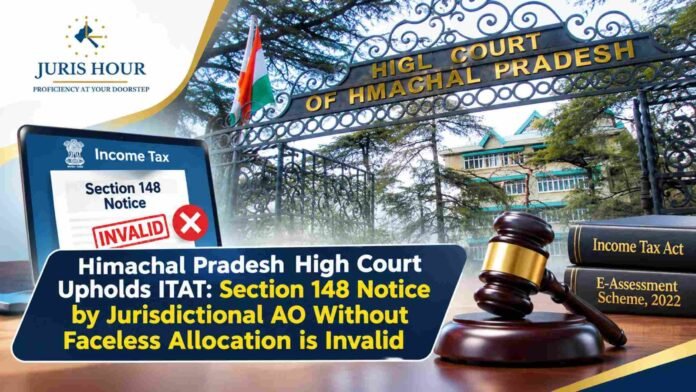
The Himachal Pradesh High Court has dismissed an appeal filed by the Income Tax Department’s appeal upholding the Income Tax Appellate Tribunal’s decision quashing the reassessment proceedings on the ground that the notice issued under Section 148 of the Income Tax Act, 1961, was not issued in accordance with law.
The bench of Justice Ajay Mohan Goel and Justice Yogesh Jaswal has held that a notice under Section 148 of the Income Tax Act, 1961, must be issued through automated allocation and in a faceless manner in accordance with the E-Assessment of Income Escaping Assessment Scheme, 2022.
Buy Now: Direct tax (Income Tax) Judgments E-Magazine October 2026
The dispute arose from reassessment proceedings initiated against the assessee under Section 147 of the Income Tax Act, 1961.
The Assessing Officer had issued a notice dated April 8, 2023, under Section 148 of the Act, which subsequently culminated in an assessment order dated January 30, 2024.
The assessee challenged the assessment proceedings before the Commissioner of Income Tax (Appeals), NFAC. However, the appeal was dismissed by the CIT(A) vide order dated July 18, 2024.
Aggrieved by the decision, the assessee approached the Income Tax Appellate Tribunal (ITAT).
The ITAT, vide order dated November 17, 2025, allowed the assessee’s appeal and quashed the assessment proceedings, holding that the notice under Section 148 had not been issued by the competent faceless Assessing Authority.
The Revenue thereafter challenged the ITAT’s order before the Himachal Pradesh High Court.
The department contended that the ITAT had erred in holding that the notice issued under Section 148 was legally invalid. The notice issued under Section 148, read with Notification S.O. 1466(E) [No. 370142/16/2022-TPL (PART-1)] dated March 29, 2022, was legally sustainable.
The Department further argued that there was no requirement in the present case for issuance of the notice by a Faceless Assessing Officer and that the ITAT had returned perverse findings while holding otherwise.
The assessee submitted that Notification No. 18/2022 dated March 29, 2022, issued under Section 151A of the Income Tax Act, 1961, clearly prescribed the manner in which notices under Section 148 were required to be issued.
It was contended that the notice issued in the present case was not in conformity with Clause 3 of the E-Assessment of Income Escaping Assessment Scheme, 2022.
Therefore, the ITAT had correctly concluded that the reassessment proceedings were initiated in violation of the statutory notification.
The High Court examined the provisions of Section 151A of the Income Tax Act, 1961, along with Notification No. 18/2022 dated March 29, 2022, introducing the E-Assessment of Income Escaping Assessment Scheme, 2022.
The Court noted that the scheme was notified by the Central Government in exercise of powers conferred under sub-sections (1) and (2) of Section 151A of the Income Tax Act.
Clause 3 of the Scheme specifically provides that assessment, reassessment or recomputation under Section 147 and issuance of notices under Section 148 shall be carried out through automated allocation in accordance with the risk management strategy formulated by the Board and in a faceless manner, to the extent provided under Section 144B of the Act.
The Court observed that the statutory notification was unambiguous and clearly mandated that notices under Section 148 must be issued through automated allocation and in a faceless manner.
A significant aspect considered by the High Court was that the notice under Section 148 dated April 8, 2023, had been issued by Pyare Lal Sharma, Income Tax Officer, Ward No. 1, Shimla.
The officer was the jurisdictional Assessing Officer (JAO) of the assessee and was not a Faceless Assessing Officer.
The High Court observed that the notice had not been issued through automated allocation in a faceless manner and was, therefore, in contravention of Clause 3 of the E-Assessment of Income Escaping Assessment Scheme, 2022.
The Court further noted that the Revenue had failed to demonstrate how the findings recorded by the ITAT were perverse or unsupported by the material available on record.
Accordingly, the High Court found no reason to interfere with the Tribunal’s findings.
The Himachal Pradesh High Court held that the notice issued under Section 148 of the Income Tax Act, 1961, was contrary to Clause 3 of the Notification dated March 29, 2022.
The ITAT had rightly held that the notice was not issued in accordance with law and had correctly quashed the consequential assessment order.
Membership Required to Access Case Details & Order Copy
To view the complete Case Details and Download Order Copy, you must have an active membership. Please subscribe to continue.
Read More: Rs. 10K Cost Imposed On Taxpayer For Suppressing Receipt of SCN: AP HC

