
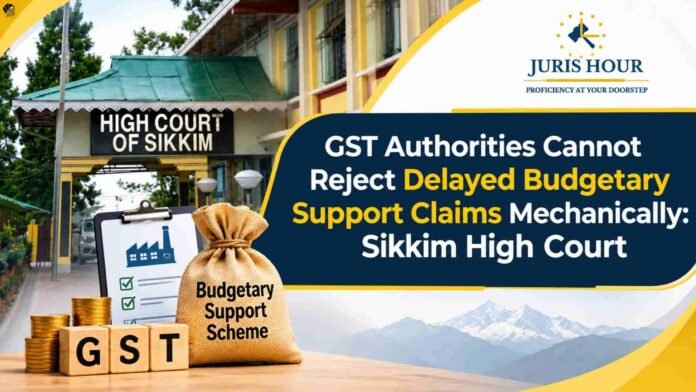
The High Court of Sikkim has held that a delayed application for Budgetary Support under the Government’s incentive scheme cannot be rejected mechanically merely because it was filed beyond the prescribed procedural timeline, particularly when the delay was caused by extraordinary circumstances beyond the applicant’s control.
The bench of Chief Justice A. Muhamed Mustaque observed that in the absence of an express statutory provision prescribing limitation or prohibiting consideration of belated applications, the designated authority has the discretion to examine such claims on their merits.
Buy Now: 210+ GST Judgments E-Magazine – October 2026
The bench set aside the order rejecting its Budgetary Support claim of ₹1,12,51,974 for the period July 2023 to September 2023. The designated officer has been directed to reconsider the application by treating it as validly filed and pass appropriate orders on the merits within one month.
The petitioner/assessee is a pharmaceutical company operating a manufacturing unit in Pakyong District, Sikkim, was eligible for the Budgetary Support Scheme introduced through the Notification dated 5 October 2017.
The company had commenced production in 2017 and was eligible to receive benefits under the scheme until 16 February 2027. Its eligibility under the scheme was not disputed by the authorities, and Budgetary Support had been granted for all periods since commencement of production, except for the disputed quarter from July 2023 to September 2023.
Under the prescribed procedure, manufacturers were required to submit applications for Budgetary Support in respect of taxes paid in cash, excluding the amount discharged through utilisation of Input Tax Credit, by the 15th day of the succeeding month after the end of the relevant quarter.
However, the company’s claim for the July–September 2023 quarter was rejected by the Assistant Commissioner, CGST, Gangtok Division, through an order dated 28 April 2025.
The rejection was based on the ground that the application had been submitted with a delay of 107 days in violation of paragraph 7.1 of the DIPP Notification dated 5 October 2017.
Before the authorities, the company explained that the delay was attributable to the devastating Glacial Lake Outburst Flood (GLOF) that affected several parts of Sikkim on 4 October 2023, particularly the area where its manufacturing unit was situated.
The sudden surge in the flow of the Teesta River severely disrupted the company’s business operations and affected the functioning of its manufacturing facility. The disruption also affected the lives of its employees.
The company further submitted that technical issues on the CBIC website, which was required to be accessed for filing the application, contributed to the delay.
It was only after these difficulties that the company could successfully submit its application. The authorities, however, rejected the claim on account of the delay in filing.
The company contended that a procedural requirement should not override substantive rights, particularly when the delay was caused by circumstances beyond its control.
It was argued that the flood constituted an extraordinary natural calamity and that an act of God should not deprive the company of its legitimate entitlement under the Budgetary Support Scheme.
The company further submitted that neither the Notification nor the Scheme expressly prohibited the designated officer from entertaining applications filed beyond the prescribed date.
Reliance was also placed on a similar instance where the Assistant Commissioner, Jammu and Kashmir, had accepted a belated application for Budgetary Support and subsequently sanctioned the claim.
The department opposed the petition, contending that the prescribed timeline served a specific purpose and that the company was required to exercise due diligence in filing its application within the stipulated period.
The authorities argued that the relevant data was already available with the company and that there was no difficulty in accessing the GST portal within the prescribed timeline.
It was further submitted that the company had been provided an opportunity of personal hearing to substantiate its explanation for the delay, but its explanation was found unsatisfactory.
The department relied upon the Supreme Court’s judgment in Commissioner of Customs (Import), Mumbai v. Dilip Kumar and Company and Others [(2018) 9 SCC 1], which lays down the principle that exemption notifications must be construed strictly and that the burden lies upon the claimant to establish compliance with the applicable conditions.
Reliance was also placed on M/s VJ Jindal Cocoa Private Limited v. Union of India and Others [2023 SCC OnLine J&K 1350], arguing that benefits under the Budgetary Support Scheme cannot be claimed as a matter of right.
The High Court examined whether a belated application could be considered when the Notification and the Scheme did not expressly prescribe a limitation period or provide that applications submitted beyond the specified date must necessarily be rejected.
The Court observed that the case involved a situation of silence in the regulatory framework.
It held that the absence of an express statutory provision or a specific provision in the Notification or Scheme for condonation of delay does not, by itself, mean that the designated officer lacks the power to consider a delayed application.
The Court clarified that where the regulatory framework is silent, the designated officer must exercise the discretion vested in him in conformity with the Notification and the underlying objectives of the Scheme.
The procedure prescribed for submitting applications is intended to facilitate the exercise of statutory authority and should not be applied mechanically in circumstances where compliance within the prescribed period was beyond the applicant’s control.
In arriving at its conclusion, the Court referred to the legal philosophy of Ronald Dworkin, particularly his works Taking Rights Seriously and Law’s Empire.
The Court highlighted the distinction between applying established legal rules and considering broader legal principles in cases where the existing rules do not provide a complete answer.
It observed that legal reasoning is not confined merely to the mechanical application of procedural requirements. Principles and policies underlying the legal framework must also be considered while deciding difficult cases.
Applying these principles, the Court found that the delay could not be attributed to negligence or lack of diligence on the part of the company.
The magnitude of the natural disaster was such that the rule-makers could not reasonably have foreseen circumstances preventing an applicant from submitting its application within the prescribed period.
The Court emphasised that the Budgetary Support Scheme was introduced with the broader objective of encouraging entrepreneurs and manufacturers to establish industrial units in geographically challenging regions such as Sikkim.
Such schemes are intended to promote industrial development, attract investments and contribute to the economic development of these regions.
The Court observed that any action defeating the very purpose of such an incentive scheme would be contrary to its underlying objectives.
It further held that the designated officer could not act mechanically while deciding the company’s claim and was required to consider the ground realities, including the devastating impact of the GLOF on the manufacturing unit.
The officer had failed to appreciate these circumstances and had proceeded to reject the claim mechanically.
In view of the absence of any express prohibition against entertaining applications submitted beyond the prescribed date, the High Court held that the company’s application deserved to be accepted for consideration under the Budgetary Support Scheme.
Accordingly, the Court set aside the impugned order dated 28 April 2025 rejecting the company’s claim. The designated officer was directed to reconsider the matter afresh by treating the application as validly filed and pass appropriate orders on the merits of the claim within one month from the date of receipt of a copy of the judgment.
Membership Required to Access Case Details & Order Copy
To view the complete Case Details and Download Order Copy, you must have an active membership. Please subscribe to continue.
Read More: Jharkhand High Court Denies Bail in Rs. 734 Crore GST Fraud and Money Laundering Case

