
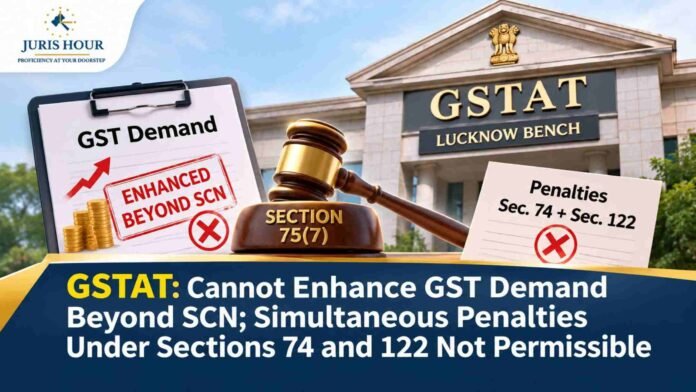
The GST Appellate Tribunal (GSTAT), Lucknow Bench, has held that adjudicating authorities cannot enhance the tax demand beyond the amount specified in the Show Cause Notice under Section 75(7) of the CGST Act and ruled that simultaneous imposition of penalties under Sections 74 and 122 for the same act or omission is impermissible in view of Section 75(13) of the Act.
The Bench of Narendra Kumar (Judicial Member) and Alok Chopra (Technical Member) has allowed an appeal challenging the demand confirmed under Section 74 of the CGST/UPGST Act for FY 2017-18 and set aside the impugned demand after finding that the adjudicating authority had enhanced the proposed tax demand beyond the amount specified in the Show Cause Notice without issuing a supplementary notice or providing an adequate opportunity of hearing.
Buy Now: Indirect Tax Judgments E-Compilation – October 2026
The bench found that the authorities had imposed penalties under both Sections 74 and 122 of the CGST Act for the same alleged act or omission, contrary to the statutory restriction under Section 75(13).
The dispute originated from a Special Investigation Branch (SIB) survey conducted on December 12, 2017, at the premises of the appellant, a society registered under the Societies Registration Act, 1860, in Lucknow.
Following the survey, the Deputy Commissioner, Commercial Tax, Sector-1, Lucknow, issued a Show Cause Notice dated December 28, 2019, under Section 74 read with Section 122 of the CGST/UPGST Act.
However, while passing the Order-in-Original dated September 4, 2021, the adjudicating authority enhanced the alleged suppressed turnover to ₹30,24,450 and determined the tax liability at ₹5,44,402, along with interest and an equivalent penalty.
The enhanced demand was confirmed without issuing any supplementary Show Cause Notice.
An important factual aspect considered by the Tribunal was that the appellant had deposited ₹5,44,402 on December 24, 2019, through a bank challan, four days before the issuance of the Show Cause Notice dated December 28, 2019.
The appellant subsequently set off the deposited amount through Form GST DRC-03 on January 27, 2020, and furnished Form GST DRC-07 reconciliation details.
The appellant contended that the tax amount had already been deposited and that the reconciliation difference between GSTR-3B and GSTR-9 was explained. It was further argued that the authorities had failed to properly consider the financial documents and reconciliation statements submitted by the appellant.
The appellant challenged the demand on several grounds.
Firstly, it was argued that the adjudicating authority could not enhance the proposed turnover and tax liability beyond the figures mentioned in the Show Cause Notice. Such enhancement, without issuing a supplementary notice or granting an opportunity of hearing, was contrary to Section 75(7) of the CGST Act.
Secondly, the appellant submitted that the invocation of Section 74 was unjustified in the absence of evidence establishing fraud, wilful misstatement or suppression of facts with an intention to evade tax.
It was also contended that the alleged discrepancies in B2C invoices and revenue-sharing arrangements could not automatically establish suppression of turnover.
The appellant further argued that the department had failed to establish the alleged discrepancies through reliable evidence and had proceeded on assumptions and conjectures.
Additionally, the imposition of penalties under both Sections 74 and 122 for the same alleged act or omission was challenged as being contrary to Section 75(13) of the CGST Act.
The department defended the demand by submitting that the SIB survey had revealed discrepancies in the appellant’s business operations, including unexplained variations in lawn rental rates, non-maintenance of regular books of account and non-verification of revenue-sharing arrangements.
It was argued that despite being granted opportunities during the investigation, the appellant had failed to produce primary books of account, cash books, ledger records, trading accounts and employee wage registers to substantiate its claims.
The department further contended that the deposit of ₹5,44,402 could not be treated as voluntary compliance under Section 73(5) of the UPGST Act, since the payment was made after the SIB survey and the issuance of the Show Cause Notice was preceded by the investigation.
Accordingly, the department maintained that the demand and penalties were legally sustainable.
After examining the submissions and records, the Tribunal identified two principal issues for determination:
- Whether a demand raised under the GST Act could travel beyond and exceed the amount proposed in the Show Cause Notice.
- Whether adjudicating authorities could simultaneously impose penalties under Sections 74 and 122 of the GST Act.
The Tribunal examined Section 75(7) of the CGST Act, which provides that the amount of tax, interest and penalty demanded in an order cannot exceed the amount specified in the notice and that no demand can be confirmed on grounds other than those specified in the notice.
In the present case, the Show Cause Notice proposed suppressed turnover of ₹26,50,000 and tax demand of ₹4,77,000.
However, the adjudicating authority enhanced the turnover to ₹30,24,450 and the tax demand to ₹5,44,402.
The Tribunal observed that the adjudicating authority had not recorded cogent reasons for disagreeing with the appellant’s submissions and enhancing the demand.
It further noted that the authority had failed to adequately consider the reconciliation figures and financial documents placed on record.
The Tribunal observed that adjudication proceedings must strictly remain within the allegations, grounds and quantum proposed in the Show Cause Notice. Any departure from the proposals contained in the notice would violate the principles governing adjudication.
The Tribunal reiterated that an adjudicating authority cannot travel beyond the allegations and proposals contained in the Show Cause Notice.
The Tribunal also examined the legality of imposing penalties under both Sections 74 and 122 of the CGST Act.
It observed that neither the Order-in-Original nor the Order-in-Appeal had adequately discussed the applicability of Section 122 in the context of the penalty already imposed under Section 74.
The Tribunal specifically referred to Section 75(13) of the CGST Act, which provides:
“Where any penalty is imposed under section 73 or section 74 or section 74A, no penalty for the same act or omission shall be imposed on the same person under any other provision of this Act.”
The Tribunal also referred to CBIC Circular No. 171/03/2022-GST dated July 6, 2022, concerning the applicability of demand and penalty provisions under the CGST Act and the Finance Act, 1994.
Applying the statutory restriction, the Tribunal held that once a penalty is imposed under Section 74, another penalty for the same act or omission cannot be imposed on the same person under Section 122.
Accordingly, the simultaneous imposition of penalties under Sections 74 and 122 was held to be impermissible.
In view of the above findings, the GST Appellate Tribunal, Lucknow Bench, allowed the appeal with consequential relief.
The Tribunal held that the adjudicating authority could not enhance the demand beyond the amount specified in the Show Cause Notice and that simultaneous penalties under Sections 74 and 122 for the same act or omission were contrary to Section 75(13) of the CGST Act.
Membership Required to Access Case Details & Order Copy
To view the complete Case Details and Download Order Copy, you must have an active membership. Please subscribe to continue.
Read More: Customs Dept. to Grant MOOWR Licence for Solar Power Generation: Andhra Pradesh HC

