
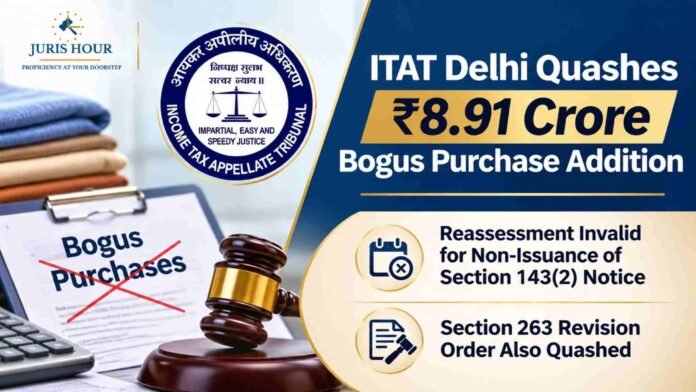
The Income Tax Appellate Tribunal (ITAT), Delhi Bench, has quashed a reassessment order involving an addition of ₹8,91,01,440 towards alleged bogus purchases, holding that the Assessing Officer (AO) cannot complete reassessment proceedings without issuing the mandatory notice under Section 143(2) of the Income Tax Act, 1961, even where the return of income in response to a notice under Section 148 was filed belatedly.
The bench of Anubhav Sharma (Judicial Member) and Manish Agarwal (Accountant Member) has observed that Section 69C of the Income Tax Act cannot be invoked merely because the genuineness of purchases is questioned, when the source of payments towards such purchases is duly explained and established through regular books of account and banking transactions.
Buy Now: Direct tax (Income Tax) Judgments E-Magazine October 2026
Wadhawan Fabrics Pvt. Ltd. had filed its original return of income under Section 139(1) of the Income Tax Act on October 9, 2018, declaring total income of ₹6,95,007.
Subsequently, the Income Tax Department issued a notice under Section 148A(b) on March 31, 2022, alleging that the assessee had made purchases from entities belonging to the M/s KK Spun Group, allegedly managed and controlled by Shri Aditya Jain, who was stated to be engaged in providing accommodation entries through bogus purchase bills.
The alleged bogus purchases were stated to aggregate to approximately ₹14.20 crore.
After considering the assessee’s response, an order under Section 148A(d) was passed and notice under Section 148 was issued on March 31, 2022.
In response, the assessee filed its return of income on February 27, 2023, declaring income broadly consistent with its original return.
However, the Assessing Officer subsequently passed an assessment order dated March 31, 2023, under Sections 147 read with Sections 144 and 144B of the Act, making an addition of ₹8,91,01,440 under Section 69C read with Section 115BBE towards alleged bogus purchases from M/s Decent Trading & Exim.
The total assessed income was determined at ₹8,97,91,750.
The assessee challenged the assessment order before the CIT(A), NFAC. However, the appeal was dismissed ex parte for non-prosecution vide order dated March 20, 2025.
Separately, the Principal Commissioner of Income Tax (PCIT), Delhi-7, initiated proceedings under Section 263 and passed a revisionary order dated March 28, 2025, alleging that purchases amounting to ₹1,26,50,000 from shell entities had not been added to the assessee’s income.
Aggrieved, the assessee approached the ITAT by filing two appeals.
At the outset, the Tribunal noted that both appeals were delayed by 253 days.
The assessee explained that it was facing severe financial distress, its business operations had substantially closed down, and the bank accounts of its director had been seized and classified as NPA.
It was further submitted that the appellate order had been received by the company’s accountant, who was not sufficiently conversant with income-tax compliance requirements. Due to the financial difficulties and lack of awareness regarding the e-assessment procedure, the management could not take timely action.
The Department opposed condonation of delay, contending that no sufficient or reasonable cause had been established.
After considering the explanation and affidavit filed by the assessee, the Tribunal observed that every instance of delay may involve some lapse on the part of the litigant. However, such lapse alone cannot be a ground to deny adjudication on merits.
The Tribunal held that where the explanation does not indicate mala fide intention or a deliberate dilatory strategy, the litigant should not be deprived of the opportunity of hearing.
Accordingly, in the larger interest of justice, the delay of 253 days was condoned and both appeals were admitted.
The assessee raised an additional legal ground before the Tribunal, challenging the validity of the reassessment order on the ground that the Assessing Officer had failed to issue the mandatory notice under Section 143(2) of the Act after the assessee filed its return in response to the notice under Section 148.
The assessee submitted that although the return was filed belatedly on February 27, 2023, the Assessing Officer was under a statutory obligation to issue notice under Section 143(2) before proceeding with the reassessment.
Reliance was placed on the Delhi High Court judgment in PCIT v. Dart Infrabuild (P.) Ltd., reported in [2024] 460 ITR 532 (Delhi), along with other judicial precedents.
The Department opposed the additional ground, arguing that the return had not been filed within the time stipulated in the notice under Section 148 and that the assessee had participated in the assessment proceedings.
The Tribunal, however, admitted the additional ground, observing that it involved a pure question of law and that the relevant facts were already available on record.
The Tribunal noted that the notice under Section 148 was issued on March 31, 2022, and the assessee had filed its return in response to the notice on February 27, 2023.
It further observed that the assessee had duly informed the Assessing Officer about filing the return through its submissions and the e-filing portal.
However, the assessment order did not record whether the return filed in response to Section 148 had been admitted or provide any reason for not taking cognizance of it.
The Tribunal specifically noted that the Assessing Officer had referred to the income declared in the original return while computing the assessee’s total income, even though the assessee had subsequently filed a return in response to Section 148.
The Tribunal held that once a return is filed in response to a notice under Section 148, the Assessing Officer is required to issue the mandatory notice under Section 143(2), even if such return is filed belatedly.
The Tribunal placed significant reliance on the Delhi High Court decisions in PCIT v. Dart Infrabuild (P.) Ltd. and PCIT v. Shri Jai Shiv Shankar Traders (P.) Ltd.
The Tribunal observed that the Delhi High Court had categorically held that where an assessee files a return in response to a notice under Section 148, the Assessing Officer must issue notice under Section 143(2) before completing reassessment proceedings.
The mere fact that the return was filed beyond the period specified in the notice under Section 148 does not dispense with this statutory requirement, particularly where the Assessing Officer takes cognizance of the return while framing the assessment.
The Tribunal also considered the distinction between failure to serve a notice and failure to issue a notice, observing that Section 292BB cannot cure the complete absence of a mandatory jurisdictional notice.
Following the judicial precedents, the Tribunal held that the absence of notice under Section 143(2) constitutes a jurisdictional defect and renders the reassessment invalid.
Accordingly, the reassessment order was quashed.
The Tribunal thereafter examined the addition of ₹8,91,01,440 made by the Assessing Officer under Section 69C read with Section 115BBE of the Act.
The addition was made on the allegation that M/s Decent Trading & Exim was an accommodation-entry provider and had issued bogus purchase bills to enable the assessee to claim input tax credit under the GST law.
The Tribunal noted that the Assessing Officer had not disputed the source of payments made by the assessee towards the purchases.
The assessee had furnished relevant documentary evidence, including: copies of purchase invoices issued by M/s Decent Trading & Exim. Shipping bills relating to transportation of goods. Bank statements evidencing payments. Ledger accounts. Copies of GST returns.
The Tribunal observed that the purchases were duly recorded in the regular books of account and the payments were made through the assessee’s regular bank account.
The Tribunal emphasised that Section 69C deals with unexplained expenditure and primarily concerns the source of expenditure.
Where the assessee has explained the source of payments and the same is duly established through its books of account and banking records, Section 69C cannot be invoked merely because the genuineness or authenticity of the expenditure is questioned.
The Tribunal distinguished between the provisions of Section 69C and Section 37(1), observing that Section 69C concerns the source of expenditure, whereas Section 37(1) deals with the allowability of business expenditure.
It further noted that the Assessing Officer had accepted the trading results declared by the assessee and had not rejected the books of account under Section 144.
The Tribunal relied upon the Delhi High Court judgments in CIT v. Radhika Creation, ITA No. 692/Del/2009, dated April 30, 2010 and PCIT v. Param Dairy Ltd., ITA No. 50/Del/2022, dated March 15, 2022. In Radhika Creation, the High Court had explained that the focus of Section 69C is on the source of expenditure and not merely on the authenticity of the expenditure itself.
The Tribunal held that once the source of payments towards purchases was established and the expenditure was duly recorded in the books of account, the addition under Section 69C could not be sustained in the facts of the case.
The second appeal concerned the revisionary order passed by the PCIT under Section 263 of the Income Tax Act.
The PCIT had held that the assessment order was erroneous and prejudicial to the interests of the Revenue because purchases amounting to ₹1,26,50,000 allegedly made from shell entities had not been added to the assessee’s total income.
Before the Tribunal, the assessee argued that once the reassessment order itself had been quashed for non-issuance of the mandatory notice under Section 143(2), the consequential proceedings under Section 263 could not survive.
The assessee also contended that the PCIT had failed to identify the alleged shell entity from which purchases of ₹1,26,50,000 were supposedly made.
According to the assessee, the Assessing Officer had examined the relevant details and accepted the purchases from four parties, while making an addition only in respect of M/s Decent Trading & Exim.
The assessee argued that the PCIT’s observation regarding unexplained purchases of ₹1,26,50,000 was vague, as no specific supplier or supporting details were identified.
The Tribunal first held that once the underlying reassessment order under Section 147 had been quashed, the consequential revisionary proceedings under Section 263 could not survive.
It accordingly quashed the Section 263 order.
The Tribunal also examined the matter independently on merits.
It observed that the PCIT had referred to purchases of ₹1,26,50,000 allegedly made from shell entities without identifying the names of such entities or bringing the relevant particulars on record.
The Tribunal further noted that the Assessing Officer had already examined the purchases from the five parties identified during reassessment proceedings and had made an addition in respect of the purchases which were found unverifiable.
The Tribunal held that the PCIT had failed to establish that the Assessing Officer had not conducted the necessary enquiries or that the assessment order was erroneous and prejudicial to the interests of the Revenue.
It further observed that directing a roving and fishing enquiry into purchases allegedly made from unidentified parties was not permissible under the Act in the circumstances of the case.
Accordingly, the Tribunal held that the revisionary order under Section 263 was unsustainable even on merits.
The ITAT Delhi Bench allowed both appeals filed by Wadhawan Fabrics Pvt. Ltd. for Assessment Year 2018-19.
The Tribunal quashed the reassessment order on the ground that the mandatory notice under Section 143(2) had not been issued after the filing of the return in response to Section 148.
It also deleted the addition of ₹8,91,01,440 under Section 69C, holding that the source of payments towards the purchases was established through regular books of account and banking transactions.
Further, the Tribunal quashed the consequential revisionary order passed under Section 263, both on the ground that the underlying reassessment had been quashed and independently on merits.
Membership Required to Access Case Details & Order Copy
To view the complete Case Details and Download Order Copy, you must have an active membership. Please subscribe to continue.

