
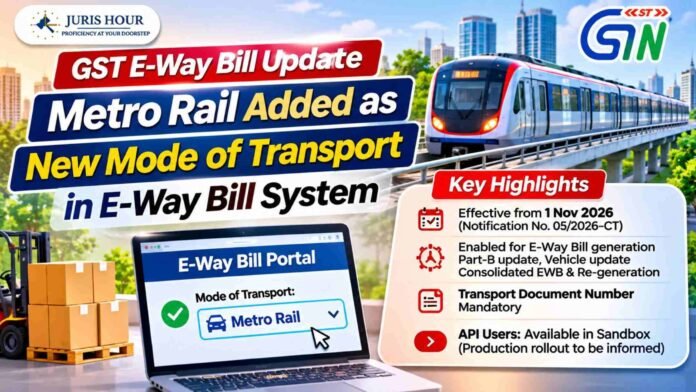
The Goods and Services Tax Network (GSTN) has introduced Metro Rail as an additional mode of transport in the E-Way Bill system, allowing taxpayers and transporters to report the movement of goods through Metro Rail while generating E-Way Bills and updating transportation details.
The facility has been enabled pursuant to Notification No. 05/2026–Central Tax dated October 26, 2026, which brought Metro Rail within the scope of Rule 138(2A) of the Central Goods and Services Tax (CGST) Rules, 2017, with effect from November 1, 2026.
The development is significant for businesses and transporters using Metro Rail infrastructure for the movement of goods, as it provides a specific mode of transportation within the E-Way Bill compliance framework.
Buy Now: 210+ GST Judgments E-Magazine – October 2026
Metro Rail Introduced as Additional Transport Mode
Under the existing E-Way Bill mechanism, taxpayers and transporters are required to furnish transportation-related particulars while reporting the movement of goods.
With the latest enhancement, Metro Rail has been added as an additional mode of transport in the E-Way Bill system. Accordingly, taxpayers can now select Metro Rail when generating an E-Way Bill or updating Part-B transportation particulars.
The introduction of this option is intended to facilitate appropriate reporting of goods transported through Metro Rail and align the E-Way Bill portal with the amended regulatory framework.
Five E-Way Bill Functionalities Enabled
As per the GSTN advisory dated November 20, 2026, the Metro Rail option has been enabled across multiple functionalities of the E-Way Bill system.
The facility is available through Web, Excel and API interfaces for the following activities:
| S. No. | Functionality |
| 1. | E-Way Bill Generation |
| 2. | Part-B Update |
| 3. | Vehicle Update |
| 4. | Consolidated E-Way Bill Generation |
| 5. | Consolidated E-Way Bill Re-generation |
This means that taxpayers and transporters can use the Metro Rail option not only at the time of initial E-Way Bill generation but also while updating transportation particulars and undertaking consolidated E-Way Bill-related activities.
Transport Document Number Mandatory for Metro Rail
One of the important compliance requirements introduced with this facility is the mandatory furnishing of the Transport Document Number.
GSTN has specifically clarified that whenever Metro Rail is selected as the mode of transportation, entering the Transport Document Number is compulsory.
Accordingly, taxpayers and transporters must ensure that:
- Metro Rail is selected as the appropriate mode of transportation.
- The Transport Document Number is entered mandatorily.
- The correct Transport Document Number and other relevant transportation particulars are furnished before submitting the E-Way Bill details.
Failure to furnish the required transportation particulars may affect the submission of the relevant E-Way Bill information.
Different Deployment Status for Web and API Users
GSTN has also clarified the deployment status of the new functionality for different categories of users.
1. Web Users
The Metro Rail facility has already been deployed in the Production environment and is available for taxpayers and transporters accessing the E-Way Bill portal through the web interface.
2. API Users
For API-based users, the functionality has initially been released in the Sandbox environment to facilitate system integration and testing.
API users are advised to undertake the necessary modifications in their existing systems and complete testing in the Sandbox environment before the functionality is rolled out in the Production environment.
GSTN has further clarified that the availability of this facility in the API Production environment will be communicated separately.
Action Required for Taxpayers and Transporters
Taxpayers and transporters involved in the movement of goods through Metro Rail should take note of the revised functionality and ensure that the appropriate transportation mode is selected while generating E-Way Bills or updating Part-B details.
Businesses using automated or API-based E-Way Bill generation systems should coordinate with their software and technology service providers to incorporate the new transport mode and validate the mandatory Transport Document Number field.
The latest enhancement is particularly relevant for businesses adopting alternative transportation infrastructure and seeking to maintain accurate transportation records under the GST framework.
Legal Provisions Involved
Rule 138(2A) of the CGST Rules, 2017: The provision governs the furnishing of information relating to the transportation of goods through specified modes of transport and the corresponding E-Way Bill requirements.
Notification No. 05/2026–Central Tax dated October 26, 2026: The notification provides the regulatory basis for including Metro Rail under the relevant E-Way Bill framework, effective November 1, 2026.
Conclusion
The introduction of Metro Rail as an additional mode of transportation represents an important enhancement to the GST E-Way Bill system. By enabling Metro Rail across E-Way Bill generation, Part-B updates, vehicle updates and consolidated E-Way Bill functionalities, GSTN has expanded the portal’s ability to capture transportation details through this mode.
Taxpayers and transporters should ensure that Metro Rail is selected wherever applicable and that the mandatory Transport Document Number is correctly furnished. API users, in particular, should complete the required system modifications and Sandbox testing before the Production rollout.
Membership Required to Access Notification Details & Copy
To view the complete Notification Details and Download Copy, you must have an active membership. Please subscribe to continue.

