
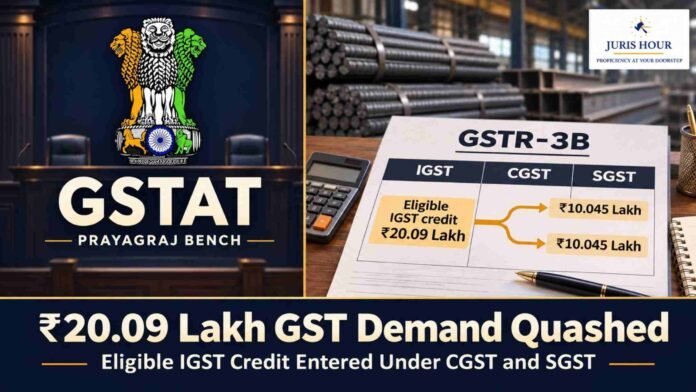
The Goods and Services Tax Appellate Tribunal (GSTAT), Prayagraj has held that a clerical error in GSTR-3B did not amount to wrongful availment of input tax credit under Section 73. It also found that a next-day hearing notice gave the taxpayer insufficient time to appear.
The bench of Mahtab Ahmad (Judicial Member) and Ashish (Technical Member) has set aside approximately ₹20.09 lakh in input tax credit (ITC), interest and penalty demands against an iron and steel trader that mistakenly reported eligible integrated GST (IGST) credit in the central GST (CGST) and state GST (SGST) columns of its GSTR-3B returns.
Buy Now: 210+ GST Judgments E-Magazine – October 2026
The Bench held that the department’s comparison of individual tax heads overlooked the corresponding IGST credit the trader had left unclaimed. The underlying entitlement to that credit was undisputed.
The trader’s GSTR-2A reflected IGST, CGST and SGST on its purchases. While filing GSTR-3B, its accountant entered part of the IGST credit under CGST and SGST. For FY 2018–19, the combined CGST and SGST claim exceeded the corresponding GSTR-2A figures by ₹6,42,832, while the trader claimed ₹6,42,468.60 less IGST credit than GSTR-2A showed. For FY 2019–20, the combined difference of ₹3,63,192 under CGST and SGST was offset by ₹3,63,193.22 of unclaimed IGST credit.
The Tribunal recorded a marginal aggregate excess of ₹363.64 for the first year and a short claim of 90 paise for the second. It noted that neither residual difference formed the basis of the demand. The department issued notices under Section 73 in December 2023 and May 2024. The adjudicating officer confirmed the demands, and the first appellate authority upheld the disputed portion for both years.
The department argued that the taxpayer could claim credit only under the head in which the supplier had paid the tax. It invoked Section 16(2)(c) and argued that using SGST credit without a matching receipt would cause a loss to the State. The Tribunal noted that the department had accepted the underlying entitlement to IGST credit and had raised no dispute over the genuineness of the invoices, receipt of the supplies or payment of tax by the suppliers.
The Bench distinguished entitlement to credit from the sequence in which it is used. Section 49(5) provides for IGST credit to be applied first against IGST liability, with the balance available for CGST and SGST. The department had alleged neither an unpaid IGST liability nor a breach of the utilisation sequence as a basis for the demand. In those circumstances, the Bench held that entering the credit in the wrong columns did not amount to wrongful availment or utilisation under Section 73(1).
The Tribunal drew on the Kerala High Court’s ruling in Rejimon Padickapparambil Alex v. Union of India, which considered the electronic credit ledger as a whole in a similar dispute. It also followed the reasoning of the GSTAT Lucknow Bench in Lucknow Test House v. Shashi Bhushan Singh.
The Bench accepted that the reporting error could affect how revenue was allocated between the Centre and the State. It held that the governments could address the difference through the statutory settlement mechanism. The Tribunal declined to extend the expired deadline for rectifying the returns under Section 39(9).
The Bench held that interest under Section 50(3) requires credit to have been both wrongly availed and utilised. As wrongful availment was not established, the interest demand failed. The penalty under Section 73(9) also fell with the principal demand. The amounts set aside totalled ₹10,06,024 in ITC, ₹9,02,858 in interest and ₹1,00,602 in penalties.
For FY 2018–19, the trader filed its written reply on 2 January 2024 and did not appear at the hearing scheduled for 15 January. The department then waited almost three months before uploading a final notice on 9 April for a hearing on 10 April. The Tribunal held that less than 24 hours gave the taxpayer insufficient time to arrange representation and prepare for the hearing.
The Bench held that service through the GST portal under Section 169 did not by itself establish a reasonable opportunity to be heard under Section 75(4). It also found that the hearing before the first appellate authority did not cure the defect at the adjudication stage. Since the demand failed on the merits, the Tribunal disposed of both appeals without remanding the matter.
The Tribunal set aside the adjudication and first appellate orders to the extent they confirmed the disputed ITC, interest and penalties. It directed the department to make consequential adjustments and refund the pre-deposit within 60 days of receiving a certified copy of the order, with admissible interest under Section 115.
Membership Required to Access Case Details & Order Copy
To view the complete Case Details and Download Order Copy, you must have an active membership. Please subscribe to continue.
Read More: Transfer Pricing Costs Must Match Operating Revenue: Karnataka High Court Upholds Recalculation

